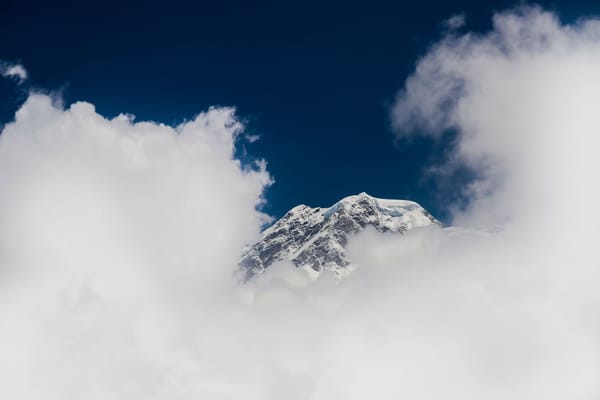
The Valley Narrows Until There Is No Sky. Then It Opens.


The valley narrows so completely between Hiunchuli and Machhapuchhre that you stop seeing sky. Then the walls pull back, and you are inside.
That threshold at the MBC narrows is a cirque the Gurung have held sacred for generations, a mountain bowl 40km north of Pokhara that most visitors look at and a few, briefly, enter.
What is the Annapurna Sanctuary
The Annapurna Base Camp trek reaches a high-altitude cirque at 4,130m enclosed by eight Himalayan peaks, starting from Nayapul roughly 1.5 hours from Pokhara by taxi. The trek takes 7-12 days depending on route and pace. You need an ACAP permit (Annapurna Conservation Area Project) and a TIMS card. No technical climbing experience is required.
The route from Pokhara
The bus from Pokhara drops you at Nayapul. Most trekkers barely register it as a town. Stone steps, a chai stall, the Modi Khola already audible below. From here the route climbs south of the river through Tikhedhunga and eventually Ghorepani, where the rhododendron variant rewards anyone walking in March or April with tree-height blooms in red and pink that close overhead on the trail. Trekkers on journeybybackpack.com noted the trail through this section feels enclosed in a way no photograph prepares you for, the canopy dense enough to make midday feel like dawn. But Ghorepani is optional. The direct line goes through Chhomrong, a Gurung village on a spur above the Chhomrong Khola, and then into the Modi Khola valley proper.
Chhomrong is where the Annapurna Base Camp trek changes character. Below it, the trail passes through terraced farmland and bamboo forest. Above it, the walls begin to rise. The settlements thin: Himalaya village, Dovan, Deurali. The forest closes. The river gets louder. By the time you reach Machhapuchhre Base Camp at 3,700m, you have been inside the approach corridor for two days and the sky overhead is a narrowing strip between ridgelines.
Elevation gain is steep above Chhomrong but not technical. The challenge is cumulative: the Day 2 climb to Ulleri alone involves more than 3,000 consecutive stone steps, a section that trekkers on Nepal Vision Treks described as one of the hardest single mornings on the route, where the legs are fresh but the steps seem to recalibrate your idea of vertical. The long descent into the bamboo zone punishes the knees more than the ascent did. The altitude above 3,500m is where pace matters more than fitness. The approach trail is intact, despite road construction having consumed roughly 75% of the old Annapurna Circuit route farther north.
The approach through MBC: the narrows
Between Machhapuchhre Base Camp and Annapurna Base Camp sits a passage that itinerary tables note as a two-hour walk. It is that. It is also a geological event.
The valley compresses between Hiunchuli (6,441m) to the west and Machhapuchhre (6,993m) to the east until the walls are vertical and the path runs along the moraine at their feet. Cloud rolls through this corridor with purpose, filling it from below. In early morning, before the sun clears the ridgeline, the temperature drops abruptly and the trail is in near-total shadow.
A trekker on theeverestholiday.com wrote of arriving at MBC: 'Machhapuchhre, the Fish Tail, rising directly above you in a wall of ice and rock so steep, so close, and so impossibly vertical that your neck aches from looking up.' The vertical distance from camp to summit is more than 3,000 metres, compressed into a single face. Above Deurali, the forest noise drops away entirely at the tree line. Theeverestholiday.com documents the Milky Way at 3,230m as dense enough to cast shadows.
Then the cirque opens. The walls simply release you into a bowl roughly two kilometres across, ringed by Annapurna I (8,091m), Annapurna South (7,219m), Hiunchuli, and Machhapuchhre closing behind you like a door. The sensation is architectural. You are inside something that has an inside.
Inside the sanctuary: what the cirque is actually like
The Annapurna Sanctuary receives only seven hours of direct sunlight daily at peak summer. The cirque geometry drives this: the walls are high enough and close enough that the sun clears them late and drops behind them early. By mid-afternoon the bowl is already in shadow, the temperature falling fast.
Trekkers who arrive expecting an open summit ridge find an enclosed world with its own microclimate and its own rhythms. The wind through the cirque at dawn carries ice crystals even in October. The silence at 5am, before the tea houses stir, is absorbed by rock rather than carried away on open air. At ABC itself, trekkers staying at lodges including the Annapurna Sanctuary Lodge and Hotel Peaceful report rooms cold enough to see your breath by morning, with no bedroom heating anywhere above MBC. The dining hall is where everyone converges, garlic soup ordered by nearly every table, credited by guides and trekkers alike for keeping altitude headaches at bay.
The cirque has no gap in its walls, no horizon, no visual escape route. The enclosed feeling is, oddly, calming. Avalanche sounds from the surrounding glaciers carry through the bowl at night like distant thunder, occasionally visible as a dust cloud rising in the moonlight. The glacier below camp has retreated over the past two decades; trekkers crossing the moraine field walk terrain that was under ice within living memory.
The Gurung people of the Annapurna foothills have occupied these valleys for centuries, their villages positioned along the same drainages that trekking routes now follow. The high cirque in Gurung cosmology is a boundary, not a destination: where the human world gives way to something else. The peaks are not backdrop. They are the point.
Most trekkers spend one night at ABC and descend. The ones who stay a second night describe the cirque at dusk differently. The bowl holds the last light on Annapurna South long after the trail below is dark. The tradeoff is sleep: at 4,130m, trekkers on journeybybackpack.com reported that many in their group struggled to sleep through the night at base camp, the altitude keeping the body alert in short, restless cycles even when exhaustion argues otherwise. The second morning, however, gives you the cirque before anyone else moves.
Best time to trek
March to May and October to November are the two reliable windows. They offer different treks.
Spring gives you the Ghorepani rhododendron variant at its peak, stable morning skies, and temperatures that are cold at altitude but workable. The bloom runs from roughly late February at lower elevations to late April near Ghorepani at 2,860m. Views cloud by afternoon, and the Modi Khola valley fills with trekkers. Headaches start for many around Machhapuchhre Base Camp at 3,700m, where the altitude is high enough to slow the body perceptibly; trekking accounts consistently flag garlic soup at MBC as the standard first response, ordered on arrival before dinner is even considered. The acclimatisation logic for a 7-12 day itinerary is built around avoiding the speed that triggers serious altitude sickness above 3,500m.
October and November bring the clearest skies of the year. The autumn light on the cirque peaks is sharper than anything spring produces. But late October carries avalanche risk on the upper sections above MBC. In October 2025, ABC was closed entirely due to avalanche conditions on the approach above Machhapuchhre Base Camp. Build your itinerary with the understanding that the upper section is weather-dependent in ways the lower trail is not.
October is also the busiest month. Tea houses at ABC fill fast; book 4-6 weeks ahead. Above Deurali, the corridor to MBC has lateral walls exceeding 35 degrees of inclination, creating avalanche funnels that channel snow directly toward the trekking path. Late October nights at ABC reach -5 to -8 degrees Celsius.
November is the safer autumn choice. The crowds thin, the skies hold, and the cold is predictable rather than dangerous.
Permits and practical logistics
Two permits are required: ACAP (Annapurna Conservation Area Project permit) and TIMS (Trekkers' Information Management System card). Both are available at the Nepal Tourism Board office near Lakeside in Pokhara, or at trail checkpoints. The ACAP permit funds conservation of the Annapurna range, the largest protected area in Nepal.
Accommodation is tea house-based throughout. Rooms at Chhomrong, including the Panorama Point Lodge and International Guest House, are comfortable and well-supplied with reliable hot showers. Above Deurali the lodges are simpler. At MBC, options include Fish Tail Lodge and Shankar Guest House, where bathrooms are shared and outside. At ABC, a handful of lodges including Hotel Peaceful and Annapurna Sanctuary Lodge provide sparse but functional shelter; hot showers cost NPR 600-800 and run lukewarm at best. A sleeping bag rated to -10 degrees Celsius is non-negotiable above Deurali; the blankets provided are not sufficient when temperatures inside rooms drop below freezing. Book ahead in October and during spring bloom weeks.
From Pokhara, taxis to Nayapul take about 1.5 hours and cost roughly 2,500-3,000 rupees. Local buses cover the same route for a fraction of that. Most trekkers take the taxi for the early start it allows.
On this route, the stone steps are not abstract. A trekker on theeverestholiday.com documented close to 30,000 stone stairs over ten days, with the Day 2 climb to Ulleri alone involving more than 3,000 steps in a single ascent. One trekker told us mental strength mattered more than physical fitness on that section. Above Chhomrong, solar-heated showers fail on cloudy days. At ABC, bottled water costs roughly five times the Pokhara price. On the descent, most trekkers route through Jhinu Danda, where natural hot springs sit a short walk below the village. Trekkers on Nepal Vision Treks described soaking there after eight days on trail as one of the most relieving experiences of the whole trip, legs dropped into warm water, the walls of the Annapurna range still visible upstream.
No technical gear is required. Good boots, layers, a rain jacket, and trekking poles for the descent cover the essentials. Above MBC, a down layer and gloves are not optional. ABC sits at 4,130m, high enough to cause altitude symptoms in trekkers who ascend too fast; the 7-12 day itinerary window exists in part to allow proper acclimatisation pace.
Before you go
Pokhara is the base for the Annapurna Base Camp trek, and worth more than one night before and after. From Sarangkot hill at dawn you can see the full cirque backdrop, a first orientation to the peaks you will walk into.
See the Goreto guides to Pokhara, Sarangkot, Machhapuchhre, and best time to visit Pokhara for broader planning context.
Forty kilometres north. On a clear morning from the Phewa lakeshore, you can see exactly where you are going.