The Sunrise Sarangkot Cannot Guarantee


The jeep leaves Lakeside at 4:30am. There is no good reason to be awake at this hour unless you believe the sky will do something worth seeing. Some mornings it does. The Annapurna range catches the first light at a frequency that photographs cannot hold, and then the clouds arrive and everything ordinary returns. Whether you witness the first version or the second depends on conditions you cannot control and a calendar window you can roughly predict.
Sarangkot sits at 1,592 metres above the Pokhara valley. It is not a separate village. Since 2015, when the local government merged it into Pokhara Metropolitan City, Sarangkot has been Ward 18. It has schools, a health post, electricity, residents who work in the city below and return home at dusk. The tourism layer is on top of that. Most visitors arrive not knowing this, which is not a problem, but it changes what you see when you look beyond the viewpoint.
What Sarangkot is
Ward 18 of Pokhara Metropolitan City occupies a ridgeline west of Phewa Lake. The viewpoint tower at 1,592 metres is what most maps mark simply as "Sarangkot." The community runs higher and lower than this point.
Tourism arrived here because the ridge faces east and northeast, which places the Annapurna massif directly in the morning sight line. On a clear day from the tower, you can see Annapurna I at 8,091 metres, Annapurna II at 7,937 metres, Annapurna III at 7,555 metres, Annapurna South at 7,219 metres, Machhapuchhre at 6,993 metres, and Dhaulagiri at 8,167 metres to the west. Six peaks above 6,900 metres in a single panorama. No preparation makes that feel expected.
Pokhara sits at around 800 metres, which means Sarangkot rises roughly 800 metres above the city in less than five kilometres of horizontal distance. The ascent is what creates the view.
The sunrise viewpoint
The viewpoint tower is a small concrete platform at the top of the ridge. Pre-dawn, it fills quickly. The shared jeep ride up takes about 30 minutes from Lakeside; the road bends tighter as it climbs and the headlights swing across the hillside. When you arrive, the moon is often still up. You can see the outline of the mountains in the dark.
Shared jeeps depart between 4 and 5am during peak season. By the time the sky begins to lighten, there can be 200 people on the platform. It does not feel crowded. Everyone is facing the same direction, watching for the same thing, and the scale of the peaks in front of you tends to reduce conversation.
Tea stalls open before the sun does. A cup of chai while you wait is not optional in December.
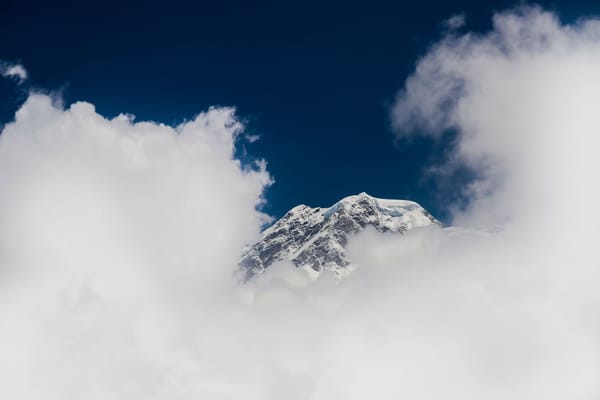
What the sunrise actually looks like depends on what the atmosphere is doing. When conditions are clear, the high peaks catch light in a gradient from pale gold to orange over about twenty minutes, Machhapuchhre first, then the Annapurnas in sequence, each a slightly different colour for a few minutes. When cloud sits at mid-elevation, the peaks emerge above it, which can produce a stranger and more memorable image than a clear day. When cloud is total, you see nothing. This happens.
Probability improves substantially in October, November, March, and April. June through August is monsoon season: cloud cover is nearly constant. December and January can be cold with unpredictable conditions, but clear winter mornings at this altitude are among the sharpest views of the range you will find anywhere in the Pokhara district. The best time to visit page covers the full seasonal breakdown.
Paragliding from Sarangkot
The launch site sits just below the main viewpoint, facing south. Sarangkot works as a paragliding site because of its geography: a south-facing hill above a valley that heats quickly in the morning sun. As the valley air warms, it rises. Thermals develop along the hillside in a pattern reliable enough that Pokhara became one of Asia's most established paragliding destinations.
Standard tandem flights last between 15 and 25 minutes, landing at Lakeside or in the Phewa Lake basin depending on the operator and conditions. The flight path takes you over the ridge, out above the lake, and down. The view of the Annapurna range from air is different from the view from the tower: you lose the foreground, you gain scale.
Peak paragliding season follows the same logic as the sunrise window. October to November and March to April provide the most consistent thermal conditions. Monsoon flights are suspended by most operators due to unpredictable wind.
Getting to Sarangkot
Two routes. On foot from Lakeside, the staircase climbs approximately 1,600 steps, taking between 45 and 60 minutes at a steady pace. The path is well-used and not difficult, but it requires being awake and moving in darkness for the sunrise. Bring a headlamp.
By vehicle, taxis and motorcycles run to the base road, reducing the walk to 20 or 30 minutes. Shared jeeps from Lakeside are the most common option for sunrise visitors, departing around 4 to 4:30am and returning after the light finishes. Book the night before through your accommodation. See things to do in Pokhara for current transport options.
Best time to go
October and November are the most reliable months for clear views. The post-monsoon air is washed, the sky is a specific shade of blue that does not appear in other seasons, and the probability of a clear sunrise is higher than at any other point in the year.
March and April are the second window. Warmer, with some haze on the valley floor, but the range is visible most mornings and the rhododendrons on the hillsides below are in flower.
The ward does not close when the tourists leave. Sarangkot was a community before it was a viewpoint, and it continues to be one after the jeeps go back down.