The World Peace Pagoda Took One Monk's Entire Life to Build


Nichidatsu Fujii was sixty years old when the first atomic bomb fell on Hiroshima.
He was a Buddhist monk of the Nipponzan Myohoji order. He had spent decades walking, and chanting as he walked: Nam Myoho Renge Kyo, the title of the Lotus Sutra. What he decided after August 1945 was that he would spend the rest of his life building pagodas. He built eighty of them, on six continents, before he died in 1985 at the age of one hundred. The one in Pokhara, at 1,100 metres above a lake that catches the Annapurna range in its surface on calm mornings, was inaugurated on October 30, 1999. Fourteen years after Fujii died, his order finished what he started.
Almost no travel article about the World Peace Pagoda Pokhara tells this story. Most say 'built by Japanese Buddhist monks' and move on to the view.
What the World Peace Pagoda is
The pagoda is white, 115 feet tall, 344 feet in diameter. It stands on Anadu Hill, south of Phewa Lake, visible from the lake's western shore on clear days as a bright point against the treeline. Four golden Buddha statues face the cardinal directions from niches in the exterior. The structure is a stupa in the Japanese tradition: solid, not hollow, the form itself the statement.
There are approximately eighty World Peace Pagodas worldwide. Japan, the United Kingdom, Austria, the United States, India, Sri Lanka, Nepal. Each was built by Nipponzan Myohoji as an act of deliberate, sustained response to nuclear weapons. Not protest. Response. The distinction mattered to Fujii.
Nipponzan Myohoji: who built it and why
Fujii founded the order in 1917, drawing from the Nichiren tradition of Japanese Buddhism. The practice centres on chanting and on walking, which the order treats as inseparable. Fujii walked with Gandhi in India in the 1930s. He was, by Western reckoning, already an old man when Hiroshima happened.
His response to the atomic bombings was not primarily political. It was architectural. He believed that building pagodas in the places most damaged by war, and in cities never touched at all, created a physical counter-presence to the logic of nuclear destruction. Build enough of them, in enough places, and something accumulates.
Whether you find that convincing or not, it is a more interesting thing to stand in front of than a viewpoint platform.
The monks who still live here
The Pokhara pagoda is not a monument. Nipponzan Myohoji monks live at the site. They maintain the grounds, conduct daily practice, chant. Visitors arriving on quiet mornings sometimes hear the chanting before they see the pagoda. The sound carries down the trail.
This is a functioning monastery that happens to have a spectacular view and a position in every Pokhara itinerary. The two facts coexist. The monks have been managing this long enough that tourists arriving in the hundreds on busy days are simply part of the environment.
Remove your shoes before entering the pagoda area. Speak quietly. Donations to the monastery are the norm; there is no fixed entrance fee.
The view
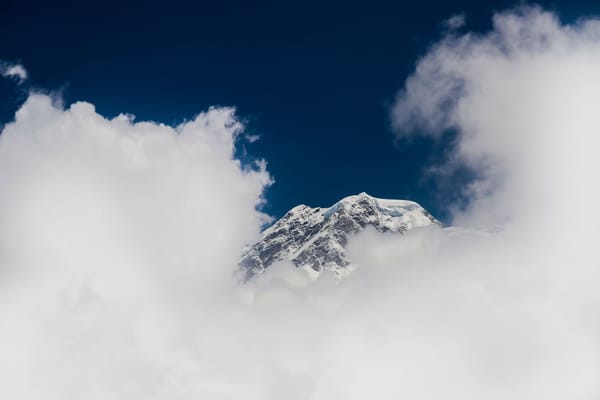
From the first viewing platform on the way up, the Pokhara valley opens wider than most visitors expect. Phewa Lake sits below, its full shape visible from this elevation in a way it never is from the shore. The Annapurna range fills the northern horizon: Dhaulagiri, Annapurna, Machhapuchhre, Manaslu, all simultaneously visible. On calm mornings, the lake surface below reflects the peaks.
Sunrise here is quieter than Sarangkot. Fewer jeeps come this way. What you trade in elevation you gain in stillness.
Getting there
Two routes. The boat route: hire a wooden boat from Lakeside across Phewa Lake to the southern shore, roughly thirty minutes. From the dock, a steep forested trail climbs to the pagoda over forty-five minutes to an hour. The trail is stone-stepped in sections, slippery after rain. You arrive from below, which means the pagoda appears above you as you climb through forest and then out into open ground. This is the route worth taking.
The second route approaches by road from the south side of the hill, by taxi or motorcycle from the Damside area. Faster, less atmospheric. The lake crossing is part of the experience; skipping it leaves a gap.
Boat hire from Lakeside runs approximately NPR 500 to 700 return. The pagoda is open during daylight.