Devi's Falls and the Woman Who Gave It Her Name

The waterfall has three names. Each one arrived by a different route.
The oldest is Patale Chhango. In Nepali, patale means the underworld. Patala, the realm beneath the earth in Hindu cosmology, where the waters go when they leave the living world. Chhango means waterfall. The name is not poetic. It is descriptive. The water falls and goes underground, into the dark.
Then there is the drowning. On July 31, 1961, a Swiss couple were near the falls when the Phewa Lake dam opened upstream. Mrs Davis was pulled by the surge and swept into the channel. Her body was recovered three days later in the Phusre River. Her father came afterward and reportedly funded the site's development as a tourist attraction. The falls were named after her. Davis Falls: a waterfall named for a death.
Over decades, Davis became Devi. Through signboards, tourist brochures, guesthouse directions repeated in English, the hard consonant softened. Devi is a name of Parvati, Shiva's consort, the divine feminine in its most encompassing form. Nobody planned this. A tourist attraction named for a fatal accident acquired the name of a goddess through pronunciation drift. All three names coexist in Pokhara without contradiction. Locals say Patale Chhango. Signboards say Devi's Falls. Old maps say Davis. The waterfall does not seem to mind.
Where the Water Goes
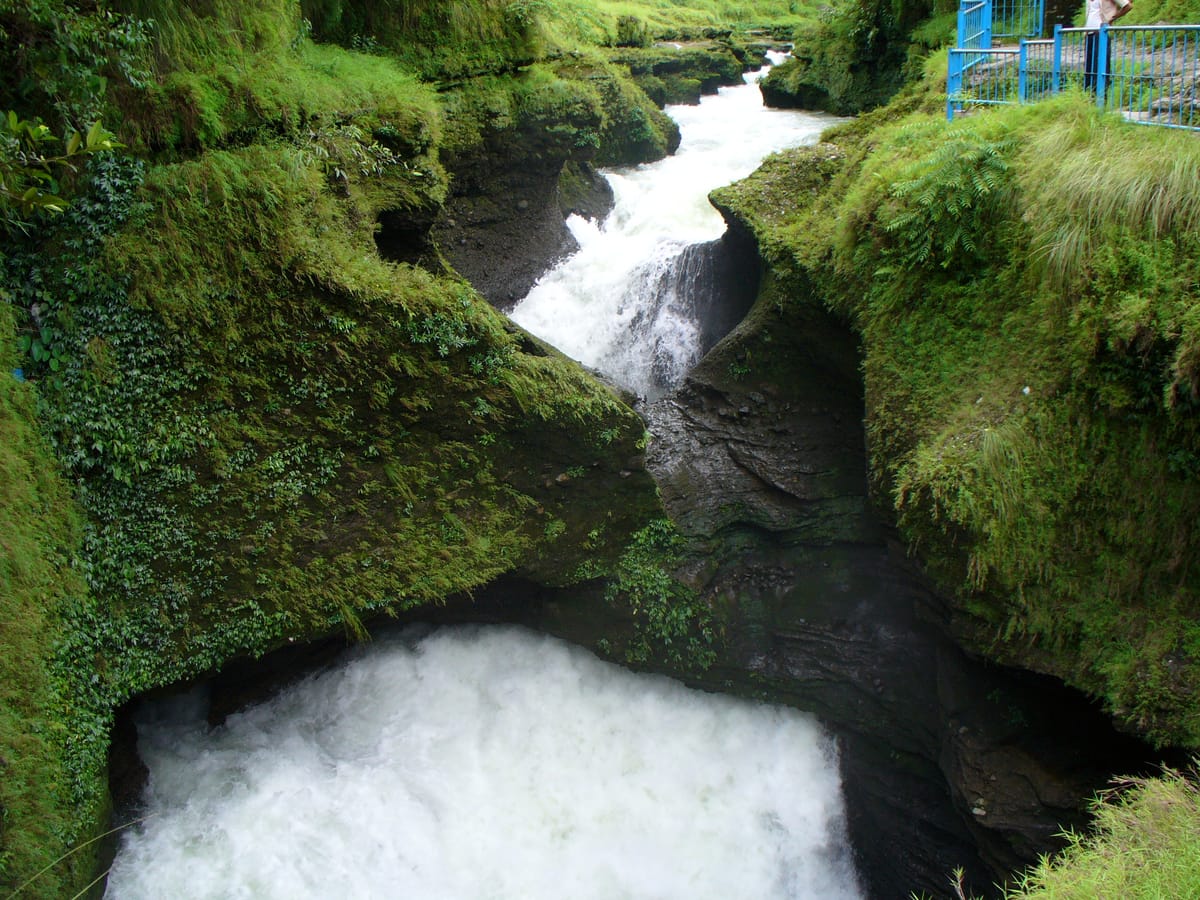
Most waterfalls hit a pool at the bottom and continue as a river. This one does not. The water drops into a narrow channel cut into the rock and disappears. Stand at the viewing fence and watch: the falls enter the stone, and the sound continues below you while the surface goes quiet.
What you are looking at is a karst sinkhole. The Pokhara Valley sits on limestone bedrock, and limestone dissolves over centuries when water moves through it, creating hollow channels and cave systems beneath the surface. The water at Devi's Falls enters one of those systems. It does not disappear, it travels underground, through a tunnel approximately 500 feet long and running about 30 metres below ground level, before emerging inside Gupteshwor Cave fifty metres north.
The fencing around the viewing platform was installed after accidents. The channel is narrow and the sides are slick. Before the fencing, people stood at the lip. Some did not step back in time.
The Gupteshwor Cave Connection
This is the detail most travel writing on both sites misses.
Fifty metres north of Devi's Falls, on the same road, there is a cave entrance. This is Gupteshwor Cave, named for the hidden Shiva shrine inside it. Most visitors treat the two sites as separate stops, visiting one or the other, rarely understanding they are looking at the same phenomenon from opposite ends.
Inside the cave, if you walk far enough through the passages, you reach a metal viewing platform. From there, you look up through an opening in the limestone and see the base of Devi's Falls coming through the rock above you, the same water you watched disappear from above, visible again, roaring through the stone from below. In monsoon season, the underground roar is audible well before you reach the platform.
The logical visiting order is: Devi's Falls first, from above, then Gupteshwor Cave, from below. The experience of watching water vanish and finding it again underground is the point. Visit them in reverse and the narrative runs backwards.
Monsoon vs Dry Season: Two Different Falls
Most travel writing describes the dry season version: accessible, steady flow, photographable. That is the version most guidebook writers visited. It is not the more interesting version.
In monsoon, from June through August, the volume of water entering the falls is at its highest. The sound reaches you before you see anything. At full flow, the mist from the falls reaches the viewing area and the roar makes conversation difficult. You cannot stand behind the fence without getting wet. The falls in monsoon are not decorative. They are geological force.
The dry season, October through March, brings lower flow but clearer access. The channel walls become visible. You can see the opening the water enters, the structure of the karst formation. The falls are smaller and more legible. Which version you prefer depends on what you came for: spectacle or comprehension.
the lower section of Gupteshwor Cave near the waterfall viewing platform closes during monsoon due to water hazard. If visiting in monsoon, you can see the falls from above at Devi's Falls, but the underground view requires a dry season return.
Getting There and What to Know
Devi's Falls is on the Siddhartha Highway, about two kilometres from Pokhara airport and three kilometres from Lakeside. Taxis from Lakeside take ten to fifteen minutes. The site is well-signposted from the main road.
Entry fee is around NPR 100 to 200. The site is open daily. Gupteshwor Cave has a separate entry fee and is 50 metres north on the same road.
For both sites together, plan ninety minutes to two hours. The falls take twenty minutes if you are moving; longer if you watch the water. The cave takes forty-five minutes to an hour depending on how far in you walk. Exit Devi's Falls, turn left, walk fifty metres, enter the cave from the road.
Wear shoes with grip. In monsoon, the viewing area stone stays wet from the mist. In the cave, the floor near the waterfall platform is permanently damp and slippery regardless of season.