Nepal Food: What You Eat Depends on Where You Are

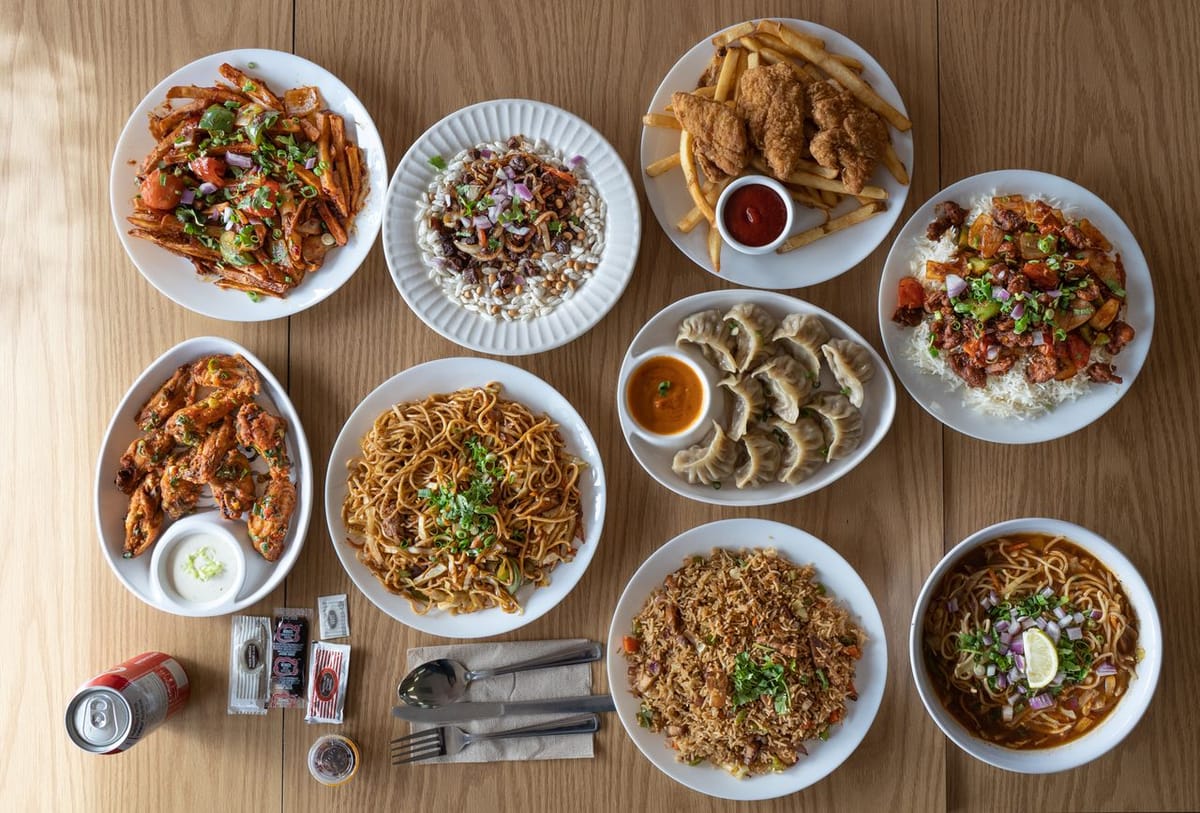
Ask someone what Nepal tastes like and they will probably say momos. Ask again after two weeks in the country and they will say dal bhat. Ask after a month and they will pause, because the honest answer is: it depends entirely on where you were.
Nepal's food does not have a single national identity in the way that, say, Thai food does. The country runs from the subtropical lowlands of the Terai to passes above 5,000 metres, and the food shifts at every elevation. The Tharu communities along the Indian border eat differently from the Newars in the Kathmandu Valley. The Sherpas of the Khumbu eat differently from both. The teahouse above Namche Bazaar serves a menu that would be unrecognisable to the chef at a Patan khaja ghar.
Dal bhat is the thread that connects all of it. Everything else changes.
Dal Bhat

Dal bhat is the national food of Nepal. It is rice, lentil soup, vegetable curry, pickles, and papad, served twice a day in most Nepali households and in every teahouse from the Terai to the high Himalaya. It is the national dish in the way that a country's language is its national language: the common ground under everything else.
The version in a Kathmandu restaurant differs from the version in a hill-town home, which differs from the version at 4,800 metres. The lentils change. The vegetables change with season and altitude. The pickle, sharp and bright, is the detail that separates a good dal bhat from a forgettable one.
On the trekking trails, dal bhat comes with unlimited refills. The fixed price, NPR 500-600 at lower elevations and rising to NPR 800-1,000 above Gorak Shep, covers as much rice and lentils as you can eat. The trail saying is 'Dal Bhat Power, 24 Hour.' It is partly a joke and partly accurate: the dish is nutritionally complete, easily digestible, and calibrated for sustained effort at altitude.
Start here. Everything else is variation.
The Kathmandu Valley
What Newari food actually is
Newar people are the indigenous inhabitants of the Kathmandu Valley, and their food is distinct from anything else in Nepal. It is older, more ceremonially organised, and considerably spicier.
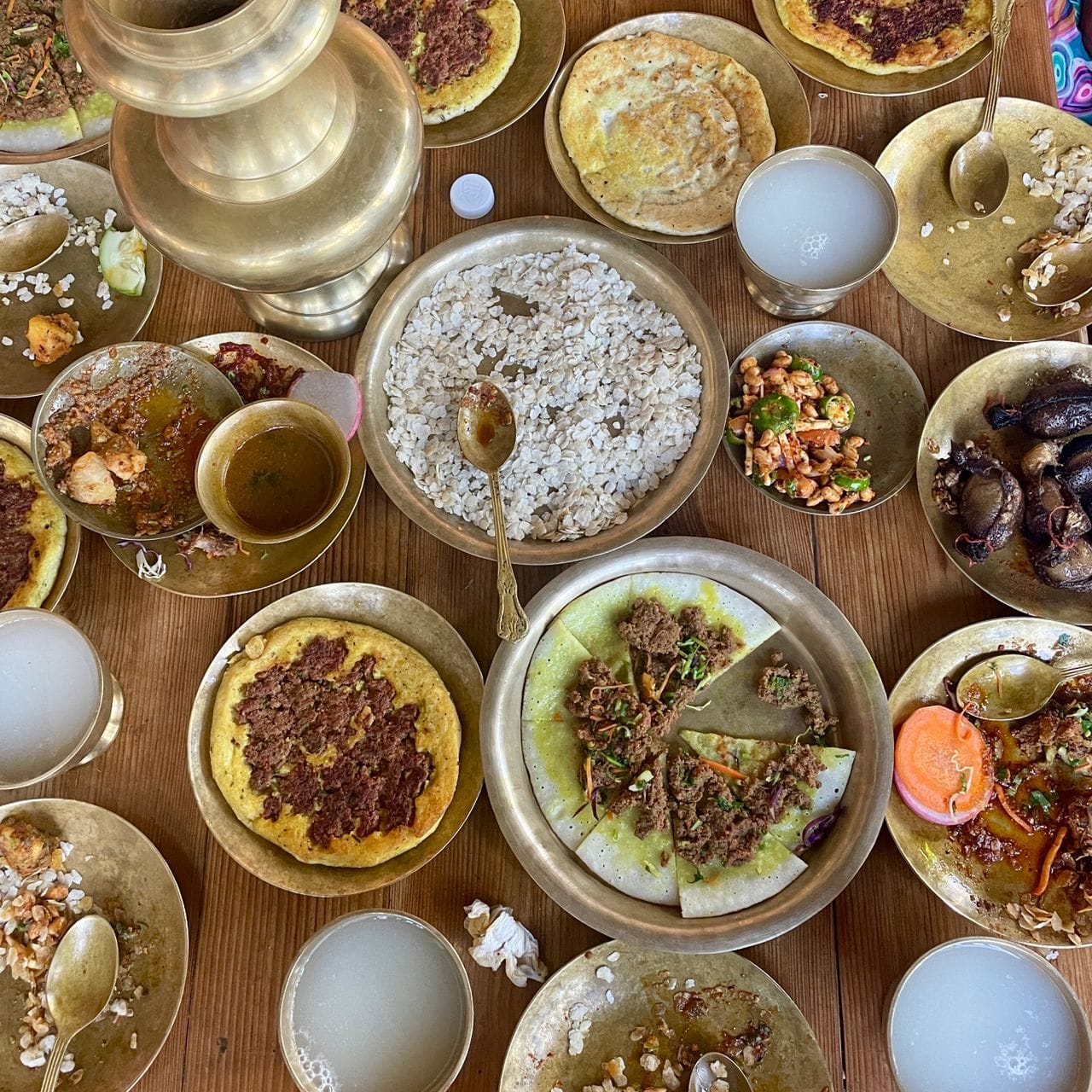
The defining dish is samay baji: a ceremonial platter of beaten rice (chiura), spiced grilled buffalo meat (buff choyla), black lentil pancakes (bara), boiled egg, fried soybeans, ginger, and a collection of sharp pickles. It is the food of festivals and family gatherings, and in Bhaktapur and Patan it appears on menus alongside the main meals. First-time visitors are sometimes puzzled when the chiura arrives raw and crunchy. It softens as you eat.
Buff choyla deserves its own sentence. Buffalo meat, marinated in mustard oil, chilli, and spices, then grilled and served at room temperature. Soft, smoky, and direct. It is not mild. The heat builds from the chilli but it is the mustard oil that defines it, a flavour that is specific to the Valley and absent from most Nepali food elsewhere in the country.

Bara, the lentil pancake, works as a counterweight: slightly fermented, dense, satisfying. The combination of bara and buff choyla is the pairing the Valley has been eating for centuries.
The city food scene beyond dal bhat
Kathmandu in 2026 has cafes, rooftop restaurants, good espresso, and a street food culture that operates from early morning until late at night. The tourist district of Thamel has its own ecosystem. The older squares of Bhaktapur and Patan have theirs.

In the squares, food is functional. Vendors set up before the rain in monsoon. Chatpate, a mixture of puffed rice, chickpeas, chopped vegetables, chilli, and lime, is sold from carts and consumed standing. The combination of crunch, heat, and sourness hits in sequence. Momos appear everywhere: steamed or fried dumplings, served with a dark, tomato-based achar that is nothing like the dipping sauces served outside Nepal. The best ones in Kathmandu tend to be at street stalls rather than restaurants.
Pani puri, hollow fried spheres filled with spiced potato and dipped in sharp tamarind water, are eaten in one bite. The liquid arrives with some force. Dahi puri adds yoghurt and chutney to the equation. Sour, sweet, and sharp. There is nothing like it outside the subcontinent.
On the Trail
Below 3,000m
The section of most trekking routes below Namche Bazaar or equivalent elevation is better supplied than most trekkers expect. Bakeries serving croissants, cinnamon rolls, and espresso-quality coffee are not unusual. Pizza exists. Fresh vegetables arrive regularly from the valleys below.
The teahouse dining hall is the social centre of the building, and usually the only heated room. Trekkers spend evenings there: eating, drying gear near whatever heat source exists, meeting people from other parts of the world. The food is not sophisticated but it is good. Dal bhat, fried rice, chow mein, momos, spring rolls, Sherpa stew, pasta. The menu is longer than it needs to be and shorter than it looks, because most items rotate through the same few ingredients.
Breakfast is where teahouse cooks show range: Tibetan fried bread with honey, porridge, chapati, eggs in various forms, Nepali milk tea brewed with ginger and cardamom. The tea arrives in a metal pot and keeps the cold at a manageable distance.
Above 3,000m
Above 3,000 metres, supply logistics tighten. Everything that is not grown locally was carried in by porter or yak. Prices reflect this. Dal bhat at Gorak Shep costs twice what it costs at Namche, not because the teahouse is extracting profit but because the rice was carried to 5,000 metres on someone's back.
The menu shrinks at altitude. By Lobuche and Gorak Shep, it is dal bhat, noodle soup, fried rice, and porridge. Garlic soup appears on most menus and is ordered by most trekkers as a hedge against altitude sickness, the evidence for which is contested but the ritual of which is consistent.
Meat is reliably available on menus above Namche and reliably inadvisable to order. There is no refrigeration. Experienced guides recommend avoiding it above 3,400 metres. The risk is not theoretical.
Yak butter tea is available at teahouses throughout the high Himalaya. It is made with tea, salt, and yak butter churned together, and it tastes like a warm, salty broth more than any tea you have had before. Reactions on first encounter are split. Most people need more than one sip to calibrate. In the cold, above 4,000 metres, with cold hands around a warm cup, the context changes the taste. Many trekkers who disliked it at sea level find themselves ordering it again.
In the Terai
The Terai is the subtropical strip along Nepal's southern border, and its food is closer to northern India than to the Kathmandu Valley. Tharu communities, the indigenous people of the western Terai, eat differently from both: rice and fish from local rivers, lentils prepared without the spice load of the Valley, mustard greens, and flatbreads that share lineage with chapati.
In Sauraha, the town adjacent to Chitwan National Park, the food is geared toward tourists but retains its lowland character. Dal bhat here uses different lentils and different rice than the hills. The heat is real. The fish, when available, comes from rivers not ocean.
Most visitors to the Terai pass through quickly. The food rewards more time.
What to Drink

Nepali tea, called chiya, is milky, sweet, and brewed with ginger - a combination that sounds like a recipe for something oversweet but consistently tastes right at altitude. It costs almost nothing. Available everywhere. It is drunk throughout the day in most households and teahouses, and for cold mornings there is genuinely nothing better.
Yak butter tea has been noted above. Po cha is its Tibetan name. Above 3,000 metres it is practical as much as cultural: the fat provides calories, the salt replaces what altitude sweat removes.
Tongba is a millet-based hot fermented drink served in a wooden vessel with a bamboo straw. Specific to Limbu and Rai communities of eastern Nepal, it appears on menus in certain parts of the Khumbu. You add hot water repeatedly to the same vessel of millet. It gets progressively weaker. Drink it slowly.
Chhaang is a fermented barley or millet beer, cloudy and mild, found at altitude - the traditional alternative to the warm drinks that fill teahouse menus above treeline. It pairs logically with cold evenings and with nothing in particular. Water above 4,000 metres should be boiled or treated; ask the teahouse, and they will.
Practical Notes
Is street food safe?
Street food in Nepal carries the same calculus as anywhere in South Asia: freshly cooked and hot is generally safe, and sitting food is not. Pani puri is the one item that gives experienced travellers pause, because the water it is dipped in is unboiled. Most people eat it without incident. Some do not. The decision is yours.
Kathmandu's established street food areas, Patan Durbar Square, Asan market, the streets around Thamel's edges, operate with consistent throughput. High turnover means fresh preparation. Seek the vendor with the queue.
Vegetarian and vegan
Nepal is straightforward for vegetarians. Hindu and Buddhist influences mean plant-based cooking is the default in many households, not an accommodation. Dal bhat is vegetarian in its standard form. Newari food centres on buff but the non-meat dishes stand alone. Teahouse menus at altitude are largely plant-based by necessity.
Vegans need to ask about ghee, which is used in some preparations. Above Namche, most teahouses will adjust if asked in advance. Communicating through a guide is more reliable than asking directly.
What things cost
Dal bhat is priced by altitude more reliably than by anything else: NPR 200–400 at a local Kathmandu restaurant, NPR 500–600 at a Namche teahouse, NPR 800–1,000 at Gorak Shep. A street momo in Thamel runs NPR 60–100. A sit-down meal in Patan, NPR 500–1,000. Prices are low by European or North American standards regardless of elevation, but they are not the same price - and the gap compounds as you climb.
The cost of food rises with altitude because transportation is human. A porter carries 25-30 kilograms. The rice in your dal bhat at 5,000 metres was among those kilograms. The price is not a margin. It is a wage.
For more on eating in Nepal during the monsoon, when food culture shifts with the season and the trails, see our guide to the monsoon season in Nepal.
For the full street food picture in Kathmandu, see our guide to Nepal street food.