Marpha Built Itself Around a Wind That Arrives at Eleven


At 11am the wind comes.
It arrives from the south, funnelled up through the Kali Gandaki gorge, and within an hour it can reach 60 to 80 kilometres per hour. Trekkers describe it as someone opening a giant hairdryer pointed directly at your face. The people who built Marpha knew this. They built the lanes running east-west, narrow enough that two people pass sideways, oriented specifically so that the wind has no straight line to travel. Step off the main cobblestone path into any one of those lanes and you move from wind into calm in a few paces. The sound changes.
Marpha sits at 2,667 metres in Mustang district, about an hour's walk south of Jomsom, on the western bank of the Kali Gandaki. It was built by the Thakali people (the name comes from "mar," meaning hard-working, and "pha," meaning people) and it is known across Nepal as the apple village of Mustang. Most people who write about it stop there. The orchards are not the point. The point is a community that solved wind.
What Marpha Is
Marpha is a Thakali village of a few hundred permanent residents on a trade route that no longer exists for its original purpose. For centuries, Thakali merchants controlled the salt route between Tibet and the lowland plains: Tibetan rock salt moving south, lowland grain moving north. The Thakali sat in the middle of this exchange and grew wealthy. When the Chinese border closure in 1959 effectively ended that trade, someone brought apple seedlings up from the south.
The altitude proved ideal. The cool dry air, the irrigation from snowmelt channels cut through stone, the intense sun at high elevation: the Mustang microclimate produces apples with high sugar concentration and firm flesh. Orchards now cover the slopes above the village, and the harvest runs September to October. The economy remade itself around a fruit.
Both decisions were made under the same constraint: the world outside Marpha changes, the gorge does not.
The Architecture: Built Against the Wind
The houses in Marpha are flat-roofed and whitewashed. Flat roofs are practical: they can be used for drying apples, grain, and firewood in the brief warm months. The whitewash reflects heat in summer and cold in winter. Drainage channels cut through the stone lanes to carry snowmelt. The heavy wooden doors have been here for generations.
None of this is aesthetic.
The Thakali were traders. A trading community has economic reasons to maintain a reliable reputation: cleanliness, order, a village that functions. Marpha is one of the cleanest settlements at altitude in the Mustang region. The drainage channels are part of that system.
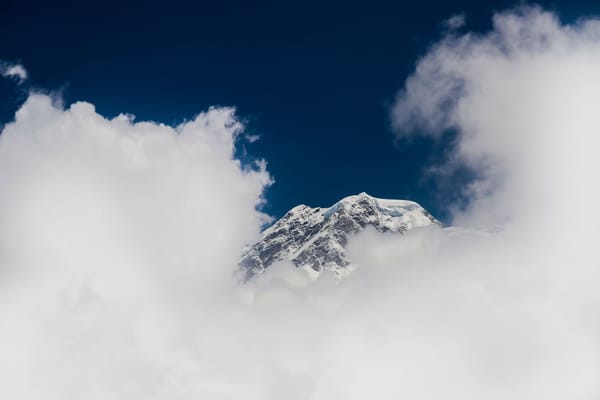
In the morning, between six and eight, before the wind comes, the whitewashed walls glow. The orchards are still. The peaks behind the village catch the first light before the valley does.
The Kali Gandaki Wind
The Kali Gandaki gorge is, by some measures, the deepest gorge in the world. The river cuts between Annapurna (8,091 metres) and Dhaulagiri (8,167 metres), with a horizontal distance between the two peaks of roughly 38 kilometres and a vertical difference of over 5,500 metres from riverbed to summit.
This creates a thermal corridor. Cool air from the high plateau to the north and warm air rising from the lowlands to the south move through the gorge every day. The wind begins around 11am and strengthens through the afternoon. Trekkers who start late learn this the hard way.
In Marpha, the narrow lanes are what the village arrived at over generations. The wind howls above the walls. Inside the courtyards and covered walkways, you hear it but do not feel it.
Apples and Apple Brandy
Apples came to Marpha in the 1960s as an agricultural experiment after the border closure. The Mustang microclimate proved better suited to the crop than anyone had expected.
Marpha brandy is distilled in six commercial distilleries in the village. The process: the harvested fruit is washed and fermented in airtight barrels with yeast for around two weeks. The mixture is then boiled and the steam collected as the finished spirit, 42% ABV, clear, made in small batches. Local shops wrap bottles in newspaper for the journey back.
At altitude, fermentation runs cooler and slower than in warmer climates. The brandy comes out clean rather than hot. It is served in small glasses that, if you are sitting in one of the village courtyards watching Nilgiri South turn gold in the late afternoon light, somehow keep refilling themselves.
A note worth keeping in mind: 42% spirits feel different at 2,667 metres than they do in Kathmandu.
The apple products in the shops go further than brandy: apple wine, apple cider, dried apple rings, apple jam, apple juice. The Thakali dal bhat here uses more mustard oil and timur, the Sichuan pepper that grows in Nepal's mid-hills, and dried meat rather than fresh. The buckwheat pancakes, served with apple honey, are worth the stop on their own. The lodge apple pie competition is genuinely competitive, and trekkers on the Annapurna Circuit consistently rank it the best food on the route.
Practicalities
There is no ATM in Marpha. The nearest is Jomsom, roughly 45 minutes south by foot or 15 minutes by jeep. Carry cash before arriving.
Accommodation is available in a small number of guesthouses. The Annapurna Circuit passes directly through Marpha, so rooms are available during trekking season (October-November, March-May) but can fill quickly at peak times. Arrive before noon.
The connection to Pokhara is via Jomsom: either by flight (25 minutes, weather-dependent, early morning departure) or by jeep along the Kali Gandaki road.
Leave Marpha before 11am if you are walking south. After that, you will be walking into the wind.