Nobody on the Bus Is Looking at the Road


About two hours into the journey, somewhere between Kurintar and Mugling, the Trishuli River appears below the road. It is turquoise in November, running fast between steep walls of green. The bus slows for a hairpin. Nobody on board is looking at the road.
There are three ways to make this journey. All of them work. The choice is about what you want from the 200 kilometres between the two cities.
Quick comparison: flight, bus, or private car
By flight: 25 minutes in the air, plus airport time at both ends. Around USD 99-130 one-way. The fastest door-to-door option if weather cooperates. Weather does not always cooperate.
By tourist bus: 7-9 hours, sometimes more. NPR 600-2,500 depending on class. You see the country. You stop at Mugling. The road runs through a gorge that most people on the flight miss entirely.
By private car or jeep: 5-6 hours, no fixed schedule. NPR 8,000-15,000 depending on vehicle. Right for families with luggage, or anyone who wants to stop where the road is interesting rather than where the bus does.
By flight: 25 minutes over the mountains
Buddha Air and Yeti Airlines operate the route most reliably. The aircraft are small turboprops. The runway at Pokhara is short. In the 25 minutes between the two cities, the route passes over the foothills and into the Annapurna approach.
On a clear day, take the left side of the plane (A or B seat) flying toward Pokhara. The right side on the return. On clear mornings in October and November, those windows show Annapurna, Dhaulagiri, Machhapuchhre, the whole chain. On a June morning, the windows show cloud. Mountain views are weather-dependent, and the weather in the Himalayan foothills is not predictable.
The new Pokhara International Airport opened on January 1, 2023. Fourteen days later, Yeti Airlines Flight 691 crashed on approach, killing all 72 people aboard. It remains Nepal's deadliest aviation disaster since 1992. The cause, per the official investigation, was pilot error: the condition levers were accidentally feathered, cutting power to both propellers on final approach. The airport subsequently suspended new airline registrations while safety reviews were conducted.
From September 2026, flydubai begins direct flights between Dubai and Pokhara. For travellers connecting through Dubai from Europe or the Gulf, this removes the need for a domestic leg entirely.
At USD 99-130 for a 25-minute flight, this is not cheap by the standards of what you paid to get to Nepal. Some Nepalis who can afford to fly still take the bus. The reason appears later in the road.
By tourist bus: the budget classic
Tourist buses depart from various points near Thamel. Greenline has its own departure terminal. Leave before 7am. Kathmandu's traffic thickens quickly and an early start means you clear the valley before the roads lock up. Delays are common once traffic builds past the Manakamana cable car junction.
The bus hierarchy matters. Standard tourist bus: NPR 600-900, older vehicles, they run. Deluxe tourist bus: NPR 1,200-1,500, newer, more comfortable. Greenline: NPR 2,000-2,500, Nepal's most reliable tourist bus operator, air-conditioned, on schedule, lunch stop at Mugling included. In peak season it books out. Reserve in advance.
Sit on the right side of the bus. From roughly Naubise onward the road follows the Trishuli River, and the right-hand window gives you the river for most of the gorge section. The left side gives you the cliff face. Both have their appeal, but the river is the point.
Seven to nine hours is the range. In 2026, with active road widening along the Prithvi Highway, expect closer to nine or beyond. Delays of one to five hours are possible in monsoon when landslides close stretches. There is no alternative route.
Sit in the front half of the bus. The rear half amplifies every pothole.
By private car: the flexible option
A private car does the journey in 5-6 hours. NPR 8,000-15,000 depending on vehicle type, arranged through your guesthouse or negotiated directly. You leave when you want, stop where the road is interesting, and do not stop where the bus does.
This works for families with young children, anyone with significant luggage, or anyone who wants to visit Manakamana Temple on the way (cable car above the gorge, 15km before Mugling) without managing bus timings. For a group of four splitting the cost, it competes with the flight on price and beats the bus on flexibility.
The road itself: Prithvi Highway and the Trishuli gorge
The Prithvi Highway runs west from Kathmandu, drops through serpentines after Thankot, and descends steeply to the Trishuli River. From there it follows the gorge. For roughly 50 kilometres the road and the river run alongside each other, the water below on the right, the cliff face above on the left. In dry season, rafting groups use this stretch. You can sometimes spot their orange inflatables on the water below the road.
The river runs fast and turquoise in October and November. In June it swells brown with snowmelt.
At Mugling the gorge opens and the road turns southwest. This is where most buses stop. Mugling is a truck-stop town at the confluence of the Trishuli and Marsyangdi rivers. Rows of roadside restaurants serve dal bhat, tea, and fried snacks. You get 20-30 minutes. The town is functional. The river confluence below it is not.
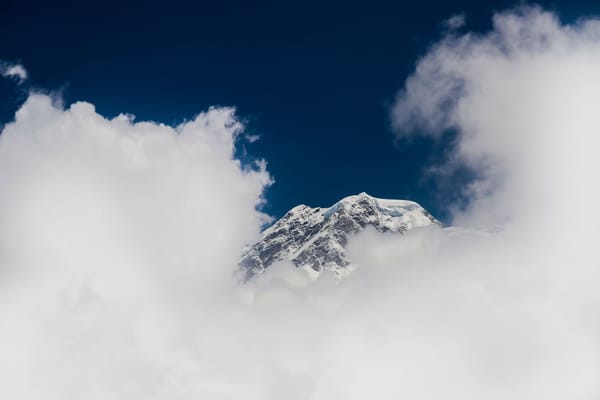
After Mugling the landscape widens into broader valley. About an hour later, somewhere near Dumre, the Annapurna range appears above the valley to the north. It comes suddenly: very large, still snow-capped in October, filling the northern horizon. Most bus passengers reach for their phones. This is why some Nepalis who can afford the flight still take the bus.
Which option to choose
If your time is short and the forecast is clear: fly. You arrive fresh with the afternoon ahead.
If you have the day and want the journey to matter: take the Greenline or a good tourist bus. The gorge section is worth it. The mountain view after Dumre is the kind of thing you do not get from 1,500 metres in a turboprop.
If you are travelling with family or significant luggage, or want to make stops: private car. The cost at group size is competitive and the flexibility is real.
The flight loses the gorge. The bus takes the day. The car splits the difference.