Sleeping Beauty of Everest: Who Was Francys Arsentiev?
She was still alive. That was what Cathy O'Dowd understood the moment she saw the figure in the purple jacket. She had assumed it was a body. Then the figure moved.


It was May 24, 1998. Francys Arsentiev, the first American woman to summit Mount Everest without supplemental oxygen, had spent two nights on the mountain without shelter. She was alive, but she could not stand, could not move her hands, could not say where she was or what year it was. She could only repeat three things.
"Don't leave me."
"Why are you doing this to me."
"I am an American."
O'Dowd later described Francys's skin as milky white and totally smooth: the texture of porcelain, the colour of it too. Severe frostbite does that. It is one of the body's final acts of self-preservation, redirecting blood from the extremities to keep the core organs alive for a few more hours.
O'Dowd and her partner Ian Woodall remained for more than an hour at 8,200 metres, in temperatures around minus 30 degrees Celsius. There was nothing they could do. When they finally descended, they left Francys Arsentiev where she lay.
She died shortly after. Her body remained on the mountain for nine years, visible to every climber who passed that section of the northeast ridge. They called her the Sleeping Beauty of Everest. It is not a gentle nickname.
Who Was Francys Arsentiev?
Francys Arsentiev was born on January 18, 1958, in Honolulu, Hawaii. She was a climber of serious ability and serious ambition. By 1998, she had ascended mountains across four continents and had made her way into the world of high-altitude climbing through persistence rather than privilege. She had a son, Paul DiStefano, from a previous relationship. In 1992, she married Russian mountaineer Sergei Arsentiev.
Sergei was an accomplished Himalayan climber with extensive high-altitude experience. Together they were a formidable team, and in 1998 they arrived at Everest's base camp with one specific goal: to reach the summit via the northeast ridge, without supplemental oxygen.
The distinction matters. Climbing Everest with bottled oxygen is already extraordinarily difficult. Climbing without it is a different category of endeavour. The body at altitude above 8,000 metres consumes more oxygen than the thin air can provide. Without supplemental support, every movement requires more time, more effort, more metabolic cost. Climbers who go without oxygen move slower, think slower, and fatigue faster. The summit is possible. Every hour past midday narrows the window for a safe descent.
Francys understood this. She and Sergei trained for it. She wanted to be the first American woman to stand on top of Everest without a tank. She made it.
Before she left for the expedition, her son Paul called her. He was 11 years old. He had a nightmare about climbers stuck on a mountain. She told him she would be careful.
May 1998: The Summit That Took Three Attempts
The 1998 expedition began with two failures.
On May 20, Francys and Sergei started their summit push but turned back near the First Step when their headlamps failed. On May 21, they tried again and managed only 50 to 100 metres before descending. Both were correct decisions, the kind that keep climbers alive.
On May 22, they made their third attempt.
They were climbing without oxygen. The climb takes longer. The summit that oxygenated climbers reach by early morning comes for them late in the day. Francys Arsentiev summited on the evening of May 22, 1998. She was 40 years old. She had become the first American woman to stand on the summit of Mount Everest without bottled oxygen.
She had also summited too late to descend safely before dark.
This is the decision that defines what follows. Not a mistake, exactly: the summit was within reach and they reached it. But summiting at altitude without oxygen in the late afternoon means spending the night above 8,000 metres. The descent happens in the dark, in wind, in cold that kills exposed flesh within minutes. They had no tent. No sleeping bag. No shelter.
They stopped somewhere around 8,200 metres and waited for the sun.
A Night Without Shelter at 8,200 Metres
The Death Zone on Everest begins at 8,000 metres. The name is not metaphorical. At this altitude, the human body cannot acclimatise. It can only endure, and what it is enduring is a slow unravelling: cells starved of oxygen, organs beginning to falter, coordination declining, judgment compromised. Even experienced climbers with supplemental oxygen develop altitude-related oedema, disorientation, and hallucinations at these heights.
Francys and Sergei spent the night at 8,200 metres with none of the equipment that might have helped them survive it. By the time other climbers encountered them on May 23, Francys was in severe distress. An Uzbek climbing team found her half-conscious, already unable to move independently. They gave her their oxygen, helped carry her downward, and continued until their own supply ran out and they could go no further.
What the oxygen deprivation was doing to her body at that point was irreversible. The brain loses function at altitude in a specific sequence: first executive decision-making, then coordination, then language, then the most basic instincts. By the time O'Dowd found her the following morning, Francys was in the final stage: conscious enough to feel afraid, not conscious enough to understand her situation or form new thoughts. She could only repeat what was already in the loop.
"Don't leave me."
"Why are you doing this to me."
"I am an American."
Why Nobody Could Save Her
The question most people arrive at when they learn about Francys Arsentiev is: why didn't someone carry her down?
The answer is not simple and it is not comfortable, but it is physical.
Carrying a semi-conscious adult body down the northeast ridge of Everest from 8,200 metres requires an extraordinary number of people working in perfect coordination, with full oxygen support for everyone involved, in conditions that make ordinary walking difficult. A rescue of that nature requires helicopters, which cannot operate at that altitude. It requires organised ground teams, which take days to position. It requires a conscious patient who can cooperate with movement, which Francys was not.
More simply: the Death Zone kills people who are standing upright, moving forward, with full oxygen. A rescue operation on a dying climber in that zone, without preparation, without additional climbers, without equipment, carries a genuine probability of killing the rescuers too.
O'Dowd and Woodall were experienced mountaineers. They were not on Francys's expedition. They had not planned for a rescue. They were at that section of the ridge because they were attempting their own summit. They stopped, assessed, attempted to help with the resources they had, and stayed for more than an hour. The encounter marked O'Dowd permanently. She did not return to attempt Everest again.
There are climbers who have argued that a larger-scale rescue was theoretically possible, that better-organised teams could have reached a different outcome. These arguments are not wrong in principle. They do not account for the speed at which the situation developed, the resources available, or the fact that by the morning of May 24, Francys had been dying for more than 36 hours. She was not a climber who had just had an accident. She was a person whose body had been shutting down for a day and a half.
Where Was Sergei?
On the evening of May 23, as the Uzbek team helped Francys downward, Sergei Arsentiev was seen ascending. He had an oxygen tank. He was going back for her.
That was the last time anyone saw him alive.
His body was discovered the following year, in 1999, lower on the mountain. The evidence indicated he had fallen during the attempt to reach Francys. He had gone back alone, with a single tank, in the dark, in deteriorating conditions, for his wife. He did not reach her.
Both died on the mountain. Their son Paul was 11 years old.
Rainbow Valley: The Name Behind the Horror
There is a place on the northeast ridge of Everest, below the summit and above the 8,000-metre threshold, that climbers call Rainbow Valley. The name sounds gentle. It is not.
Rainbow Valley gets its name from the colours of the dead.
The Death Zone above 8,000 metres has claimed more than 200 lives since Everest was first climbed. Many of those bodies have never been recovered. The extreme cold of the altitude preserves them where they fell: in bright technical climbing jackets, in vivid gear from the 1980s, 1990s, and 2000s: blue, orange, yellow, red. Against the white of the snow and the grey of the rock face, the colours are visible from a distance.
Climbers on the northeast ridge pass through Rainbow Valley on the way to the summit. The bodies are there. The gear is still bright. Francys Arsentiev lay in that zone for nine years.
She was not the only one. But the position of her body, visible from the route with her face upturned and at rest, gave her a specific presence that other bodies did not have. She looked, climbers said, like she was sleeping.
Nine Years in the Death Zone
From 1998 to 2007, Francys Arsentiev was a landmark on the northeast ridge.
Every climber who passed through that section of the route saw her. Some stopped. Some did not. Her presence generated recurring discussion in the mountaineering community: about the ethics of leaving bodies on the mountain, about whether families should be able to retrieve the dead, about what climbers owe one another in the Death Zone, about whether a body at 8,200 metres is a grave or a problem.
Nepal's government has a policy requiring expedition companies to take responsibility for their clients, including body recovery. The cost of retrieving a body from the Death Zone can exceed $100,000 - according to Smithsonian Magazine, more than 200 bodies remain on the mountain. Trekking companies have argued that without mandated insurance covering recovery, they cannot absorb those costs. The Nepali Army has since conducted its own cleanup expeditions, retrieving bodies and tonnes of waste from the mountain in seasonal operations.
But many bodies remain. Some by the family's choice: some families want the mountain to serve as the grave, feel that removal would be wrong. Others remain because the logistics are not achievable at scale.
What Sherpas and Nepal Say
The conversation about bodies on Everest runs differently in Nepal than it does in the countries that send climbers here.
For Sherpas, the guides who make almost every summit attempt possible, the bodies are part of the mountain's reality in a way that is not abstract or theoretical. They pass them on the way up and on the way down. They work alongside international climbing teams that include people who will die on the mountain. Some of those people will become landmarks.
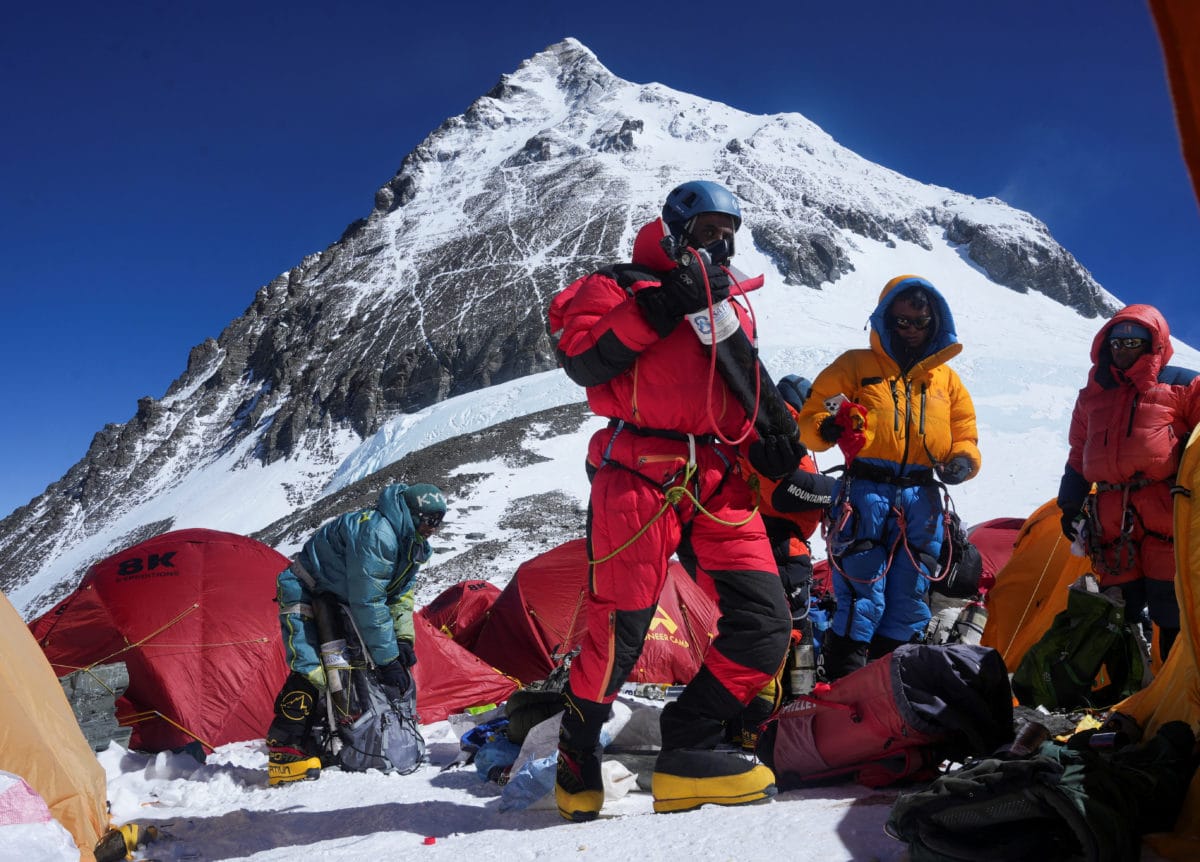
Kami Rita Sherpa, who has reached the summit of Everest more times than any person alive, has noted that many bodies are there because the families did not want to take them. Many guides believe the bodies should remain out of respect for what the mountain meant to those who died there.
The ethical burden of bodies on Everest falls unevenly. Sherpa guides carry the physical risk of any recovery attempt. The decision about whether to attempt recovery rests largely with foreign expedition companies and foreign families. Nepal's government sets policy but is not always resourced to enforce it.
Dandu Raj Ghimire, Director-General of Nepal's Department of Tourism, has stated that expedition companies must take responsibility for their clients. The response from some companies has been that the economics of body recovery at altitude are prohibitive without a mandatory insurance system to cover the cost.
The Recovery Mission of 2007
In 2007, nine years after Francys Arsentiev's death, Ian Woodall returned to Everest.
He had been one of the two climbers who found her alive on May 24, 1998. He had stayed with her in her final hours. Whatever he carried from that encounter was enough to bring him back to the same section of ridge, nine years later, for one specific purpose.
The expedition was called 'The Tao of Everest.' On May 23, 2007, exactly nine years to the day since Francys was first found by the Uzbek team, Woodall located her remains. He and his team wrapped her in an American flag. They placed a note from her son Paul DiStefano alongside her.
They moved her to a location away from the main route, where cameras could not find her, where passing climbers would not see her. They performed a brief ritual. Then they descended.
Paul DiStefano was 20 years old in 2007. His note has not been made public. Whatever he wrote went with his mother to a quieter part of the mountain.
The Ethics of the Death Zone
The question people most often want answered when they learn about Francys Arsentiev is: should someone have done more?
It is the right question. The answer is not straightforward.
At sea level, the ethics of abandoning someone who is dying and asking for help are clear. You do not leave. At 8,200 metres, every person present is already in the margins of what the human body can survive. The oxygen content of the air is roughly one third of what it is at sea level. Every minute spent helping someone else is a minute of your own reserves depleted. The climbers who reached Francys on May 24 were themselves at risk. They were not bystanders in a corridor. They were people who could die if they stayed too long.
This does not resolve the question. It contextualises it. The Death Zone is an active threat to the rescuers, not just a setting for the rescue - and that fact changes what is possible, and what can reasonably be expected of anyone present.
O'Dowd has spoken about what she saw. Finding Francys ended her desire to return to Everest. The choice she made, to leave after an hour, was not made easily. It was made because the alternative was not saving Francys: it was dying alongside her.
Those who were not there have reached different conclusions. That tension has not been resolved.
The Photograph Question
Many people searching for Francys Arsentiev arrive with a specific question: is there a photo of her face?
The answer is: images circulated over the years, photographed by climbers who passed her body on the mountain. We will not reproduce them here.
Francys Arsentiev was a person before she was a landmark. Her face is not an exhibit. What she looked like in death is not the most interesting thing about her. What she achieved in life, what she tried to do for her husband, what her husband tried to do for her, what a team of climbers did nine years later at her son's request, and what a 20-year-old wrote in a letter that went with her to a quieter place on the mountain: those are the details that hold.
Frequently Asked Questions About the Sleeping Beauty of Everest
Is Francys Arsentiev's body still on Everest?
Her remains were moved in 2007, nine years after her death, by an expedition led by Ian Woodall. She was relocated from her original position on the northeast ridge to a less exposed location. Her remains are still on the mountain, but no longer visible from the main climbing route.
What did the Sleeping Beauty of Everest say before she died?
When Cathy O'Dowd and Ian Woodall found her alive on May 24, 1998, Francys Arsentiev was repeating three phrases: 'Don't leave me,' 'Why are you doing this to me,' and 'I am an American.' She was not forming new thoughts; oxygen deprivation had reduced her speech to a loop she could not exit.
What is Rainbow Valley on Everest?
Rainbow Valley is the informal name for a section of the northeast ridge of Everest, within the Death Zone above 8,000 metres. It takes its name from the coloured climbing gear of the many climbers who have died there and whose bodies have never been recovered. The bright technical jackets, preserved by the extreme cold, create vivid colour against the rock and snow that is visible from the route.
Why couldn't climbers rescue Francys Arsentiev?
Rescuing a semi-conscious adult from 8,200 metres requires more people, more oxygen, and more equipment than any passing climbing team could provide. Helicopters cannot operate at that altitude. The Death Zone does not permit the kind of organised rescue that the same situation would allow at lower elevations. The climbers who found Francys were themselves at risk. Carrying her down would have required a coordinated team with full oxygen support, none of which was present.
Who was Sergei Arsentiev and how did he die?
Sergei Arsentiev was a Russian mountaineer and Francys's husband. He was an experienced high-altitude climber who had summited major Himalayan peaks before the 1998 Everest expedition. On the evening of May 23, 1998, he was seen ascending the mountain alone, carrying an oxygen tank, attempting to reach Francys. His body was found in 1999, lower on the mountain. Evidence indicates he fell during the rescue attempt.
What happened during the 2007 recovery mission?
Ian Woodall, one of the climbers who found Francys alive in 1998, returned to Everest in 2007 with the expedition 'The Tao of Everest.' On May 23, 2007, exactly nine years after Francys was first found by the Uzbek climbing team, Woodall located her remains, wrapped them in an American flag, placed a note from her son Paul DiStefano alongside her, and moved her to a less visible location on the mountain away from the main climbing route.
The Story That Refuses to End
Francys Arsentiev did what she set out to do. She reached the summit of the highest mountain on earth without bottled oxygen, the first American woman to do so. She achieved something most people on this planet could not imagine attempting.
That is not the part of her story that people search for. They search for the Sleeping Beauty of Everest. They want to understand how someone can die like that: slowly, in daylight, with other climbers present, on the most famous mountain in the world.
Her son was 11 when he called to tell her about a dream. He was 20 when he wrote the note that went with her to a quieter corner of the mountain. He knows the full story in the way only a person who lived it does.
She is still on the mountain. She is not visible from the route anymore. That is the ending, if it can be called one.