Nepal's Contemporary Art: What Is Being Made in Kathmandu and Lalitpur
The contemporary art scene in Kathmandu is not large. What it is, is serious - galleries in converted courtyards, artists working with earthquake rubble, a conversation not aimed at tourists.

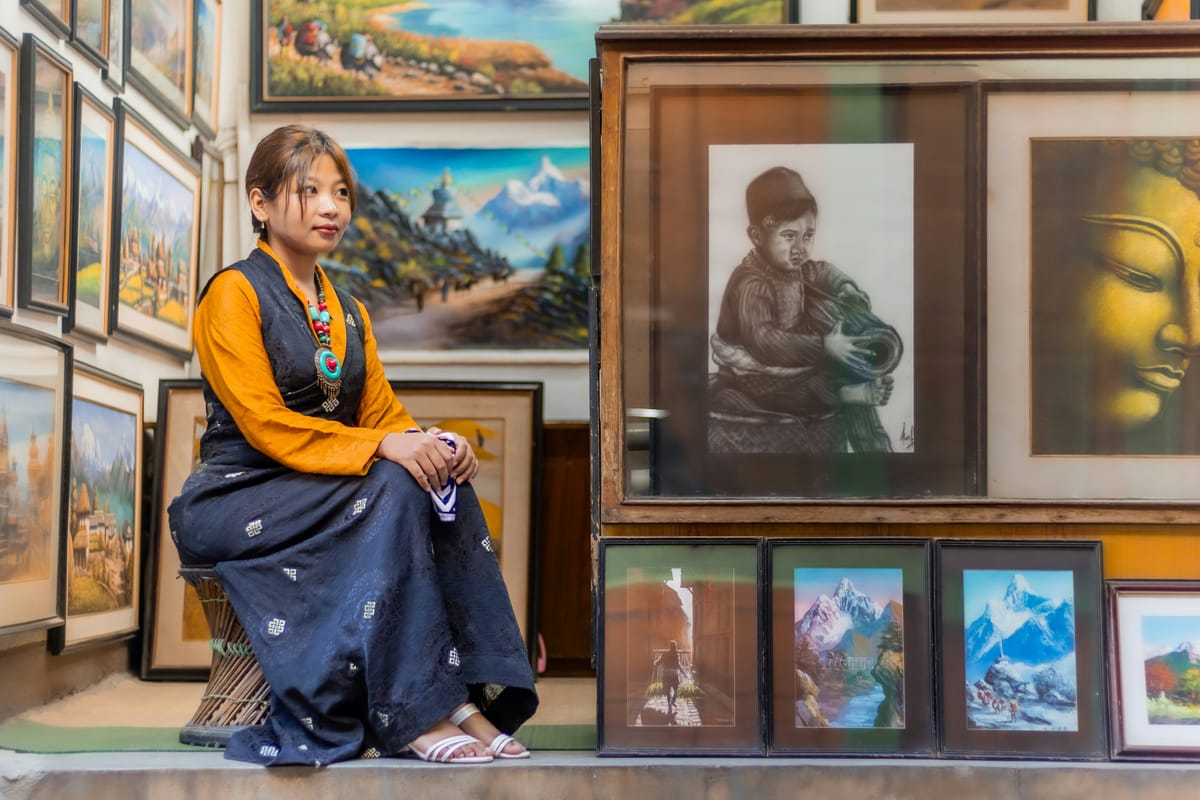
The Siddhartha Art Gallery opened in 1987 in a room in Baber Mahal Revisited, a complex built inside a former stable in central Kathmandu. It was the first contemporary art gallery in Nepal. Before it, there was no commercial or institutional infrastructure for contemporary visual art in this country. There were artists. They worked in isolation, without a circuit, without a market, without the friction that comes from showing work publicly and having it argued about.
What happened after Siddhartha is not a history that has been told in full anywhere. The shape of it is useful, though.
The gallery created a space. The space attracted artists. The artists made work that had not been made before in Nepal because there had been nowhere to show it. A generation of painters, photographers, sculptors, installation artists passed through. Some went abroad for training and came back making work that was in conversation with international contemporary practice but was not simply derivative of it. The Nepal Art Council's annual exhibition became the other fixture, a public occasion that brought together established and emerging artists and gave Nepali contemporary art a calendar presence.
The Kathmandu Triennale
In 2009, the Siddhartha Arts Foundation organized the first Kathmandu International Art Festival: 111 artists from 25 countries, six venues, twelve days. It was a statement about scale and reach that the domestic scene had not previously attempted.
In 2017 the festival rebranded as the Kathmandu Triennale, with the explicit ambition of placing Nepal on the international contemporary art circuit. The first edition brought Philippe Van Cauteren, Artistic Director of S.M.A.K. in Ghent, as curator, and Francis Alys as Patron Artist. The theme was about urbanization, migration, and identity. It featured Nepali artists alongside international names, and the programming was serious enough to attract institutional attention from outside the region.
Whether the connection that event creates is symmetrical, whether it benefits artists based in Kathmandu as much as it benefits the institutions bringing international artists in, is a question the scene has been arguing about since 2009. The Triennale is infrastructure. What infrastructure does depends on who uses it and how.
The Patan Museum, which opened in its current form in 1997 in the old Malla palace on Durbar Square, holds a collection of traditional Nepali art: bronze work, stone sculpture, painted manuscripts. It offers the context in which contemporary practice is made. A painter working in Kathmandu today grew up with access to visual traditions that are several hundred years old and have not been interrupted. That is not a minor thing. It is the condition that makes certain work possible here and not elsewhere.
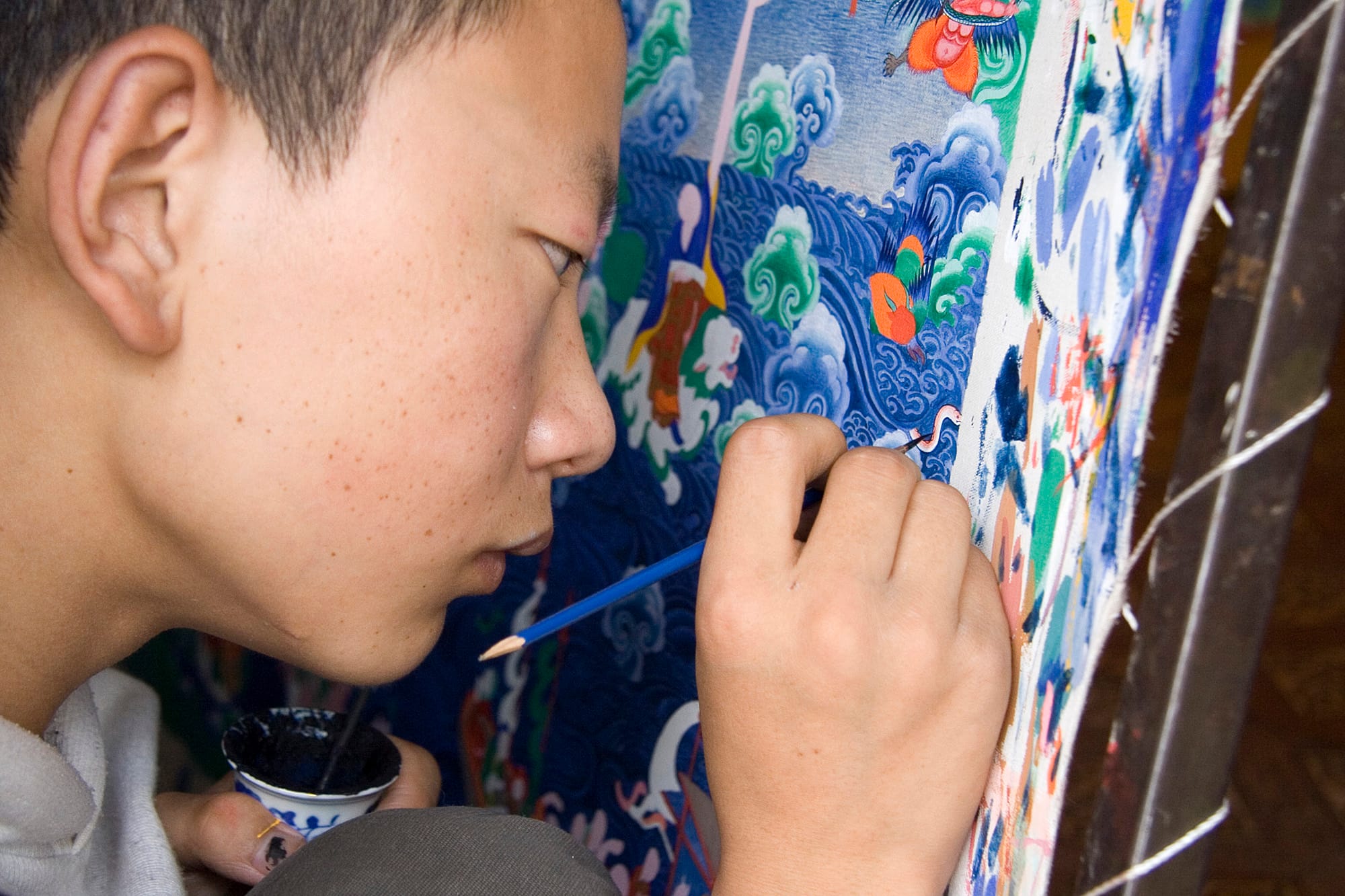
The Thangka practice is the clearest example. Traditional Thangka painting is a devotional art. The forms are prescribed. The measurements come from Sanskrit and Tibetan manuals. The gold is applied in sequence. There are painters in Kathmandu and Bhaktapur who have trained in this tradition for years and paint traditional Thangka for monasteries and for collectors. There are also artists who use the Thangka technique for contemporary subjects. Not combining traditions, not mixing registers for effect, but applying the technical vocabulary of Thangka, the precision of line, the mineral pigments, the layering, to subject matter drawn from contemporary life. This is a distinct practice. It is being made in Kathmandu because the tradition is alive enough here to work with, rather than just inherit.
The cost of maintaining a practice in Kathmandu is low by the standards of Mumbai or London. Studio space in Lalitpur runs from 10,000 to 20,000 rupees a month. Materials are accessible. The city is dense with artists in certain neighbourhoods, and the institutions that provide showing opportunities are few but consistent.
What that means for who makes art is not simple. The artists who can sustain a practice on an irregular income are usually the ones whose families have already reached some economic stability. A doctor's son, an engineer's daughter. Not because art in Kathmandu is elite in some abstract sense, but because a practice that earns unpredictably requires a cushion. This is the same everywhere. It is just more visible in a small scene.
Lalitpur and the independent spaces
Most of the commercial gallery activity is in Kathmandu. The experimental and independent scene has gravitated toward Pulchowk and the streets around it in Lalitpur.
Bikalpa Art Foundation in Pulchowk was co-founded in 2013 by Saroj Mahato and Mahima Singh. It runs on a practical model: artist residencies and exhibitions, sustained by a co-working space in the same building. The non-profit structure came in 2022. What it represents is an answer to a structural problem. You cannot run an independent arts space in this city on exhibition revenue alone. Bikalpa built adjacent income into the building and the space has stayed open because of it.
Singh is also the artist who made "Infinite Mirror," an installation that uses the rubble of the Kasthamandap as primary material. The Kasthamandap was a seventh-century pagoda at the heart of Kathmandu's old city. It collapsed in the 2015 earthquake. The formal decision to work with the actual physical debris is not a gesture. It is a statement about what material is, and about what happens to objects after an event that a city is still rebuilding around.
After the earthquake
The earthquake of April 25, 2015, killed close to nine thousand people and collapsed the Kasthamandap. It damaged an estimated eighty percent of the temples on Kathmandu Durbar Square.
The art scene responded. Hitman Gurung made "We Are at War Without Enemies": a figure with a bandaged face carrying damaged photographs, a direct indictment of institutional rebuilding failures rather than a memorial. Street art, which had not been a significant part of the Kathmandu scene, appeared on walls across the city in the months following the earthquake. Shraddha Shrestha painted "Hijo, Aaja" (Yesterday, Today) on Kantipath: two pairs of figures, one mourning, one holding tools.
photo.circle, a photography organization co-founded in 2007 by NayanTara Gurung Kakshapati, created the Instagram account @nepalphotoproject immediately after the earthquake to document the aftermath in real time. Later that year, in late 2015, photo.circle launched the first Photo Kathmandu: an outdoor photography biennial anchored in Patan's courtyards, squares, and alleyways, with exhibitions mounted at drinking fountains and in the open air. The timing was deliberate. The earthquake and the Indian blockade that followed had turned international attention toward Nepal in a particular way. Photo Kathmandu was an attempt to shift that frame.
It is now a biennial. It is one of the few structures in the valley that treats photography as fine art rather than a commercial or press category. Nepal has no dedicated photography school. Photo Kathmandu and photo.circle's archival and publishing work are most of the institutional infrastructure that exists for documentary and fine art photography here.
The diaspora is something else. Artists based in London, New York, and Sydney make work that is often explicitly about being from Nepal and not being there. Migration, distance, the gap between how Nepal is presented internationally and what it actually is. This work travels well. It gets shown at institutions that would not take work coming directly from Kathmandu. It wins prizes at festivals.
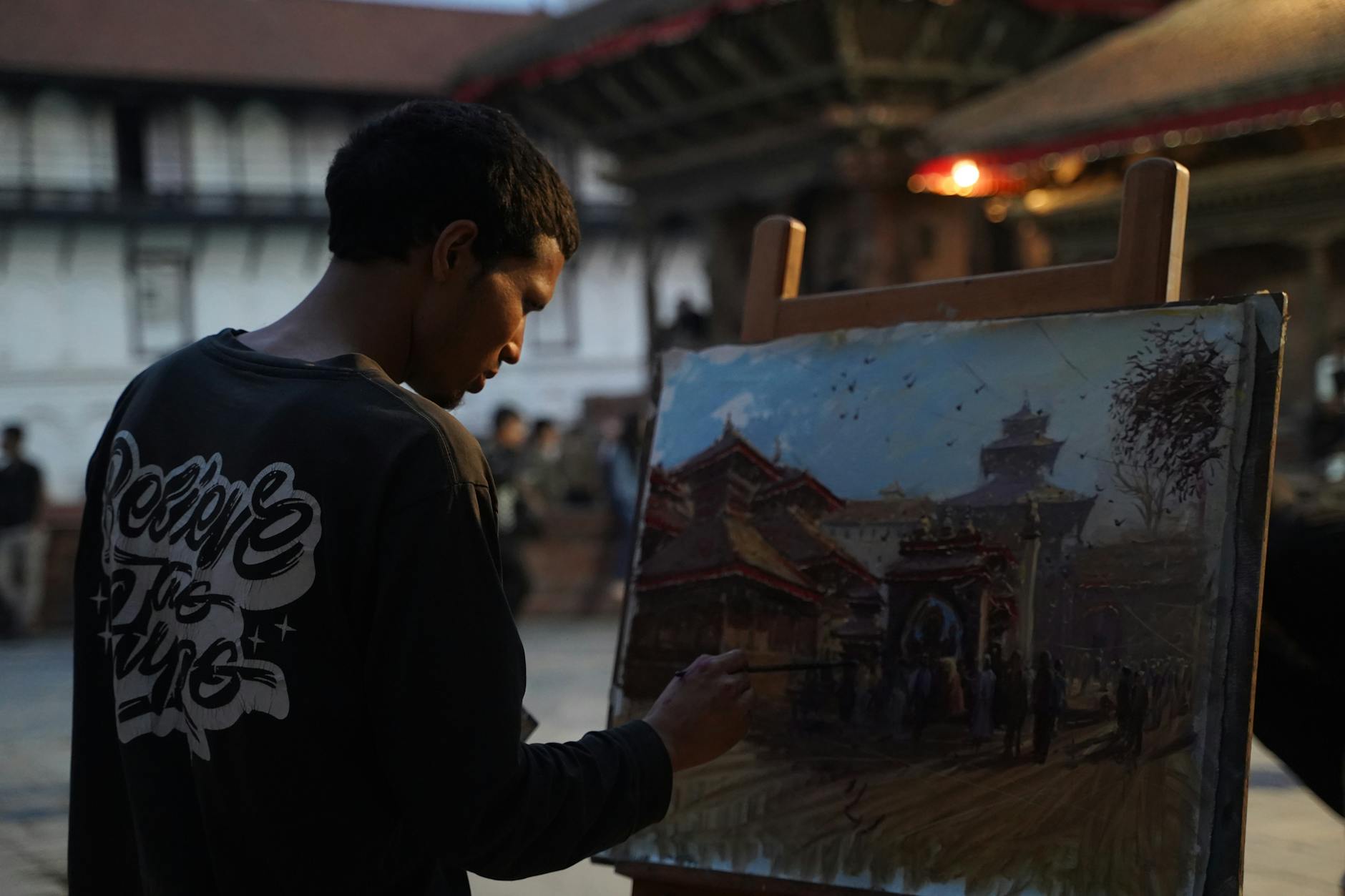
The relationship between the diaspora scene and the domestic one is not easy. Artists who stayed sometimes feel that the work which leaves gets credited for representing a Nepal it no longer inhabits. Artists who left sometimes feel that the domestic scene does not recognise the critical distance that distance provides.
Both are right. The gap is productive, when anyone bothers to cross it.
The Siddhartha Art Gallery is still open. The room in Baber Mahal still runs shows. On a weekday afternoon, it is quiet. A young man behind the desk reads. The work on the walls is from the current exhibition. Some of it is good. None of it is explained to you unless you ask.
Ask.