Kathmandu's Architecture: What the City Keeps Building Over What It Has
Kathmandu doesn't preserve its architecture so much as layer it. Newari courtyards inside office buildings, pagoda rooflines next to concrete frames, heritage sites surrounded by mid-rise construction.

Kathmandu is a city that never stops writing on top of itself. Walk a few minutes in the old core and you can feel the scripts changing under your feet: a threshold stone worn smooth by centuries of bare soles; a brick lane that bends as if it remembers a different map; a sudden white façade that looks imported, planted there to make a statement; and, beyond it, concrete frames rising in quick, repetitive gestures. To look at Kathmandu closely is to realise the skyline isn’t a single “style” so much as a set of competing promises - of power, safety, modernity, belonging - each built with whatever materials and ambitions were available at the time.
The easiest way to understand Kathmandu architecture is not by memorising periods, but by learning to read layers. Licchavi-era stone inscriptions still sit where they were placed, calm and declarative. Malla-era courtyards still choreograph daily life with a precision that feels almost musical. Rana palaces still perform their theatrical symmetry, even when their rooms now serve entirely different purposes. And the city’s most common contemporary material - reinforced concrete - tells its own story: of rapid urban growth, of remittances returning as housing, of aspirations shaped by television and migration, and of a hard lesson delivered in 2015 when the ground proved, again, that Kathmandu is built on movement.
This is an architecture of palimpsest. Kathmandu keeps building over itself - but it also keeps leaving traces.
The inner city: timber, brick, and the intelligence of courtyards
If you start with old Kathmandu - the dense, pedestrian-scale neighbourhoods around Durbar Squares and the web of lanes connecting them - the dominant impression is not monumentality but intimacy. The buildings are close enough to touch. They make shade. They place you in a corridor of brick, with windows that glance out like faces.
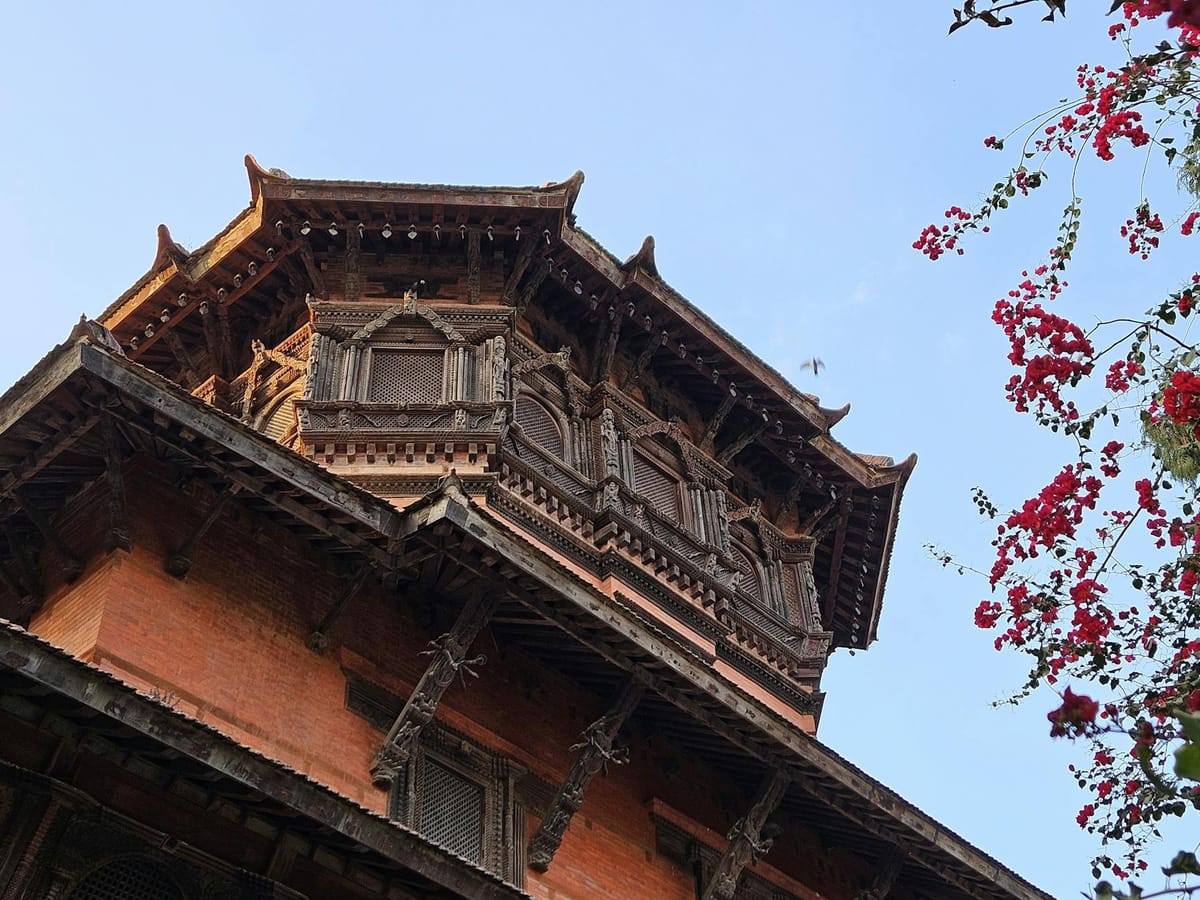
Traditional Newar architecture: brick walls, timber frames, carved struts supporting overhanging roofs, latticed windows that filter light into patterned shadows. What matters is how these parts organise life. The courtyard (bahal, bahi, chowk) is the city’s most enduring design idea: a shared interior open to the sky, a place where sound gathers, where water once sat in stone spouts and wells, where rituals and mundane chores occupy the same square of ground.
The craftsmanship is not decorative in a superficial sense - it is structural and social. Timber struts (tundal) carry roof loads, but they also carry stories: gods, animals, mythic scenes, and motifs that repeat from neighbourhood to neighbourhood. Brickwork forms its own vocabulary of patterns, subtle until you start noticing them: the rhythm of corner bricks, the way a façade shifts slightly to accommodate a lane’s curve. Even the “messiness” has intelligence. Old Kathmandu is dense because density keeps things walkable; it keeps commerce close; it makes courtyards function as communal lungs.
How much of this is left depends on where you look. Some lanes still feel intact - a continuity that makes time feel thick. Other streets are interrupted by abrupt replacements: a concrete building that ignores the old proportions, or a widened road that cuts through a once-tight urban fabric. Yet even when individual houses are lost, the city’s underlying logic persists in fragments: the placement of shrines at corners, the narrowness of lanes that refuse to become car roads, the way a courtyard can still pull you inward from the noise.
To read Kathmandu’s architecture here is to read a way of living that understands space as shared and layered, not purely private and individual.
The Rana palaces: imported grandeur and what it became

The most jarring layer in Kathmandu is also one of its most recognisable. Rana palaces - those white, neoclassical buildings with colonnades, pediments, balustrades, and formal gardens - were built in the late 19th and early 20th centuries by Rana prime ministers. Their architecture was political messaging: a performance of modernity and global sophistication, aimed outward and inward at once. The façade had to look “European” because the state wanted to be seen as aligned with empire-era power, even while Nepal remained fiercely sovereign in the way it negotiated those powers.
There is a particular confidence in the symmetry of these buildings. They sit back from the street, unlike the older city. They create distance between the public and the private. They flatten the local climate into imported ideals: grand staircases, long corridors, rooms arranged for display. In a place where traditional architecture makes shade and frames courtyards, the Rana palaces frame authority.
And yet, architecture never fully belongs to its builders after time moves on. Many Rana palaces are now repurposed. Some house government offices: bureaucratic corridors occupying rooms once designed for elite leisure. One has become a hotel, where the old façade is part of the experience being sold - curated nostalgia that packages history as atmosphere. Another has been absorbed into a shopping mall, which is perhaps the most Kathmandu thing imaginable: a 20th-century symbol of power reprogrammed for 21st-century consumption.
These transformations are not simply “good” or “bad.” They are evidence of Kathmandu’s most consistent habit: reuse. The city rarely erases completely; it absorbs, adapts, and sometimes awkwardly stitches. A palace turned office or hotel can be a preservation strategy, even when it compromises the original layout. But it also raises a question Kathmandu continually negotiates: what parts of the city are treated as heritage, and what parts are treated as real estate?
In the shadow of Rana grandeur, the older city looks even more radical - not for its age, but for its scale and its social design.
Concrete Kathmandu: growth, aspiration, and the price of speed
If the old city and the Rana palaces offer distinct visions of power and community, concrete tells the story of scale. From the 1980s onward, Kathmandu expanded rapidly. Population increased, rural-to-urban migration accelerated, and remittances changed what families could afford to build. Concrete became the default answer to almost every question: how to add floors, how to build quickly, how to signal modernity, how to make a structure “permanent” in a city of brick and timber.
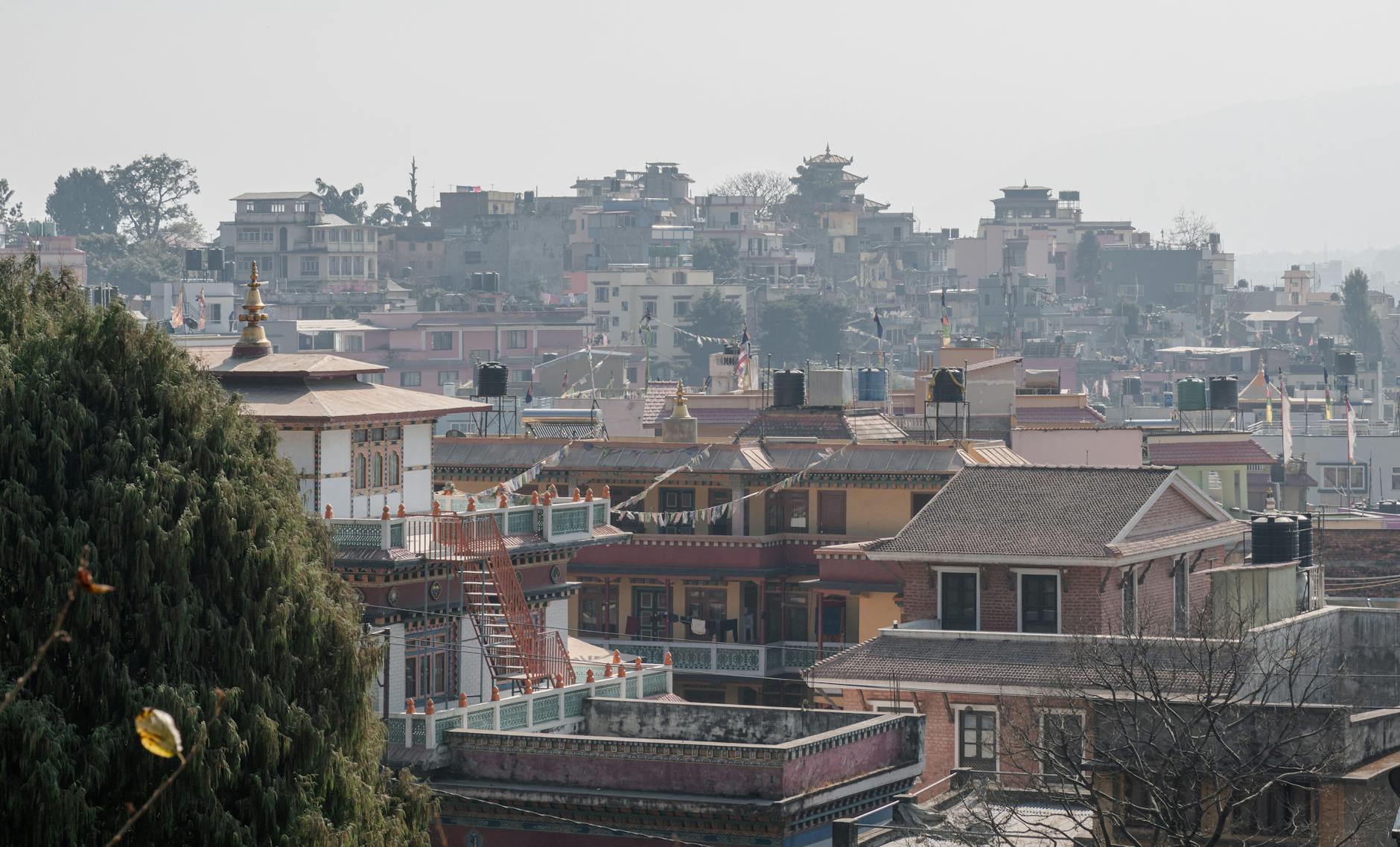
Concrete construction has its own aesthetics in Kathmandu - a repeating grammar of columns, beams, and infill walls, often with decorative tile, painted bands, or metal railings. It is easy to dismiss this as generic. But the “generic” is itself a cultural artifact. These buildings are shaped by local economics, by the availability of materials, by what builders know, and by the images of urban life people carry from abroad. A three-storey house with a flat roof and a boundary wall is not just a structure; it’s a statement about privacy, about the future, about wanting a form that reads as contemporary.
The problem is that speed and scale can outrun governance. Kathmandu’s concrete boom developed unevenly, often without consistent enforcement of building codes. Seismic risk was not theoretical - the valley sits in an earthquake zone - but it was frequently treated as a distant possibility compared to the immediate need for housing and income.
Then 2015 arrived and turned possibility into memory. The Gorkha earthquake did not “destroy Kathmandu” in a cinematic collapse, but it exposed vulnerability. Some traditional structures failed; others performed better than expected depending on maintenance and retrofits. Concrete buildings, too, showed a range: well-built structures stood; poorly built ones cracked, pancaked, or became unsafe. The lesson was not that one material is inherently safe and another inherently dangerous - it was that workmanship, detailing, and regulation matter, and that Kathmandu’s urban growth needed more than momentum.
The architecture of the last few decades is therefore inseparable from questions of safety and resilience. Concrete is not going away. The question is how Kathmandu can make its most common building type more responsible: through better design, stronger oversight, and a public culture that values long-term safety over short-term speed.
After 2015: restoration, replacement, and the politics of “authentic”
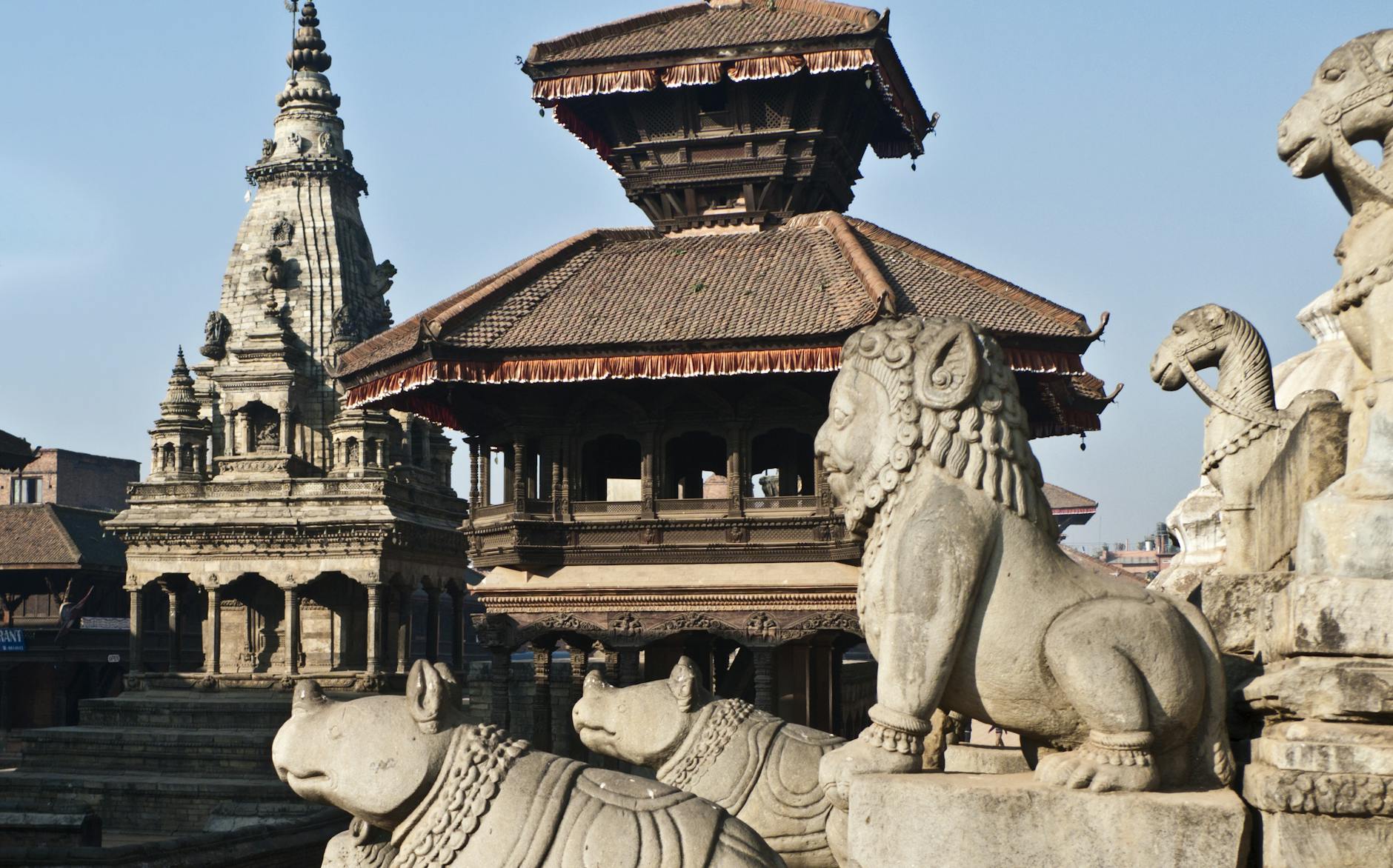
Post-earthquake rebuilding is where Kathmandu’s layers become most contested. When a historic structure collapses, the city is forced to decide what “restoration” means. Does rebuilding replicate the old form exactly? Does it incorporate modern materials for strength? Does it leave ruins as testimony? Who gets to decide - the state, local communities, donors, engineers, heritage experts?
The most visible debates played out around monuments and squares, but the deeper story is in the everyday: the repair of old houses, the reinforcement of walls, the quiet disappearance of structures deemed too expensive to restore. In some cases, the choice is made for people by economics. Timber carving is skilled, time-consuming work; brick-and-timber restoration can be costly; and insurance, financing, and legal frameworks are not always aligned with heritage outcomes. Replacement becomes the pragmatic route.
In other cases, restoration becomes a form of civic pride - a declaration that Kathmandu values its past as something living, not merely photographic. When temples and monuments are rebuilt, they are not only architectural objects; they are anchors for festivals, rituals, and community identity. Rebuilding can be a way of stitching the city back together emotionally after trauma.
But “authenticity” is not a neutral word in Kathmandu. A temple rebuilt with reinforced concrete under a traditional brick skin might be criticised for being fake; a temple rebuilt entirely in traditional methods might be criticised for being unsafe or impractical. The city’s real condition is compromise: Kathmandu negotiates between structural engineering and craft tradition, between what the eye expects and what the ground demands.
What emerged after 2015 is a sharper awareness that Kathmandu’s architecture is not just about beauty - it is about choices under pressure.
What Kathmandu is building now: hybrids, experiments, and a new confidence
Despite all the anxiety that can surround development, Kathmandu is not architecturally stagnant. New buildings are being designed with a more deliberate eye: homes that borrow proportions from traditional façades while using modern structure; cafés and hotels that incorporate courtyard-like spatial sequences; adaptive reuse projects that treat old brick shells as assets rather than obstacles. There is, in some corners, a growing confidence that “modern Nepal” does not have to mean copying elsewhere.
You can see this in small decisions: using brick as a primary material rather than a decorative cladding; carving wooden elements that are contemporary rather than imitative; designing for shade and ventilation instead of sealing interiors behind glass; respecting the human scale of streets even when the building is new. You can also see it in the rise of heritage-conscious hospitality: restored houses turned into guest spaces where the architecture is not merely a backdrop, but part of what visitors come to understand.
At the same time, Kathmandu is also building the infrastructure of a larger city: wider roads, flyovers, apartment blocks, commercial towers. These projects change the urban experience dramatically. They can improve mobility and density, but they also risk flattening the valley’s distinctive spatial character if they are designed without sensitivity to context. The coming decades will likely be defined by how Kathmandu balances the need for a functioning modern metropolis with the desire to remain Kathmandu - a city of courtyards, thresholds, and layered memory.
To read the architecture being built now is to read a city that is, slowly, learning from its own history: not to freeze it, but to use it.
A city that keeps its traces
Kathmandu architecture can feel contradictory because Kathmandu itself is contradictory: sacred and commercial, intimate and sprawling, meticulous and improvisational, ancient and relentlessly current. The layers do not resolve into a single narrative. They coexist, sometimes uneasily, like different generations sharing the same house.
And perhaps that is the point. Kathmandu does not “preserve” the past in a museum sense; it carries it in fragments, in reused rooms, in carved struts supporting roofs that still shelter ordinary life. The Rana palaces, for all their imported language, have been absorbed into the city’s daily machinery. Concrete buildings, for all their repetition, are expressions of real families building futures, even as the city learns the hard disciplines of safety and resilience.
If you want to understand Kathmandu, stop looking for a perfect skyline. Look instead for the seams: where brick meets plaster, where a carved window looks out onto a street lined with new shops, where an old courtyard opens behind a modern gate. The city keeps building over itself - but it rarely builds without leaving something behind.