Upper Mustang in Winter: The Valley When the Trekkers Leave
Upper Mustang after the trekking season ends is a different place. What the valley looks like in January and February, who remains in Lo Manthang, and what the landscape offers without the summer crowds.

The restricted area permit to enter Upper Mustang costs $500 for the first ten days. In January, there is nobody to inspect it.
The checkpoint at Kagbeni, the last village before the restricted zone begins, is unmanned. The rangers who run it in season have gone back to Jomsom, where the airstrip still operates and there are government offices with heating. The permit is still required by law. There is simply no mechanism to enforce it.
Upper Mustang was opened to foreign trekkers in 1992, forty years after the rest of Nepal. Before that, the valley was closed, partly because of its proximity to the Tibetan border, partly because of the Khampa resistance fighters who used the valley as a base against Chinese control of Tibet through the 1960s and 1970s. The permit system, the checkpoint, the $500 fee: these are the 1992 architecture of restricted access, still in place even though the restriction is now commercial rather than military.
In January, it is moot. This is what Upper Mustang looks like without the trekking infrastructure: a medieval walled city in a wind-scoured valley, functioning according to its own logic.
The landscape
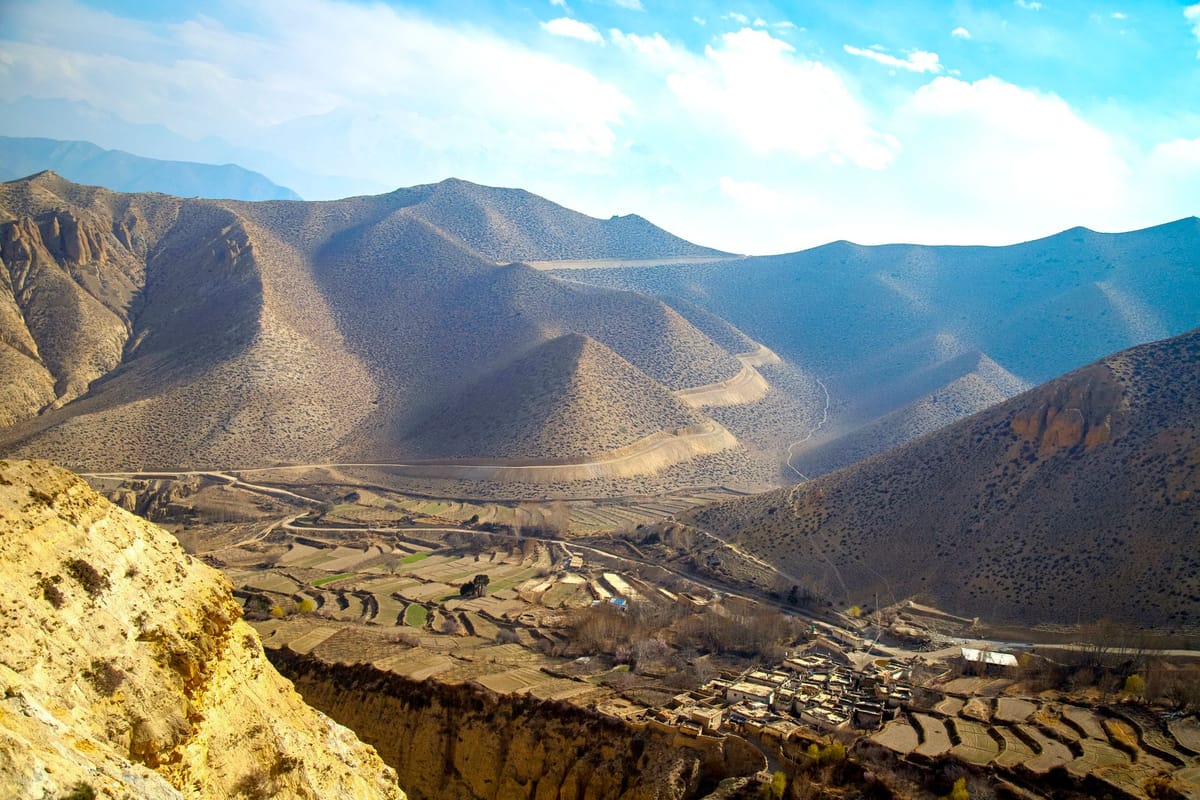
The Mustang valley sits in the rain shadow of the Annapurna and Dhaulagiri massifs. The monsoon arrives in June and passes south; by the time it reaches Lo Manthang it has given everything to the southern slopes. The result is a landscape that looks more like the Tibetan Plateau than the Nepal most visitors know: red-brown cliff walls, ochre terraced fields, the occasional monastery perched at a height that makes no architectural sense unless you understand it was built to be seen, not easily reached.
In January, the daytime temperature at Lo Manthang, at 3,840 metres, stays near zero. By mid-afternoon the wind arrives from the northwest. It does not stop until well after dark. At night the temperature falls to -20°C.
The colour in January is different from October. In October, the photographs show the ochre cliffs against a blue sky, trekkers in bright jackets, the valley floor muted from the late harvest. In January, the jackets are gone. The cliffs are the same colour they always were. Without foreground figures the scale becomes clear. Nilgiri, at 7,061 metres, stands at the southern end of the valley. In October you can miss it against the haze. In January, you cannot.
The yaks in January have been moved from the high pastures above 4,500 metres down to the lower valleys. The Drokpa, the nomadic herders who follow the high grazing in summer, have come below the snowline. The yaks' coats are thick enough that snow accumulates on their backs without melting. The herders camp near them in tents that are thinner than the animals' coats.
The walled city
Lo Manthang was founded in 1380 by Ame Pal, a Tibetan commander who built the walled capital at the head of the valley to control the trade routes between Tibet and the lower hills. The wall is still intact. The city inside it has a permanent population of roughly four hundred; in season, four times as many people move through in a day.
The Kingdom of Lo was formally abolished in 2008 when Nepal ended its monarchy. The last king, Jigme Dorje Palbar Bista, died in 2016. His son holds no official title. The king's palace is still the tallest building in Lo Manthang. It is still called the palace.
The city in January: the main square is empty except for the chortens and the dogs. Cooking smells come through the walls, yak butter, tsampa, dung fires. The guesthouses, all eleven of them, closed in November. Their solar panels are buried under snow. The dining rooms with their laminated menus and their tables set for groups of sixteen have one family living in the back. The Wi-Fi password is still written on a chalkboard near the kitchen.
The Thubchen Gompa, the assembly hall built in 1447 with its murals intact on the inner walls, is cold enough inside that the butter lamp smoke drifts rather than rises. The monks wear extra robes. The religious calendar in winter is dense with practice. Without the agricultural demands on people's time, January is when the long ceremonies happen, the ones that run for seven consecutive days and require the full complement of resident monks.
There are twenty-three monks resident in Lo Manthang through winter. The older ones have been here through every season for decades. The younger ones are boys from the valley whose families brought them at age seven or eight.
Who stays
Most of the Loba, the people of Lo, move south for winter. Pokhara has become the effective winter capital of the community: Loba trading stalls in the lakeside market, Loba-run guesthouses near the tourist strip, Loba restaurants where the menu is not the food of Lo Manthang but the food that sells. The seasonal migration has been happening for generations. What has changed is that for many younger Loba, the migration has become permanent. They bring their children to school in Pokhara. They do not return in spring.
The farming calendar in winter: mustard planted before the first freeze is in the ground. The barley fields are bare. The apple orchards, which development organisations brought to Mustang in the 1990s as an alternative to the declining trade economy, need pruning before spring. These tasks keep the families who stay.
The ones who stay through winter are, on the whole, older. They give two reasons. The land, and the irrigation channels that must be kept clear. And something harder to articulate: not wanting to leave, the place being the place even when it is coldest.
The trade
The Kali Gandaki gorge is the corridor the trade has followed for at least two thousand years. Tibetan salt, wool, and livestock moved south; grain, spices, and manufactured goods moved north. Mustang's wealth came from controlling this corridor. The Kingdom of Lo, at its peak in the sixteenth century, was rich enough to commission the Thubchen and Jampa Lhakhang temples and maintain a court.
The trade contracted when synthetic iodised salt arrived in Nepalese markets in the 1960s and undercut Tibetan rock salt. It did not stop. What moves through the valley in winter now is a fraction of what moved in the seventeenth century, smaller loads, fewer animals, different goods. The route competes with the Chinese highway on the Tibet side of the border.
But it moves. In January, when the permit system is unstaffed and the passes are technically closed, the movement through the valley belongs to the people who have always used it. They are not trekkers. They carry goods in both directions through a border that has been permeable at this altitude for longer than any current government.
The question of staying
In Pokhara, a Loba man who has spent fifteen winters there explained the decision simply. His children are in school there, his wife has a business, his grandchildren were born there. He goes back to Lo Manthang in April for the planting and stays through October. He calls it a long visit.
His mother is in Lo Manthang now. She is in her eighties. She has never spent a winter in Pokhara. She says there is nothing in Pokhara in winter that she cannot do better in Lo Manthang. She says the cold is not as bad as people who have not lived with it believe.
She says the wind has a sound she would miss.