Nepal's Indigenous Communities: Seven Nations Inside One Country
Nepal has 59 officially recognised indigenous nationalities. Seven of them -- Sherpa, Tamang, Gurung, Tharu, Newa, Limbu, and Rai -- each represent a distinct cultural world. What makes each different and where to encounter them.

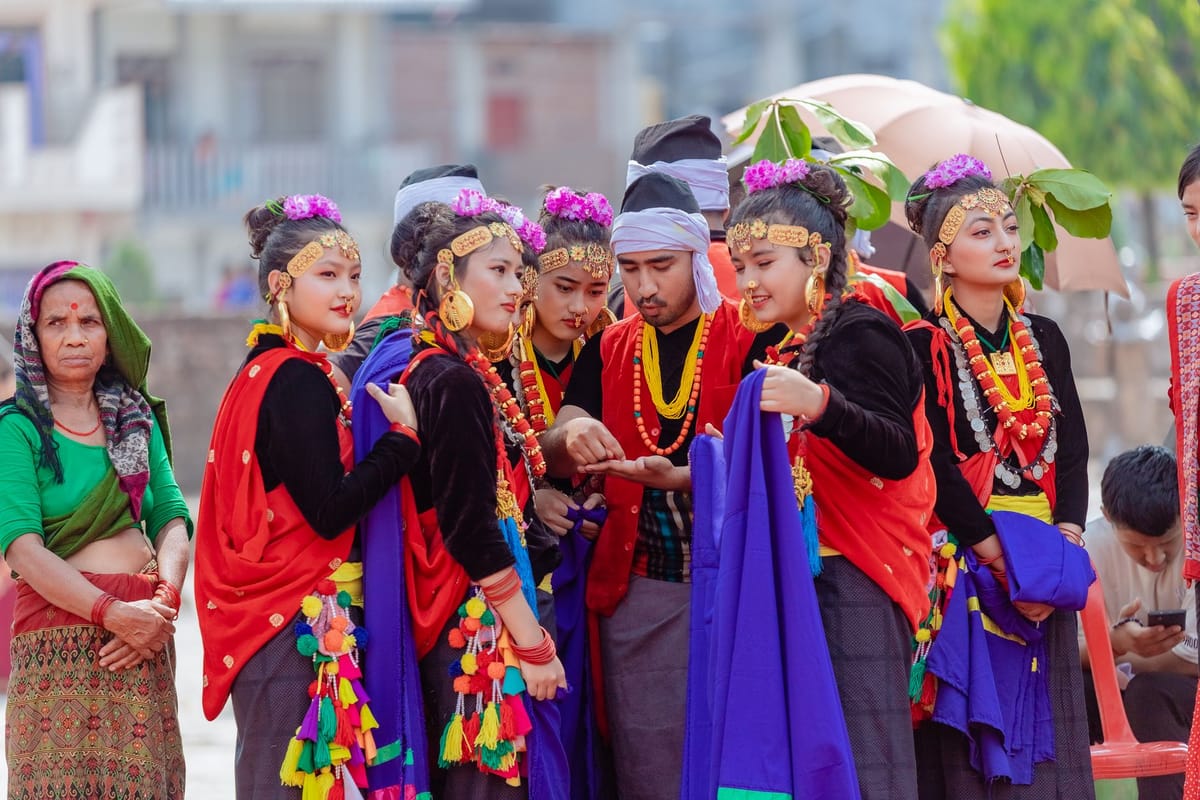
Nepal's constitution recognises 59 indigenous nationalities. Most travel writing about Nepal mentions one or two. The Sherpa, always. Sometimes the Newa. Occasionally the Tharu.
The remaining 55 are not obscure. Some number in the hundreds of thousands. Some have their own scripts, their own legal traditions, their own mountain ranges. Nepal's official category for them is Adivasi Janajati, translated roughly as 'indigenous nationalities': a term that groups communities as culturally distinct from one another as the countries of Western Europe. What they share is that the Nepali state recognises their existence while still negotiating what that recognition entitles them to in practice: land, language instruction, representation, access to resources.
Seven of the 59, in the detail they deserve.
Tharu
The Tharu are the indigenous people of Nepal's southern Terai plains. They survived the lowlands for centuries because their blood adapted to the endemic malaria that killed everyone else who tried to stay: alpha-thalassemia alleles at near-fixation levels, with up to 90% of Chitwan Tharu heterozygous for a deletion that reduces Plasmodium falciparum survival inside red blood cells. The Tharu body became a selective pressure on the parasite. What reads as an inherited blood condition is, at population scale, the record of thousands of years of adaptation to a disease that killed more effectively than any army.
The malaria eradication campaign of the 1950s opened the Terai to hill migration. The hill migrants understood the new land reform policies the government was introducing; the Tharu did not. The documented method, in case after case: a blank document, a thumb pressed to paper, a signature from someone who could read what it said. 909,743 Tharu lived across six western districts: Dang, Banke, Bardiya, Surkhet, Kailali, and Kanchanpur. Within a generation, they were tenants, then debtors, then Kamaiyas: bonded labourers whose debts were calculated by the landlords holding them and never designed to clear.
The Kamaiya system was abolished on 17 July 2000. 27,570 families were freed. As of 2024, 2,375 were still waiting for resettlement land the government promised.
Tharu architecture deserves a note. Their houses in the western Terai are built on raised platforms above the flood line, walls made of mud mixed with cow dung and rice husks, structures designed to accommodate the river's annual rise. In tourist brochures around Chitwan, photographs of these houses appear as local colour. The people who designed them are waiting for the land.
Rai
The Rai trace their roots to Khambuwan, the land of the Khambu, in Nepal's eastern hills. The 2021 census counted 640,000 Rai across Nepal, concentrated in Koshi province along the valleys running south from the Himalaya toward the Indian border.
Central to Rai identity is the Mundhum: not a text but a living oral tradition that serves simultaneously as religious scripture, legal code, and cosmology. It speaks of Sumnima, the earth mother, and Paruhang, the sky father. The nakchhong shamans carry it forward through apprenticeships that require years of memorisation and ritual preparation. The transmission works only if there are people willing to receive it. The young men leaving Khambuwan for Kathmandu's construction sites create a gap in the line.
Archaeological evidence from eastern Nepal dated to the 1st millennium CE, megalithic structures, iron tools, stone-walled settlements, shows continuity of Kirati material culture across two millennia. Some of the stone inscriptions on these sites have not been decoded. The Rai scholars working on them operate without institutional support proportional to what they are preserving.
Tamang
The Tamang are the most populous indigenous group in Nepal's central hills. Langtang village, in the high Rasuwa valley north of Kathmandu, is home to a Tamang community whose practice of Tibetan Buddhism predates the trekking industry by centuries. The monastery at Kyanjin Gompa dates to the 14th century. Pilgrims passed through Langtang long before the first trekking permit.
On April 25, 2015, the Gorkha earthquake triggered an avalanche above Langtang village. The mountain sent 40 million metric tons of rock and ice into the valley. The 668 people who had lived there lost nearly 300 in minutes. The snow that had been above them came to rest where they had been.
The survivors rebuilt. Teahouses reopened within three years. Kyanjin Gompa was reconstructed with Japanese government support in 2018.
What rebuilt was not the same. The dead included elders who held knowledge that was not written down. The pace of reconstruction prioritised structures. The transmission of Tamang ritual knowledge, which requires living teachers, was not a line item in any recovery budget.
Gurung
The Gurung inhabit the middle hills of the Annapurna range. Ghandruk, at 2,012 metres above the Modi Khola valley, is the largest Gurung village in the region. On a clear morning, it looks directly at the south face of Annapurna South and the peak of Machapuchare.
Gurung men have served in the British and Indian Gurkha regiments for two hundred years. In some Ghandruk households, the primary income is the pension of a retired soldier.
The men leave.
The women manage the farms, the children, the teahouses. The village's daily operation runs on remittances and the labour of people who are not in the Gurkha pipeline.
The Ghatu dance tells the story of King Pashramu and Queen Yambawati. Two dancers, the Ghatusaris, are selected and prepared over weeks for a ritual that begins with the full moon of Chaitra. They can enter trance states lasting hours. The festival is not on a tourist itinerary. It happens when the calendar calls for it.
Magar
The Magar are Nepal's third-largest ethnic group: 1.88 million people, 7.1% of the total population, living across the western and central hills on the flanks of the Dhaulagiri massif. They are also the least-covered of Nepal's major indigenous communities in international media.
Before Nepal's unification in 1768, the Magar governed their own territory across the mid-western hills. Some historians argue that the Shah dynasty itself has Magar ancestry. Unification absorbed the Magar the way it absorbed every other autonomous hill community: through conquest, administrative reorganisation, and the gradual substitution of the new state's authority for indigenous governance.
The Magar appear in travel writing about western Nepal as the background population: the porters on the Dhaulagiri circuit, the teahouse owners in Myagdi and Baglung. The writing describes the scenery they live in. The people who know the routes in every season, who have names for the weather patterns that matter, appear in the text as local colour.
The Magar are divided into Eastern and Western groups, subdivided into eight or more clans, with dialects distinct enough in some cases to constitute separate languages. There is no single Magar culture. There is no single person who can speak for all of them. That difficulty is part of the reason they remain undercovered: the community resists the convenience of a single representative.
Newa
The Newa are the original inhabitants of the Kathmandu Valley, the builders of Bhaktapur, Patan, and Kathmandu. Their cuisine, festivals, and wood-carving tradition are covered elsewhere on The Goreto. Here, only: the Newa did not come to the valley. The valley came to them.
Limbu
The Limbu call themselves Yakthung. Their homeland, Limbuwan, covers Taplejung, Panchthar, Ilam, and Terhathum in Nepal's far east, where the terrain climbs toward the Kanchenjunga range. The Yakthung language is the easternmost of the Kiranti languages, a subfamily of Tibeto-Burman spoken across Nepal, Sikkim, and the Darjeeling hills.
The Limbu have their own script: Sirijunga, developed in the 18th century, used to transcribe the Mundhum texts of the Limbu tradition. The script was suppressed during Rana rule and is being taught again, in some schools, in some years, depending on the district and the budget.
A visitor to Limbuwan is offered Tongba: whole-grain millet fermented, packed into a carved wooden vessel, hot water added, sipped through a bamboo straw as the grains steep. The vessel is refilled several times; the same grains yield several rounds of different intensity. It is not a novelty. It is what you drink, at altitude, in the cold, when the harvest has been good.
Each of the 59 nationalities is listed in Nepal's constitution. Each has formal recognition as an Adivasi Janajati. That recognition is real. It was fought for through protests, political campaigns, and the constitutional drafting process that followed the 2006 peace agreement.
What it does not automatically provide: land titles for communities whose occupation predates the documentary record. Language instruction budgets proportional to speaker populations. Representation in the civil service at levels matching demographics. Rights over forests, rivers, and hillsides that extractive industries also want.
These seven communities represent a different Nepal than the one in the brochures: a people adapted to a disease that killed everyone else; an oral scripture balanced on a generation of departing young men; a mountain village rebuilt around a crater; a trance dance that happens on its own calendar; nearly two million people who appear in travel writing as background; the builders of a valley they did not come to; a language with its own script and a wooden cup in the cold. Each of the 59 has this kind of story. Nepal recognises all of them. Most of the stories are still unresolved.