Kukur Tihar: Nepal's Festival That Honours Dogs
Kukur Tihar is the day Nepal's dogs receive garlands, tika, and extra food. What happens during the festival, when it falls, and where to see it.


The dog did not understand what was happening. It sat still while the garland of marigolds was placed around its neck, while the tika was pressed onto its forehead, while someone brought a steel plate of sel roti and meat. It ate the meat quickly and looked up for more. On November 8, 2026, across Nepal, this was the scene repeated in millions of households: a dog, bewildered and fed, briefly held at the centre of something ancient.
Kukur Tihar is the second day of Tihar, the five-day festival of lights. It falls on the fourteenth day of the waning moon in the Nepali month of Kartik. Every year, one day is set aside specifically for dogs. Not as a charity. As a ritual.
The Myth Behind the Day
The oldest explanation comes from the Mahabharata. When Yudhishthira, eldest of the Pandava brothers, completed his years of exile and prepared to ascend to heaven, a dog appeared at the beginning of the journey and followed the party through every trial. Each of his brothers fell along the way - Draupadi, Nakula, Sahadeva, Arjuna, Bhima - one by one. Only Yudhishthira and the dog reached the gate.
Indra, king of the gods, came to escort Yudhishthira in. The dog could not enter, Indra said. Yudhishthira refused. He had abandoned everyone he loved on that path. He would not abandon the dog. The dog, in that moment, revealed itself to be Dharma - the god of righteousness, his own divine father - testing him one final time. Yudhishthira had passed.
A second thread runs through Shaiva tradition. Bhairava, the fierce form of Shiva, has a dog as his vahana - his sacred vehicle and companion. The animal associated with the most powerful deity in the Nepali Hindu pantheon is not a lion or an eagle. It is a dog. Worshipping dogs during Tihar is, in part, worshipping Bhairava. In the iconography of Bhairava found at crossroads shrines across Kathmandu Valley, the dog sits at his feet or beside him - not as a symbol of domesticity but of guardianship at the boundary between this world and the next.
What the Worship Looks Like
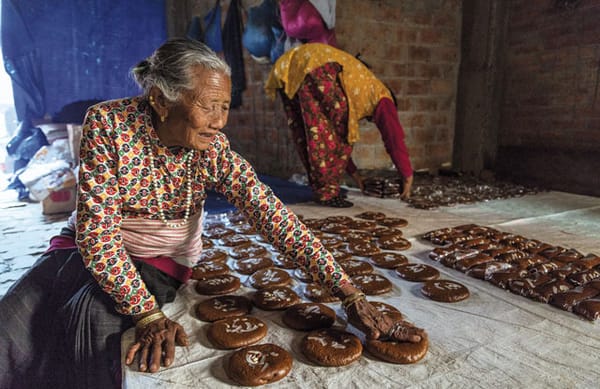
The ritual follows a specific sequence. The dog is bathed. A tika of red powder and yoghurt is applied to its forehead. A garland of marigolds - the same flower used to worship deities at household shrines - is placed around its neck. Then food: sel roti (the ring-shaped fried bread made only during festivals), eggs, meat. The quantity is generous.
The intention is not symbolic. In Nepali Hindu practice, the dog on this day holds the same ritual status as a deity. You are not being kind to a pet. You are performing puja.
Dogs that belong to households receive this treatment from their families. But Kukur Tihar is also, notably, one of the few occasions when stray dogs are included. People bring food to strays. Garlands appear on dogs in streets and alleys. Nepal has an estimated 30,000 to 50,000 stray dogs in Kathmandu alone - a population that generates persistent public health debate and periodic culling controversies. On Kukur Tihar, the same animals are garlanded.
The contrast is not lost on Nepali observers. The festival does not resolve the tension. It holds it.
Why Dogs
Dogs occupy a specific position in Hindu cosmology that has no easy parallel in Western frameworks. They guard the threshold of death - Yama, the god of death, owns two four-eyed dogs who guard the road to the underworld. They are messengers and protectors at the boundary between the living and the dead. Honouring them during Tihar, a festival that begins with crow worship (Kag Tihar) and ends with sibling worship (Bhai Tika), is not incidental. Each day of Tihar is dedicated to a different guardian relationship. The crow warns of death. The dog guards the dead.
The logic of the festival, when you follow it this way, is about acknowledging what stands between the living and whatever comes after. Crows carry omens. Dogs walk the boundary. Cows give life. Oxen labour for it. And on the final day, sisters tie a thread around their brothers' wrists and pray they will not cross over before their time. Tihar is not about light in the abstract. It is about what you are grateful to still have.
Kukur Tihar has gained attention outside Nepal in recent years. In 2016, a Kukur Tihar celebration in Mexico City - organised by Nepali diaspora - drew coverage from international outlets. The images were striking precisely because they required no caption to understand: dogs wearing marigolds, fed and decorated, their owners kneeling. The ritual looked like joy. Because it is.
When and Where
Tihar runs for five days in October or November, with the exact date determined by the lunar calendar. In 2026, Kukur Tihar falls on November 8. The festival is observed across Nepal, with particularly vivid celebrations in Kathmandu Valley, Pokhara, and in Newari communities, which have their own parallel traditions around the same period.
If you are in Nepal during Tihar, Kukur Tihar is visible everywhere. Dogs in the street with tikka still on their foreheads. Marigold garlands draped on gates and necks both. The morning smells of frying sel roti. It is not a festival designed for visitors, but it is not closed to them either. Watch, and keep a respectful distance from the ritual itself - participation is for the household.
Frequently Asked Questions
When is Kukur Tihar in 2026?
Kukur Tihar falls on November 8, 2026. It is the second day of the five-day Tihar festival.
What happens during Kukur Tihar?
Dogs are bathed, decorated with marigold garlands, and marked with tika on their foreheads. They are then offered special food including sel roti, eggs, and meat. The ritual treats the dog as a deity for the day.
Why are dogs worshipped in Nepal during Tihar?
Two traditions explain it: the Mahabharata story of Yudhishthira and the faithful dog at the gate of heaven, and the association of dogs with Bhairava, the fierce form of Shiva, for whom the dog is a sacred vehicle.
Does Kukur Tihar include stray dogs?
Yes. While household dogs are worshipped by their families, it is also common to bring food and garlands to stray dogs in the street. The festival extends, in principle, to all dogs.
Can tourists participate in Kukur Tihar?
You can observe the festival freely. Participating in the ritual itself - applying tika, placing garlands - is typically a family act. If you have a dog with you, or if a household invites you to join, that is different. Otherwise, watch. It is worth watching.