Thamel: A Tourist Quarter and the City That Grew Around It
Thamel is where most visitors to Kathmandu arrive and from where most of them are glad to leave. What the neighbourhood actually is underneath the gear shops, the rooftop bars, and the noise.

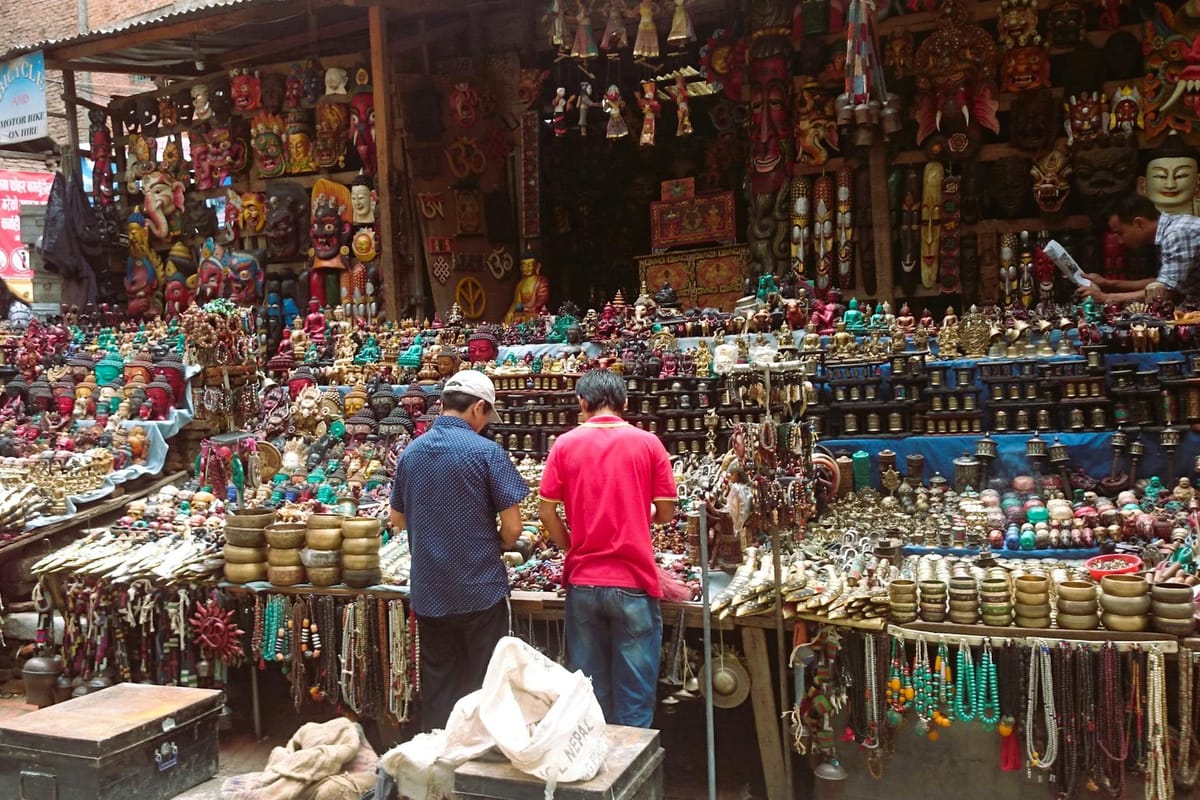
At seven in the morning the lanes of Thamel Kathmandu belong to delivery men, stray dogs, and the proprietors of the three hundred trekking outfitters sweeping dust off their plastic signs. By ten at night the same lanes belong to nobody in particular: a tide of Australians, Germans, Israelis, Koreans, one Nepali-American back for a month, and the rotating cast of men who will try to sell you hashish, a pashmina, a trek to Everest Base Camp, or the memory of any of these. This is the city's tourist quarter. It has been since the 1970s. Roughly eight blocks of overlapping lanes in north-central Kathmandu, wedged between the old royal palace and the ring road, and the single most photographed, most complained-about, and most misunderstood neighbourhood in the country. Locals do not live here. Locals do come here. What they come for is not what the visitor comes for, and the visitor rarely notices the difference.
Before It Was Thamel
Thamel was a residential Newar quarter. In the 1960s it was farmland bordered by courtyard houses, a few bahals, a handful of small temples, and a stream that now runs underground through a drain. The old trade route from the valley north into Tibet passed close by. So did the route west, towards Pokhara. When Kathmandu opened to foreigners in 1951, after a century of Rana isolation, the first hotels were not here. They were in Kantipath and Durbar Marg. Thamel was still quiet.
What changed it was not planning. It was the overland trail.
How the Hippies Made It
In 1964 the first Western backpackers arrived by bus from Delhi and Varanasi. By 1969 there was a Freak Street, an official one, in the old city near Basantapur. That was where the hippies stayed, smoked, and argued. Thamel was adjacent, cheaper, and had landlords willing to convert their ground floors into guesthouses. By 1975 the first dedicated trekking agency had opened, and by 1985 there were forty of them. The trekking industry is what made the quarter what it became. Everest Base Camp, Annapurna Circuit, Langtang: the trip starts here. It has started here for fifty years.
Then the mountaineering industry. Then the gear shops, which produced the long row selling jackets that claim to be North Face and are not. Then the pubs. Then the bakeries. Then the souvenir shops, the thanka galleries, the meditation retreats, the yoga studios, the cafés that serve a breakfast indistinguishable from Lisbon's, and the second-hand bookshops still stocking novels that have been in print since 1982.
Seven in the Morning

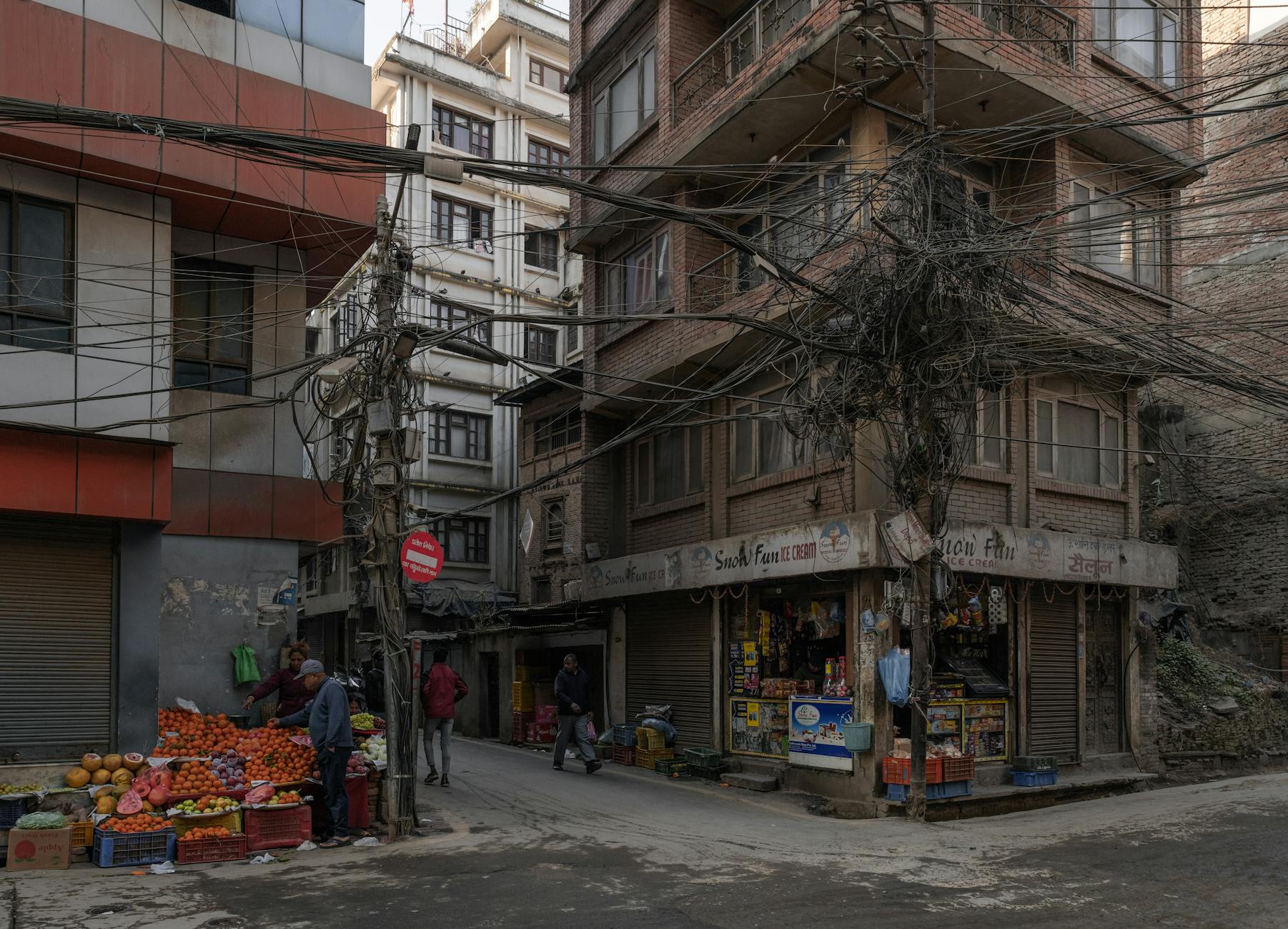
At seven the neighbourhood is quiet. A few runners pass through on their way to a longer route. Shopkeepers pull up their shutters slowly, looking tired. Porters with wicker baskets collect rubbish from the hotels. The lanes are narrow. Most are too narrow for two cars to pass. Cables hang low over the intersections in thick black loops. To see Thamel work, the hour to walk it is this one. After eight, the selling begins.
Ten at Night
By ten everything is different. The bars are full. A cover band is playing Hotel California at Purple Haze. Two streets over, a Nepali punk band is playing at the Irish Pub. The gear shops have stayed open because the Americans want a fleece before the flight to Lukla tomorrow. The cannabis smell is everywhere. One visitor wrote, "Plenty of ppl trying to scam you or sell ganja in Thamel... if someone is harassing you trying to sell you something, just ignore them and walk away." That is the most accurate instruction in any Kathmandu guidebook. Touts read willingness in a returned glance.
The patter has been the same for forty years, with minor updates. A recent Reddit visitor listed the script: "'Looking Something', 'Hash hash?', 'Tiger Balm', 'Trekking?', 'Where you from?'... touch your heart with your right hand and nod your head with a figure 8 and do not engage." The gesture works. It is the single most efficient move in the quarter's fifty-year playbook.
What Kathmanduites Actually Come Here For

Locals do come. Not for the trekking shops. Not for the pashmina racks that someone called on r/Nepal "a scam over all. Those pashmina shwal, yak wool, thanka, crystal, hemp products are all scams unless you know the quality. you will be better off buying in new road and asan." That person is right. Pashmina gets bought in Asan. Thamel is for specific things.
The wine shops. There are four of them, and they stock things no other neighbourhood stocks. A Maipokhari chardonnay from Ilam. A decent Argentine malbec. Two prosecco brands rather than the one the supermarkets carry. QFX Kumari Hall, on the edge of Thamel, shows festival films the multiplex will not. And one restaurant, which changes every eighteen months because the rent in the quarter kills restaurants and the good chefs move on. Currently it is a momo house on Jyatha, upstairs, where the buffalo momos are better than anywhere on the main drag. Before that, a Thai place off Chaksibari. The cycle is fast.
The Lights That Never Went Out
Until 2018, Kathmandu had rolling power cuts of up to eighteen hours a day. Thamel had a different arrangement. Every hotel, every restaurant, every bar ran a diesel generator. The soundtrack of the quarter at nine in the evening was a continuous low thrum from machines chained to alley walls and the metallic clang of attendants filling jerry cans. When the rest of the city was dark, Thamel glowed. That was the arrangement until Nepal resolved its power deficit by trading with India and commissioning the Upper Tamakoshi plant. The generators are quieter now, mostly. They come back on during monsoon faults.
The electrical logic has always been the same here. The quarter pays for what the quarter needs. What Kathmanduites wanted and could not get, Thamel acquired first.
"Thamel Is Gentrified. Horrible Place." And Also.
A frequent complaint on r/Nepal runs, "the only No advise I would give, don't stay in Thamel if you are looking to experience authentic city life... Thamel is gentrified, horrible place." The complaint is correct on its face and wrong underneath. Thamel is not gentrified in the San Francisco sense of the word - gentrification requires that someone who lived somewhere was pushed out by rising rents, and that is not what happened here. It is saturated with foreign-facing commerce, which is a different thing entirely. The city did not lose its residents to this quarter. They were gone by 1980, before the backpacker trail arrived, and what filled the space was never a neighbourhood in the residential sense. What the quarter became is a permanent foreign-facing strip, and the rest of Kathmandu has developed its own nightlife, its own dining, its own coffee scene, largely in parallel, in Jhamsikhel, in Baluwatar, in Naxal. Thamel does not compete with those neighbourhoods. It does not try to.
Another visitor asked whether Thamel shops quote negotiable or fixed prices, adding that "bargaining is high stress." Most shops quote bargainable. A few cafés and the larger gear outlets have moved to fixed pricing. If fixed prices matter, walk to Tridevi Marg. If they do not, the negotiation here is mild, and often good-humoured, once the seller realises no panic is on the table.
What Doubling the Arrivals Will Do to Thamel
Nepal's air connectivity is improving. A new Tribhuvan terminal is planned. Pokhara and Bhairahawa are operational. Tourism forecasts that were optimistic a decade ago now look conservative. If arrivals double in the next decade, Thamel Kathmandu will not double. It cannot. The physical footprint is fixed, the lanes cannot be widened, the buildings cannot go much higher under current regulations, and the neighbourhood already runs close to the capacity the infrastructure permits. What will happen instead is that the industry will spill sideways. Parts of Paknajol are already shifting. Jyatha has been gear-shop territory for a decade. Bhagwan Bahal is next.
The centre will get pricier and a little less chaotic. Whether that is good or bad depends on what a visitor came here for. "Thamel has enough tourists around that it should generally always be safe, but you will probably be harassed by tons of drug dealers," a user wrote in 2013. The first half of that observation has become more true. The second half has become less so. The quarter is only as visible as its most recent visitor wanted it to be. The rest of the city has been walking through it on its way to somewhere for fifty years.