Janakpur Dham: Nepal's Sacred City and the Birthplace of Sita


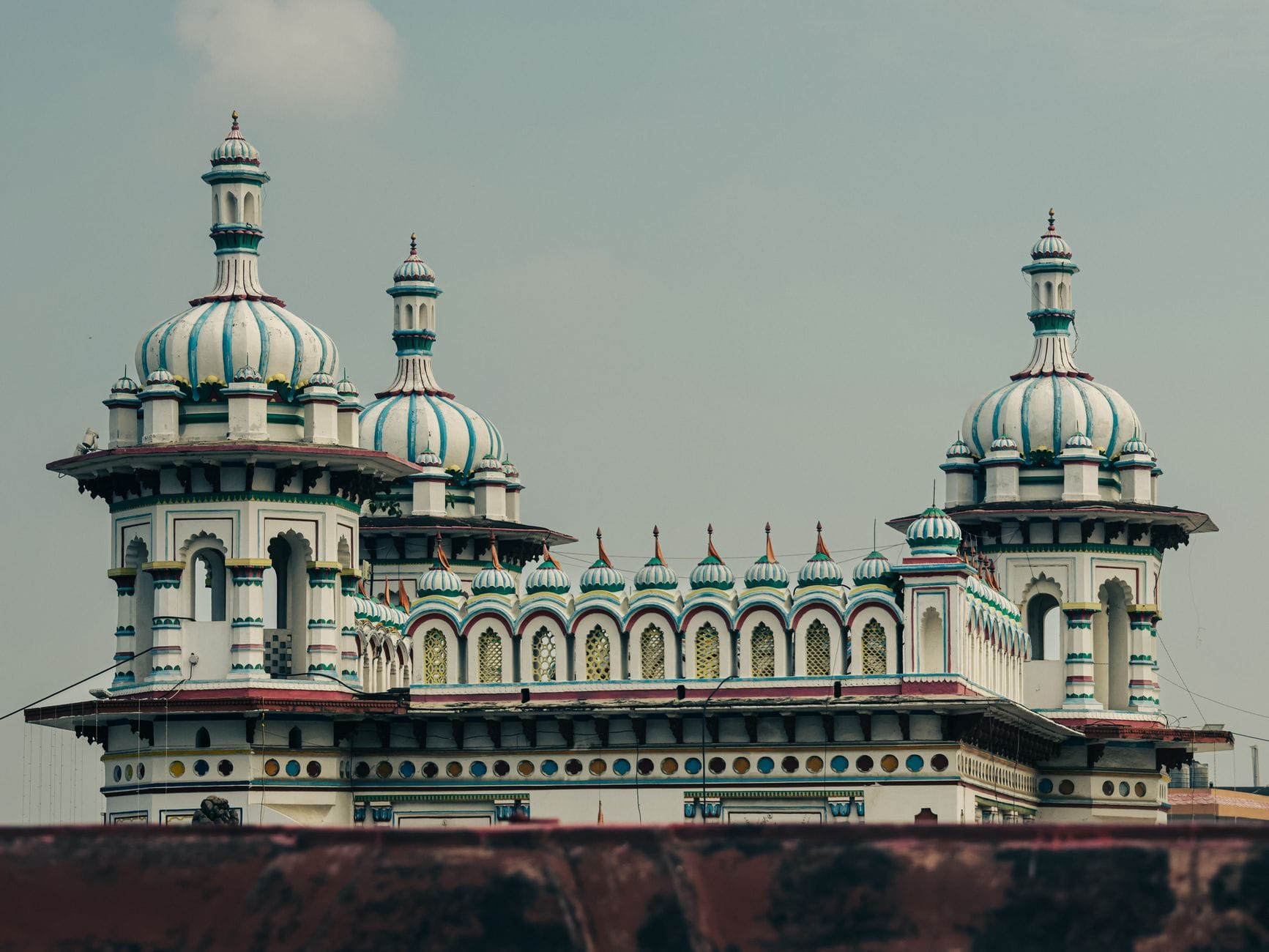
Janaki Mandir was completed in 1898. The builder was Rani Brisabhanu Kunwar of Tikamgarh, a princely state in what is now Madhya Pradesh. She built it in Janakpur, in what is now Nepal. The border drawn between the two countries in the decades that followed did not change what the site is: the place where, according to the Valmiki Ramayana, Sita was born and raised. The city grew around that claim.
Janakpur is Nepal's only Terai city with a skyline made of temples. The Janaki Mandir's domes are visible from the approach road, white and marble-faced, rising above a flat landscape of rice fields and brick buildings. The city holds around 160,000 people. Most speak Maithili as their first language. The nearest railway station is Jaynagar, across the border in Bihar.
Janaki Mandir: who built it and what it holds

The architecture is Koiri style: sometimes described as Indo-Aryan, with Mughal and Rajput elements woven into the marble cladding. Sixty rooms arranged around the central shrine. Ornate latticed windows. Dome-topped pillars on the exterior facade. The full complex has 116 carved rooms; a first visit without a guide means missing substantial sections.
Inside, the main shrine holds a murti of Sita that is dressed and adorned daily by temple priests. The morning puja begins at 4:30 AM. Pilgrims who arrive before dawn move through an interior lit by ghee lamps, flowers fresh on the altar, the smell of sandalwood and camphor before the day's heat sets in. By midmorning the compound is crowded. The experience is different at each hour.
The claim to Sita's birthplace is theological and literary rather than archaeological. The Ramayana places the event in Mithila, the ancient kingdom whose capital was in this region. The community has built around that placement for centuries. For the pilgrims who come here, the distinction between textual claim and verified site is immaterial.
The ghats and what happens on them
Janakpur has over 200 sacred ponds called kunds. Ganga Sagar, Dhanush Sagar, Ratna Sagar: each has a name, a mythological association, and a set of stone steps leading to the water. The ponds are not large. The steps are worn smooth by use.
What happens at the ghats is not ceremonial in the organised sense. People bathe. Priests sit at the top of the steps and perform rituals for pilgrims who want guidance. Flower offerings float on the surface. Men wash clothes on the lower steps; women bathe higher. Children run. The activity continues from before dawn to after dark.
No travel account of Janakpur describes the ghats in any practical detail. They appear in lists, as 200 sacred ponds, and no further. The reality is ordinary in the best sense: daily religious life conducted in public, with the efficiency of people who have been doing this for generations. The extraordinary version arrives during Vivah Panchami, when tens of thousands of pilgrims fill the steps simultaneously. The everyday version is there every morning, before the tour groups arrive.
Mithila painting as a living tradition
Mithila painting, also called Madhubani, originated in this region. The tradition predates the Janaki Mandir, predates the border, predates the formal division of Mithila into Nepali and Indian portions. The source materials are natural: soot, charcoal, turmeric, sandalwood, indigo. The subjects are mythological and domestic: Sita's wedding, fish as symbols of luck, the sun and moon flanking a deity, peacocks, the lotus pond.
The paintings appear on walls, on paper, on fabric, and in Janakpur on cycle-rickshaws. The Janakpur Women's Development Center employs forty women and produces work that reaches international markets. In the villages outside the city, Kuwa and Jaynagar, family artists teach the techniques in their homes to visitors who arrive specifically to learn them.
What distinguishes the Janakpur tradition from its Indian counterpart is that here the painting still lives primarily in homes rather than in workshops for export. The symbols carry local meaning: the lotus refers to the kund network, the fish appears on wedding walls. To understand what you are looking at, ask the person who painted it.
The cross-border character: Maithili language and the Bihar connection
Maithili is the fourth most-spoken language in Nepal and the primary language of Janakpur and the Madhesh province around it. It is also spoken by tens of millions of people in Bihar. The cultural geography of Mithila, the historical kingdom that included both sides of the current border, does not match the political line. This is covered in depth in this magazine's earlier piece on Janakpur's relationship with India. What concerns this article is what the geography makes visible on the ground.
Janakpur does not face Kathmandu. Signboards run in Maithili and Hindi as often as Nepali. The food shifts: aloo chokha (spiced mashed potato), kadhi (yoghurt curry), rice-heavy thalis with pickles and curd. The cycle-rickshaws display Ram-Sita imagery. Everything in the city is filtered through the Ramayana and the Maithili identity that claims it as its own geography.
Pilgrims arriving from India are not visitors from a foreign country in any cultural sense. The language, the food, the theological reference points are continuous across the border. The nearest railway connection is Jaynagar, twelve kilometres into Bihar, with services to Darbhanga and Patna.
Vivah Panchami and what the festival is
Vivah Panchami falls in November or December, on the fifth day of the bright fortnight in the Hindu month of Margashirsha. It marks the wedding of Ram and Sita. In Janakpur, this means a ceremonial procession re-enacting the Barat, the groom's party arriving symbolically from Ayodhya to Mithila. The Janaki Mandir is decorated with lights. Hundreds of thousands of pilgrims arrive from Nepal and India over the seven days of the festival.
For visitors not there during the festival: the absence of that crowd does not reduce the site. Janakpur's character is present every morning at the ghats and every afternoon in the bazaar. Vivah Panchami is the concentrated version of what is always there. Nepal's Festival Calendar on this site covers the full annual cycle including dates.
Getting there and moving around
Kathmandu to Janakpur: by air, 45 minutes on Buddha Air or Shree Airlines. By bus, 8 to 10 hours from Gongabu bus park on the Kathmandu-Terai highway. The road descends through the Terai; the landscape flattens and the heat rises as you go.
Within Janakpur, cycle-rickshaws cover most distances for 20 to 50 NPR. The Janaki Mandir, the main kunds, and the bazaar are within walking distance of each other in the city centre. Auto-rickshaws reach the art villages outside town.
Accommodation is limited at the upper end. Hotel Welcome is the only government-accredited property near the Mandir. Several guesthouses near the bus park offer basic rooms at 1,500 to 2,500 NPR. During Vivah Panchami, book weeks ahead.
FAQ
Why is Janakpur called the birthplace of Sita?
The Valmiki Ramayana places Sita's birth in Mithila, the ancient kingdom whose capital was in the Janakpur region. The city has held this claim for over a thousand years. The Janaki Mandir marks the traditional birthplace site. The identification is textual and devotional rather than archaeologically verified; for the pilgrims who come here, that distinction does not affect the site's meaning.
What is Vivah Panchami?
Vivah Panchami is the festival marking the wedding of Ram and Sita, observed on the fifth day of Margashirsha's bright fortnight. In Janakpur, it is the year's largest event, drawing pilgrims from across Nepal and India to the Janaki Mandir. See Nepal's Festival Calendar on this site for dates and the full annual cycle.