Langtang Valley: Walking Through the Scars of the Avalanche

It went pitch dark. The powder cloud blocked all light. Colin Haley, a climber on the trail near Langtang Valley on 25 April 2015, felt the wind blast lift him off the ground and throw him through the air. When he landed, the steel fence posts around him had been bent flat to the ground. Corrugated metal lay scattered across the slope. He survived. The village he had passed through hours before, Langtang, approximately 250 people, mostly Tamang families who had lived in that valley for generations, was gone.
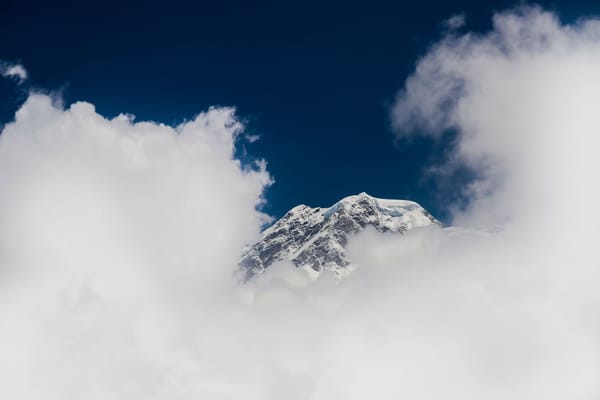
Langtang Lirung is the god of the place. In Tamang religious tradition, the yulha, the deity of a valley and its protector, lives in the mountain that defines the landscape. For the people of Langtang, that mountain was Langtang Lirung, at 7,234 metres the largest peak visible from the valley floor. The beyul, the hidden sacred refuge that Tibetan Buddhism understands Langtang to be, a place blessed by Padmasambhava and set aside from ordinary human history, was erased in seconds by the force of its own guardian.
The trek to Langtang Valley is, among other things, a walk toward that fact.
The Avalanche
The 7.8 magnitude earthquake on 25 April 2015 triggered a serac collapse from the slopes of Langtang Lirung. The ice mass, rock, and debris hit the village at a speed sufficient to demolish stone structures, bend metal, and carry wreckage hundreds of metres across the valley floor. Satellite data from NASA and ICIMOD later measured the landslide at approximately 3.72 square kilometres of coverage. The sequence, from collapse to burial, took seconds.
Most of the 243 identified victims had no time to move. More than 100 additional people were never recovered at all.
Gualboo and Lopsang, two Nepali climbers on route above the valley when the earthquake struck, learned that their village had been destroyed while still on the mountain. They wailed. Their daughters, who were with them, burst into tears. That is what it sounds like when you are told that the place you are from no longer exists.
Among the dead: 150 Nepalis, approximately 50 foreign trekkers and climbers, and an unknown number of people in transit. The original Langtang village, the stone-and-timber settlement at the valley head, built over generations at 3,430 metres, is still there in the sense that it is still beneath the debris field. The debris field has not been excavated.
It is not ruins. It is a burial site.
What the Trail Shows You Now
The walk from Syabrubesi into the upper Langtang Valley takes two to three days on a trail that is now in better condition than before 2015. Reconstruction brought path improvements alongside the guesthouses. In the first six months of 2025, the Langtang-Gosaikunda area received over 42,000 trekkers. The route has recovered in the metrics that trekking routes use to measure recovery.
What the trail shows you, approaching the valley head, is the debris field before you fully understand what you are looking at. The scale is the problem. Rocks the size of rooms are compressed into the slope. Some of them bear patches of colour, old plaster, painted surface, building material that is now rubble and that was, ten years ago, someone's wall. It takes a moment for the colours to register as what they are.
The village is underneath. Not buried in a metaphorical sense: physically underneath, unreachable, unexcavated. Most trekking accounts describe this section in a sentence and move on to the memorial. Walk through it slowly. These boulders are not geological. They are architectural.
The Tamang people who lived here were primarily herders and subsistence farmers who had occupied the valley for centuries, largely outside the trekking economy. The earthquake and avalanche did not just destroy buildings. It interrupted a way of life that had no written continuity plan. What returned was shaped by the aid economy that funded the rebuilding: concrete, guesthouses, the infrastructure of tourism rather than the infrastructure of herding.
The New Village
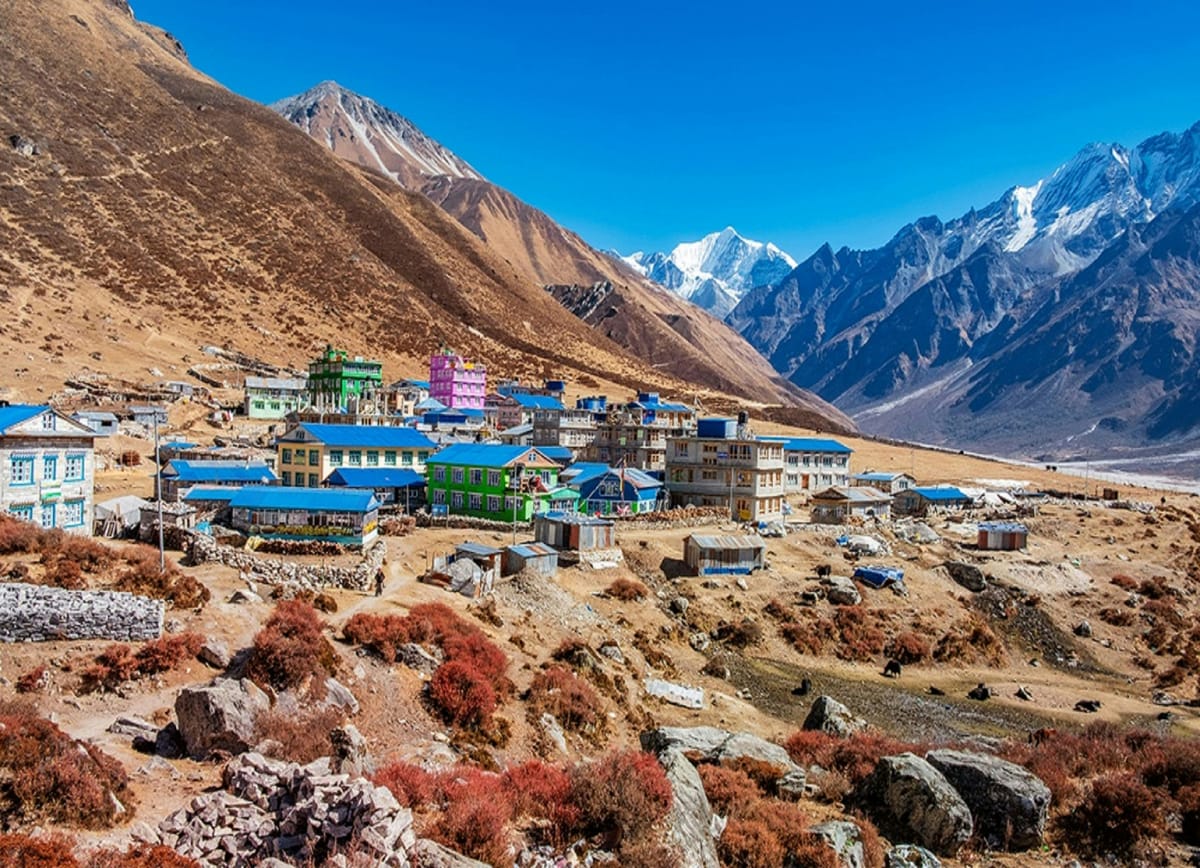
New Langtang village sits approximately 200 metres from the debris field. It is concrete: two and three-storey buildings in a grid, replacing the stone-and-timber settlement that was buried. The reconstruction was rapid by international standards. The result is a functional village that looks nothing like what was there before.
Nima Chhiring Tamang, a survivor who returned to the valley, said in 2025: 'Everyone here only cares about money and hotels now. There's lots of competition for tourists. Before life was simple, and there was peace.' On why he stayed: 'It's our motherland, we have to respect that.'
Lhakpa Tamang, secretary of the reconstruction committee: 'With business, jealousy comes. Who's gonna do better? Who is gonna earn more?' And on the direction of things: 'Our grandmothers made us clothes with yak wool. Life was happier before, but this is the way of life now. When you need to go forward and develop, going back is not possible.'
Nurchung Tamang, who runs a guesthouse in New Langtang, survived the earthquake because he was in Kathmandu when it struck. 'We had no money in Kathmandu, so we stayed at the monastery with the monks.' He returned to build. His is the story the reconstruction numbers do not capture: what it took to come back to a valley that no longer looked like home, and build something in concrete where stone used to be.
Fewer than half of the original families returned. The healthcare facility that served the original village has not been rebuilt. Trekkers who need medical attention in the upper valley must descend to Syabrubesi or be evacuated by helicopter.
The Memorial
The memorial is a mani wall of stacked stones, each etched with Buddhist mantras. Plaques list 243 names, the identified victims. Strings of prayer flags are strung across the approach. Yaks graze on the grass nearby. The setting is what the valley has always had: mountain, light, the particular quality of air at this altitude. The memorial does not compete with any of that.
What it does not contain is the more than 100 victims who could not be identified. There are no plaques for them. The mountain absorbed them completely.
On Walking Through
Every trekker who reads anything about Langtang before arriving asks some version of the same thing: is it appropriate to walk through a mass grave?
The people who rebuilt the valley have answered this by returning. They reopened the guesthouses. They need the trekking economy to function. Whether this settles the question depends on what the question actually is.
The Tamang families who stayed have a connection to this ground that existed before 2015 and continues past it. Their reason for being in the valley is not the same as a trekker's reason. That difference is not an argument against going. It is context for how to be when you arrive.
Before You Go
The trek requires a TIMS card and a Langtang National Park entry permit, available at the Dhunche checkpoint or in advance in Kathmandu. Permit cost: NPR 3,000 for SAARC nationals, NPR 5,000 for all others. Since February 2025, a registered guide is mandatory for the Langtang region. Solo trekking is not currently permitted.
The standard route from Syabrubesi to Kyanjin Gompa is four to five days one way. Altitude at Kyanjin Gompa is 3,870 metres. The elevation gain is gradual and the trails are well-maintained. The extension to Tserko Ri at 4,984 metres requires reasonable fitness. Altitude sickness is a real risk for trekkers ascending quickly from Kathmandu.
Best season: October and November for clear skies. March through May for warmer conditions and rhododendrons in the lower valley. April is quieter than October. It is also the anniversary month.
Frequently Asked Questions
What happened to Langtang Valley in the 2015 Nepal earthquake?
The 7.8 magnitude earthquake triggered a serac collapse from Langtang Lirung. Ice and rock debris buried Langtang village completely under a landslide measuring approximately 3.72 square kilometres. More than 350 people died in the immediate area; over 100 were never identified.
How many people died in the Langtang Valley avalanche?
At least 243 victims were identified and named on the memorial wall. More than 100 additional people were never recovered. The dead included approximately 150 Nepalis and around 50 foreign nationals.
Is Langtang Valley safe to trek now?
Yes. The trail has been restored and carries over 42,000 trekkers annually. The 2015 event was a specific seismic occurrence. Normal precautions apply: altitude awareness, weather, permits. The debris field is stable and is not an active hazard.
Do I need a guide for Langtang?
Yes, as of February 2025. A registered guide is mandatory for the Langtang region. Trekking independently without one is not currently permitted.
Was Langtang Village rebuilt after the earthquake?
A new village was built approximately 200 metres from the original site. It is concrete construction and looks nothing like the stone-and-timber settlement that was destroyed. Fewer than half of the original families returned.
How long does it take to walk to New Langtang village?
From Syabrubesi, the standard approach is two to three days. From the Langtang Valley trekker checkpost, the debris field and memorial are a further 30 to 45 minutes on foot.
How hard is the Langtang Valley trek?
Moderate. The elevation gain is gradual, the trails are well-maintained, and Kyanjin Gompa at 3,870 metres is manageable for most trekkers who ascend at a reasonable pace. The hardest part for most people is not physical.