Rural Nepal: What Life Looks Like Between the Mountains and the Maps
Most of Nepal lives in villages not on any trekking route. What rural life in the middle hills, the Terai borderlands, and the remote west looks like and what the distance from Kathmandu means in practice.

The pump is there.
It was installed in 2018, when an international development organisation ran a water access programme across four hill districts of Dhading. Two men from the village were trained on the maintenance schedule. Both were in Qatar by the following spring. The pump has not worked in four years. The women carry water from the stream.
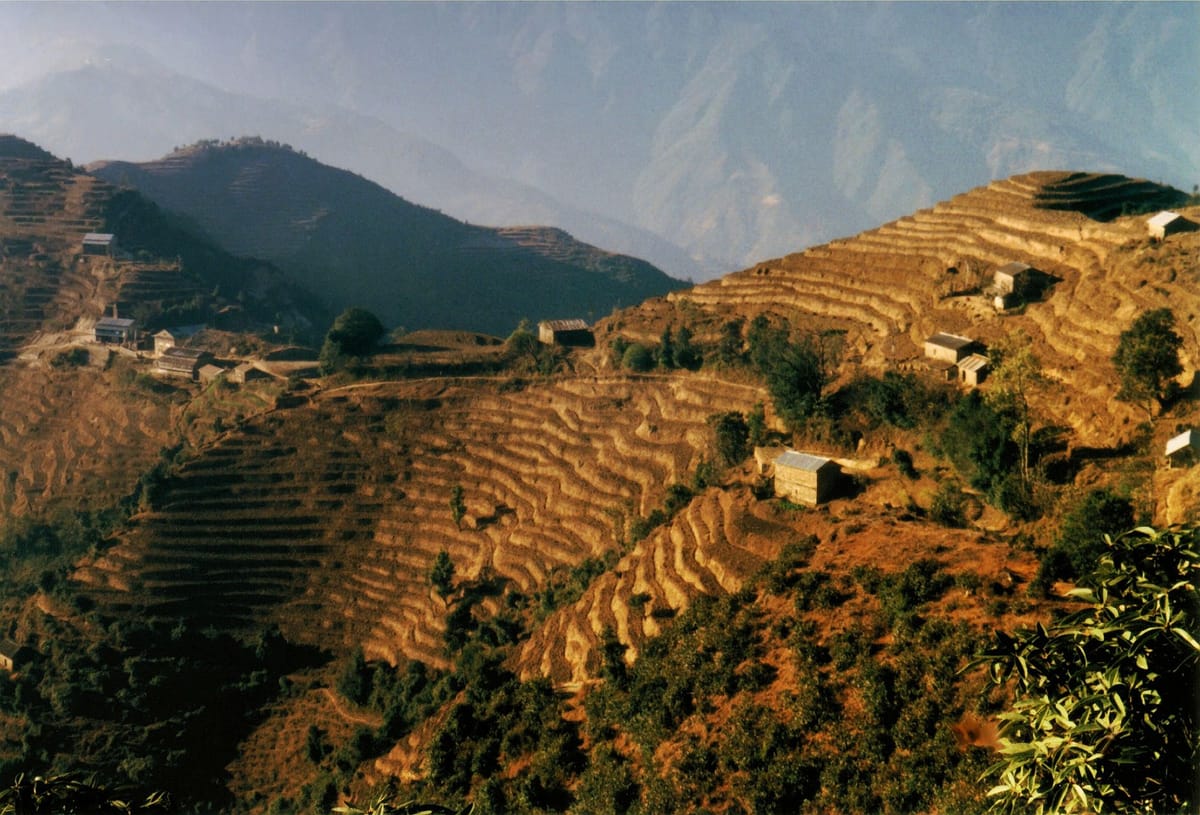
This is what the mid-hills look like. Not the terraced hillsides in the tourism photograph, shot in October when the rice is golden and everyone is in the fields. The rice is golden for six weeks. The rest of the year is harder.
The calendar
Nepal's agricultural year runs on the monsoon. In June, the first rains arrive and the paddies are flooded. Seedlings are transplanted through July and August, which means every adult body in a farming household is in the field, bent, planting, moving through water that can be knee-deep in the lower terraces. By September the grain is forming. By October it is ready.
The harvest runs from early October through November. Rice, millet, and maize all come in at the same time. In the mid-hills, a household farming half a bigha of rice will spend between three and four weeks doing almost nothing else. After the rice, the winter crops, wheat, mustard, and barley, are sown. By March, those are ready. By late April, they come in.
There is no slack month. The winter gap, roughly December through February, is the closest thing to rest the calendar offers. This is when people repair terraces, when the men who are leaving for the Gulf do their paperwork, when weddings are held.
October and March
In Sindhupalchok district, school registers tell a predictable story. Attendance in March is the highest it will be all year. The wheat is not yet ready; the rice has been done for four months. There is no competing claim on a child's hands.
In October, attendance falls. Not to zero. The schools stay open. But the numbers thin out in ways the register captures and the school does not mention. A twelve-year-old who can carry a doko can free an adult for a different task. In a household farming a steep terrace with no flat land for mechanisation, this matters. The child is not keeping a secret. The trade-off is obvious to everyone involved.
Nepal's primary education data shows that 59 percent of children who enrolled in grade 1 in 2016 did not complete the pipeline to the Secondary Education Examination a decade later. The dropout is not evenly distributed. It is heaviest in the districts where agriculture still requires children.
The health post
Most villages above 1,500 metres in the mid-hills have a health post. The building exists, the government roster shows a nurse assigned to it, and on most days someone is there.
The nurse sees patients for common conditions. Respiratory infections, wound dressing, diarrhoea cases with the supplies she has. What she cannot do is manage a complicated delivery, a cardiac event, or a fracture that needs imaging. For these, the nearest district hospital is a three-hour walk to the road, and then a bus.
Nepal has one nurse for roughly every 4,987 people. Seventy-four percent of nurse positions are filled nationally. In remote postings, the fill rate is lower. The positions exist on paper, and the paper is in Kathmandu.
The women in the village know this. When they are due in late October or early November, during harvest season, they walk out to the road two weeks before. They wait at a relative's house in the market town. They walk back when the child is four days old. This is the system working.
The actual economy
Remittances are 33 percent of Nepal's GDP. This number understates the household reality. For smallholder farm families in the mid-hills and the mountains, remittance income accounts for 80 percent of household earnings. The farm produces food. The farm does not produce school fees, cooking gas, medicine, or the cost of the walk to the road.
In 2023, 3.6 million Nepalis sent money home from abroad, up from fewer than 500,000 in 1996. The men are in Qatar, Malaysia, Saudi Arabia, the UAE. The village knows which countries pay best and which contractors can be trusted. This information travels faster than any official advice.
What the village looks like when the men are in Malaysia: mostly women. Older men who are past the age the agencies will take. Children. The farm work continues because it has to.
The ones who run everything
Ask who decides when the crops are planted, who negotiates the price when a merchant comes to buy grain, who manages the household cash when the remittance arrives. The answer is the same. The women who stayed.
They are not celebrated for this. The framing of rural Nepal in most writing is agricultural poverty plus natural beauty plus the occasional festival. The women who run the village economy, who make decisions daily about land, water, children, and money, appear in these framings as context.
They do not appear as decision-makers. They are not interviewed by development researchers who arrive in October, photograph the harvest, and leave before the rice is stored.
One woman in Kavrepalanchok, interviewed in 2019 by a Nepali journalist, described managing the household remittance for seven years while her husband was in Doha. She had renegotiated the family's water-sharing arrangement with a neighbouring household, paid off the seed loan they had taken in 2015, and decided to pull her youngest daughter from the boarding school in Kathmandu when the fees increased. Her husband came home in 2021. He was asked by the researcher what decisions he had made about the land.
He described the same decisions she had made.
This is also what the mid-hills look like. The women running it. The accounting done in someone else's name.