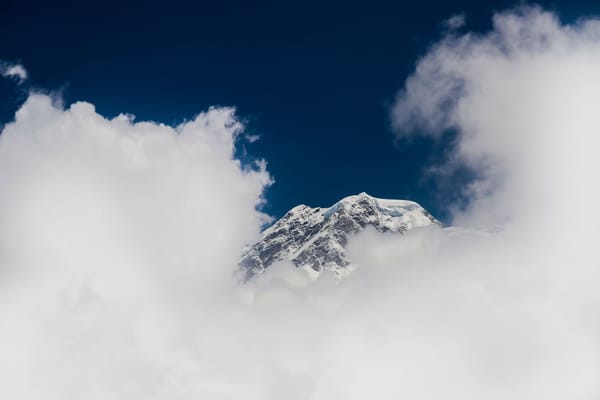
Rhododendron Season in Nepal: The Bloom Nobody Talks About
Between February and April, Nepal's hillsides turn red and pink across 30 species of rhododendron. The altitude range is 2,000 to 4,000 metres and the blooms move upward as the season progresses.

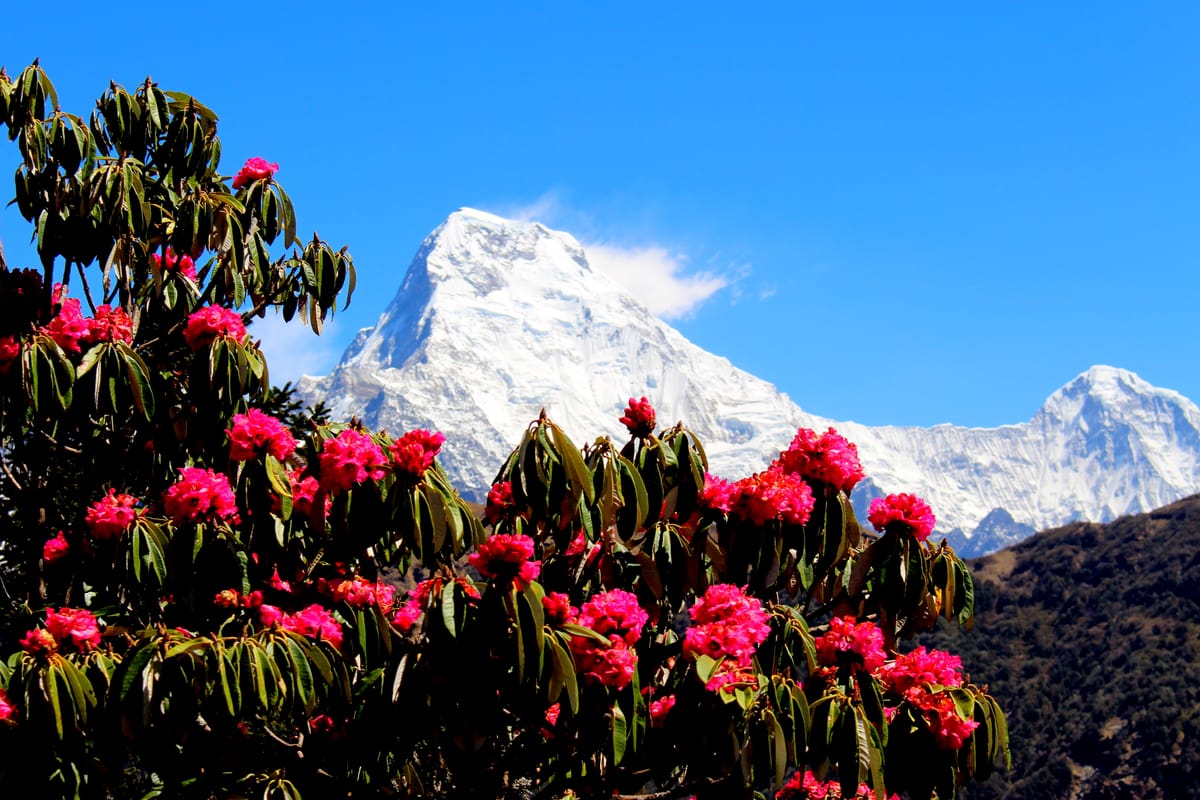
The bloom starts in February at the lower elevations and it is still going in May above 4,000 metres. Nepal has more than thirty rhododendron species distributed across an altitudinal range that few countries can match, and the result is a flowering season that is, in practical terms, three months long if you know where to look.
Most people who come to Nepal for rhododendrons come to the Annapurna Circuit in April. The circuit is beautiful in April and the rhododendrons are everywhere. It is also crowded in April, and the rhododendrons on the Annapurna Circuit have been photographed several hundred thousand times. There are other places.
The species and the sequence
Rhododendron arboreum is the national flower of Nepal. It grows from around 1,500 to 3,500 metres and it blooms red in February and March at the lower end of its range, transitioning to pink and white at the upper elevations where it blooms later. The arboreum is a tree, not a shrub, and in the middle hills it reaches ten metres or more. Walking under an arboreum forest in full bloom is walking through a canopy of red.
Above the arboreum zone, Rhododendron campanulatum takes over. Campanulatum is a shrub that grows at 3,000 to 4,500 metres and blooms white to pale purple in April and May. Its flowering at the upper end coincides with the period when most of the Annapurna Circuit trekkers have gone home, and the high passes between the valley communities in the eastern ranges are mostly empty.
Between these two extremes there are species that bloom yellow, species that bloom pink, species that bloom in shades that require very specific lighting conditions to properly resolve. Rhododendron barbatum, with its distinctive bark, is one of the most architecturally striking of the mid-elevation species. The exact sequence varies by year and by location. A botanist would tell you to consult elevation maps and recent temperature records before committing to dates. That advice is correct. The bloom is not a fixed event.
Where to go that is not the Annapurna Circuit
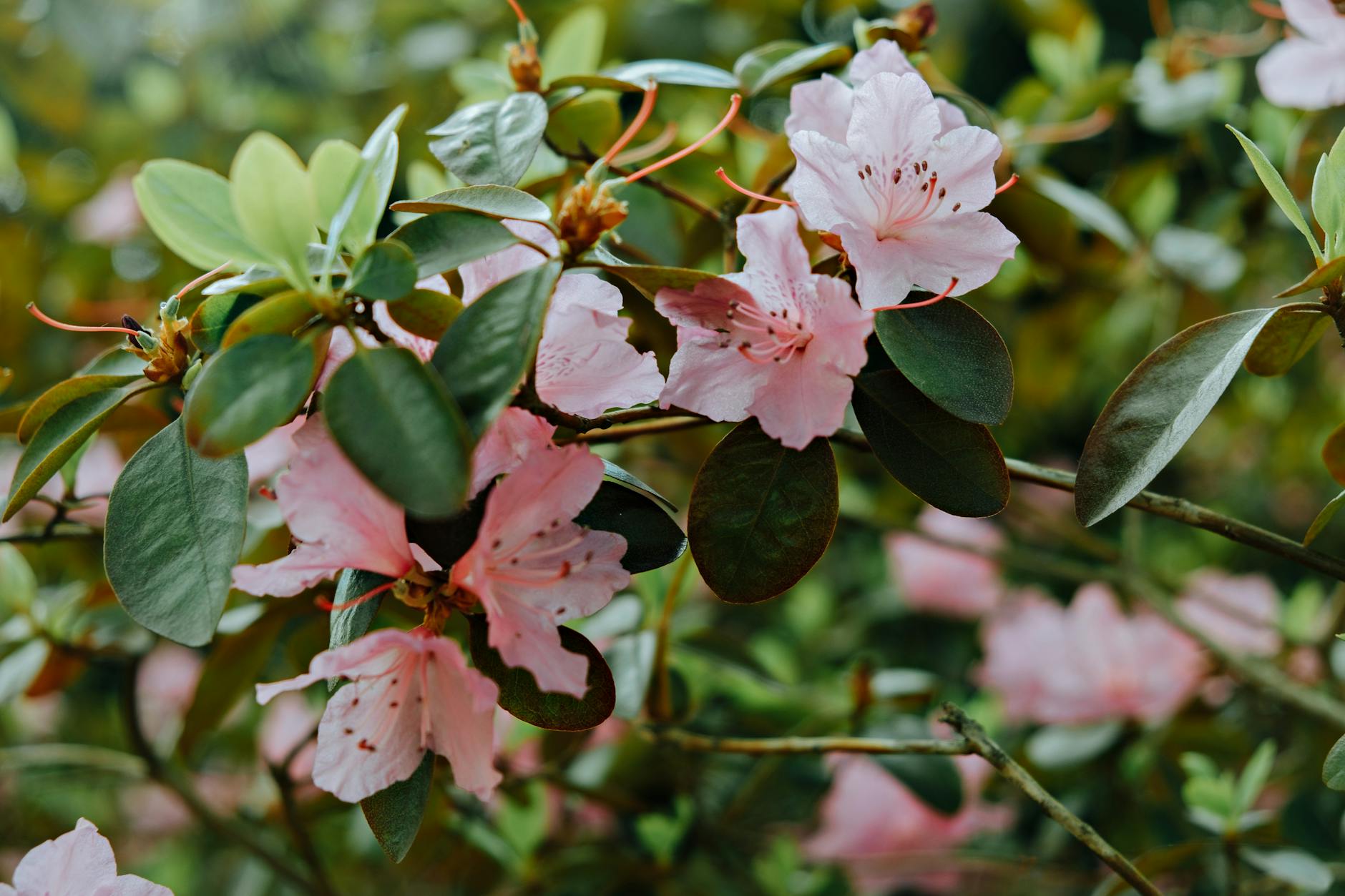
The Milke Danda ridge in eastern Nepal runs along a crest at around 3,000 to 3,500 metres and is covered in rhododendron forest that few western trekkers have walked through. The approach is from Taplejung or Chainpur. The trail is less developed than the major circuits. The scenery, when the rhododendrons are in bloom and the Kanchenjunga massif is visible to the north, is as good as anything on the Annapurna Circuit and is shared with a fraction of the people.
The Pikey Peak trail in the Solu-Khumbu region south of Lukla passes through forest at around 3,500 metres that is dense with rhododendrons and offers views of Everest, Cho Oyu, Makalu, and Kanchenjunga on clear days. The trail is short by Himalayan standards, completable in three to four days from the nearest road. The bloom there peaks in April.
The Helambu circuit north of Kathmandu passes through rhododendron and oak forest at elevations between 2,000 and 3,500 metres. It is accessible without a domestic flight. In late March and early April the arboreum is in full bloom and the trail is, by the standards of the major circuits, uncrowded.
The Ghorepani route done properly
The Ghorepani-Poon Hill circuit is the one most people mean when they say they went for rhododendrons in Nepal. It deserves more credit than the crowds suggest, and less than the photographs give it.
The rhododendron experience on this route is not at Poon Hill. It is on the climb from Ulleri to Ghorepani, which gains around 900 metres through dense arboreum and mixed rhododendron-oak forest. Ghorepani sits at 2,874 metres. Ulleri is below 2,000. The vertical between them passes through the core of the arboreum's range, and if you walk it in the morning the light comes in from the east through the canopy at an angle that is more useful for looking at rhododendrons than any summit viewpoint.
The Poon Hill viewpoint itself is at 3,210 metres and the rhododendrons thin out above the village. What you get there are mountain views with rhododendrons in the foreground of photographs. What you get on the climb is forest.
If you want to continue beyond the viewpoint, the route east from Ghorepani through Tadapani and down to Ghandruk passes through rhododendron-bamboo forest at 2,000 to 2,500 metres that sees considerably less traffic than the Poon Hill summit before dawn. The descent from Tadapani to Ghandruk, in most spring weeks, is quieter than anything on the popular circuit. The rhododendrons are the same species. The crowd is not.
The Kanchenjunga Conservation Area
The far eastern corner of Nepal, which faces Sikkim, holds twenty-three documented rhododendron species within the Kanchenjunga Conservation Area alone. That number tells you something about the east-west gradient of rhododendron diversity across the country. The eastern ranges, closer to the Himalayan biodiversity belt that extends through Sikkim and into Bhutan, support a wider range of species than the central and western hills. The forest in this restricted zone receives a fraction of the visitors that the Everest and Annapurna areas handle in a single spring week. The rhododendron stands here are not under the same pressure from foot traffic or fuel collection.
A special trekking permit is required. The approach is from Taplejung, which means a domestic flight. The routes to the northern and southern base camps pass through valley systems that most people who spend years trekking in Nepal have never walked. It is the right reason to go to a place.
From the Ilam side, the most direct route into the rhododendron zone is upward from the tea gardens. The estates sit at 1,200 to 1,800 metres. The forest above them transitions to rhododendron-oak at 2,000 metres and enters full arboreum territory as you gain elevation toward the ridges that face Sikkim. The Sandakpur ridge, at around 3,600 metres, runs along the Nepal-India border and carries some of the clearest views of the Kanchenjunga massif from any trail in eastern Nepal. In March and early April the descent from Sandakpur back through the arboreum zone is a passage through red canopy that the more photographed routes in the western circuits rarely match for density. Most people who walk it are from Ilam or the surrounding hills, not from the trekking market.
What the forest sounds like
The birds that feed on rhododendron nectar in Nepal include several sunbird species and the Himalayan bulbul. In the arboreum forest in February and March, when very little else is in bloom at that elevation, the trees concentrate the birds in a way that makes the forest unusually audible. You hear the forest before you see what is making the sound.
The crimson sunbird and the fire-tailed sunbird visit the lower-elevation blooms. As you gain elevation and the species change, the bird community shifts to match. The laughing thrush species that inhabit the higher rhododendron-oak mixed zone are audible but not always visible. You hear a forest that sounds like several conversations happening at once.
How to photograph them
The technical problem with photographing rhododendrons is the same as with any deep red flower in strong light. The camera underexposes the shadows to control the highlights, and the crimson comes out brown.
Overcast light solves it. A thin cloud cover, common enough in April mornings in the rhododendron belt, diffuses the contrast and lets the colours read without blown petals or crushed shadows. Direct sun through forest canopy is harder than most people expect before they try it.
Morning is better than afternoon for a second reason. The air at rhododendron altitude in April builds dust and haze by midday. What the eye reads as acceptable registers in photographs taken after noon as visible grey, particularly in the valley views between ridges.
The condition most photographers want and cannot plan for is mist moving through the rhododendron canopy in early morning. It occurs without schedule. At 2,500 to 3,000 metres in spring, cold air drains into the valleys overnight and the warming of the morning generates mist that rises through the forest before burning off. If it is there when you are there, stop walking and stay in it. That is the advice. Start early enough to be in the forest before the sun is high, carry patience, and accept that the best conditions will come on a morning that did not announce itself the night before.
The ethnobotany
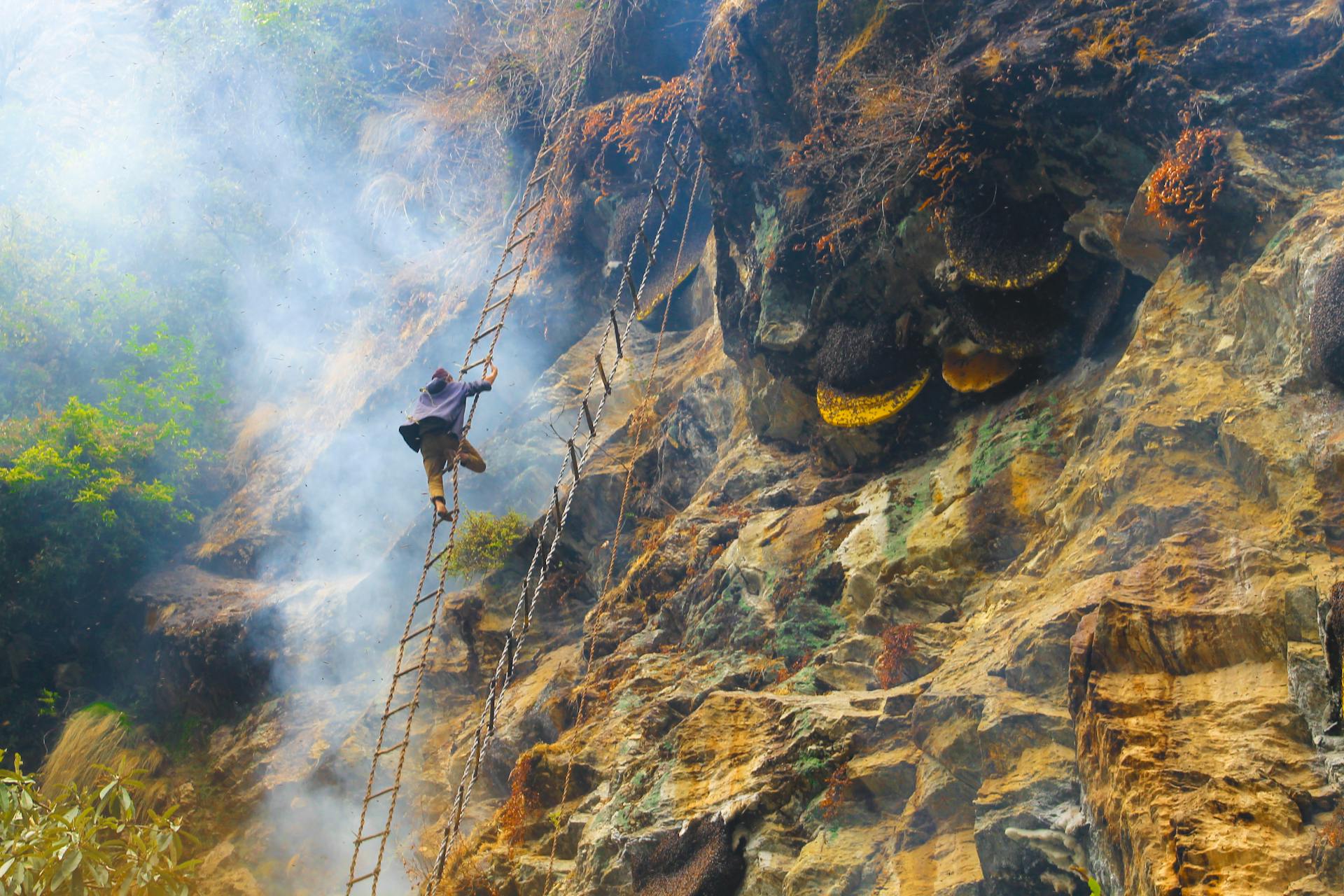
Some rhododendron species produce honey that is toxic to humans. Rhododendron ponticum is the species most associated with this in other parts of the world, but in Nepal the honey produced from Rhododendron luteum and related species contains grayanotoxins. The honey is called mad honey in the limited literature that discusses it in English. It is found in certain parts of Gurung territory in the Annapurna region and in the Kulung Rai communities of eastern Nepal. Its effects at low doses are described by those who consume it as mild intoxication. At higher doses the toxicity is more serious.
The flowers of Rhododendron arboreum are eaten in the middle hills. They are cooked with other ingredients and consumed as a seasonal food rather than a staple. The taste is described as mildly sour. The practice is regionally specific and not uniform across all communities that live within the arboreum's range.
What is changing
The rhododendron bloom in Nepal is shifting. Warmer springs have pushed the arboreum bloom earlier at the lower elevations by, in some monitored sites, two to three weeks over the past three decades. The pollinators that have co-evolved with these species are, in some cases, not shifting at the same rate or in the same direction. The relationship between bloom timing and pollinator activity is one of the more significant ecological questions in Nepal's mountain regions and it is mostly being studied by a small number of researchers without the resources the question deserves.
The bloom is not disappearing. The forest is not gone. The situation is more complicated and slower-moving than either the alarming version or the dismissive version would suggest. What I can say from observation across fifteen years is that the timing I knew as a child in the Ilam hills, when the arboreum came into full red along the tea-garden ridges in the last week of February, is not the timing I observe now. The ridge is already past peak bloom by the time I used to expect to see it begin.
Go to the Milke Danda in April. Go to Helambu in late March. Do not take photographs that assume the timing will be what it was ten years ago. Check local conditions. Talk to the people who live where you are going. They know when the bloom happens now.