Pashupatinath: What Happens at the Ghats After the Tourists Leave
Pashupatinath charges non-Hindus a thousand rupees to stand on one bank and watch the cremations from behind a fence. What happens on the other side of that arrangement is more complicated.

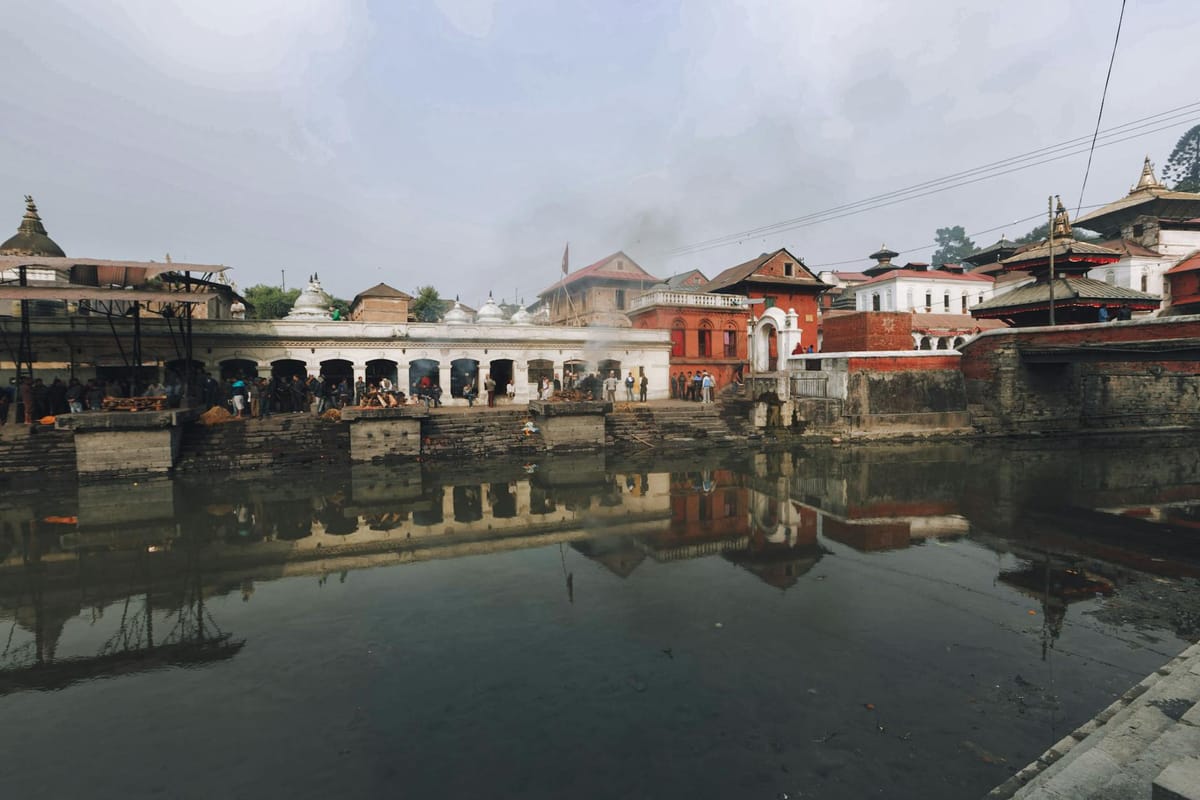
The Pashupatinath Temple Kathmandu keeps working while you watch. That is the first thing to understand about the site. It is not a monument, not a museum, not a tableau arranged for a viewing terrace. It is a functioning temple, a functioning cremation ground, a functioning monastery, and the theological centre of Nepali Hinduism, all on a single riverbank, all at once. Tourists cluster on the west side of the Bagmati, above the ghats, cameras lowered or raised depending on the moment. Across the water, families are performing the last rites they have performed in this family for generations. Priests chant. Smoke rises. The river moves slowly south, carrying ash and marigolds and the same water it has carried for millennia. One observer writing after visiting wrote that watching the cremations "offered a unique perspective on the Hindu philosophy of life, death, and rebirth." She is right, and the word perspective is exact. The site is not a show. It is a country's relationship with mortality, staged without apology on the stone steps of a river.
The Tourist Frame and What It Leaves Out
The usual tourist itinerary is narrow. Enter the outer complex through the west gate, walk to the viewing terrace on the west bank of the Bagmati, watch one or two cremations from a distance, walk back, buy a Shiva medallion from a stall, leave. The round trip takes ninety minutes. What gets missed is most of the site.
Pashupatinath occupies 246 hectares. It contains 518 separate temples and monuments. The main temple is one building among many. The cremation ghats are one activity among many. A visitor who stays for only the cremations has seen a single function of a complex that also houses sadhus, priests, Shiva lingams by the hundred, a Nandi statue the size of a small house, the shrine of Guhyeshwari on the downstream side, and the quieter upstream temples that most guides do not point out. The site has operated at something like this scale since at least the fifth century CE.
Some visitors absorb the spectacle and leave moved. Others leave unsettled. One traveller wrote, after watching the processions, that they had "watched families process through crowded streets carrying their loved ones' bodies openly overhead... celebrating the Ganga Aarti at sunset with thousands. Such a powerful way to remember the end is always present and to be celebrated, not hidden." Others are less persuaded. One user wrote, bluntly, that "if you like burning human flesh smell, it's nice... it smells like barbecued pork from what I hear." That reaction is also common. Honest, even. The site is not for everyone. The site does not claim to be.
The River
The Bagmati is a small river. It rises above Sundarijal, runs through the Kathmandu valley, and flows south through the Terai to join the Ganges in Bihar. By the time it reaches Pashupatinath it has already passed through the most densely settled stretch of the valley and picked up most of the city's sewage. The ghats sit on water that is brown, that carries visible debris, that in the dry season runs in a single central channel with exposed banks on either side. It is also the sacred river. One writer observing at the ghats noted, "This river is considered most holy and Nepali people consider auspicious to cremate their dead people on ghats of Bagmati's to attain nirvana." Both facts are true at the same time. The river is worshipped and poisoned by the same people.
A decade-long cleanup effort has been under way since 2013, mostly volunteer-driven, with occasional state support. On Saturday mornings, volunteers collect plastic from the riverbed. Upstream sewage lines have been partially diverted. The water is marginally better than it was. It is not yet water anyone would drink without consequence. The cremation continues anyway. The grieving do not wait for the river to be clean.
Arya Ghat and Bhasmeshwar Ghat
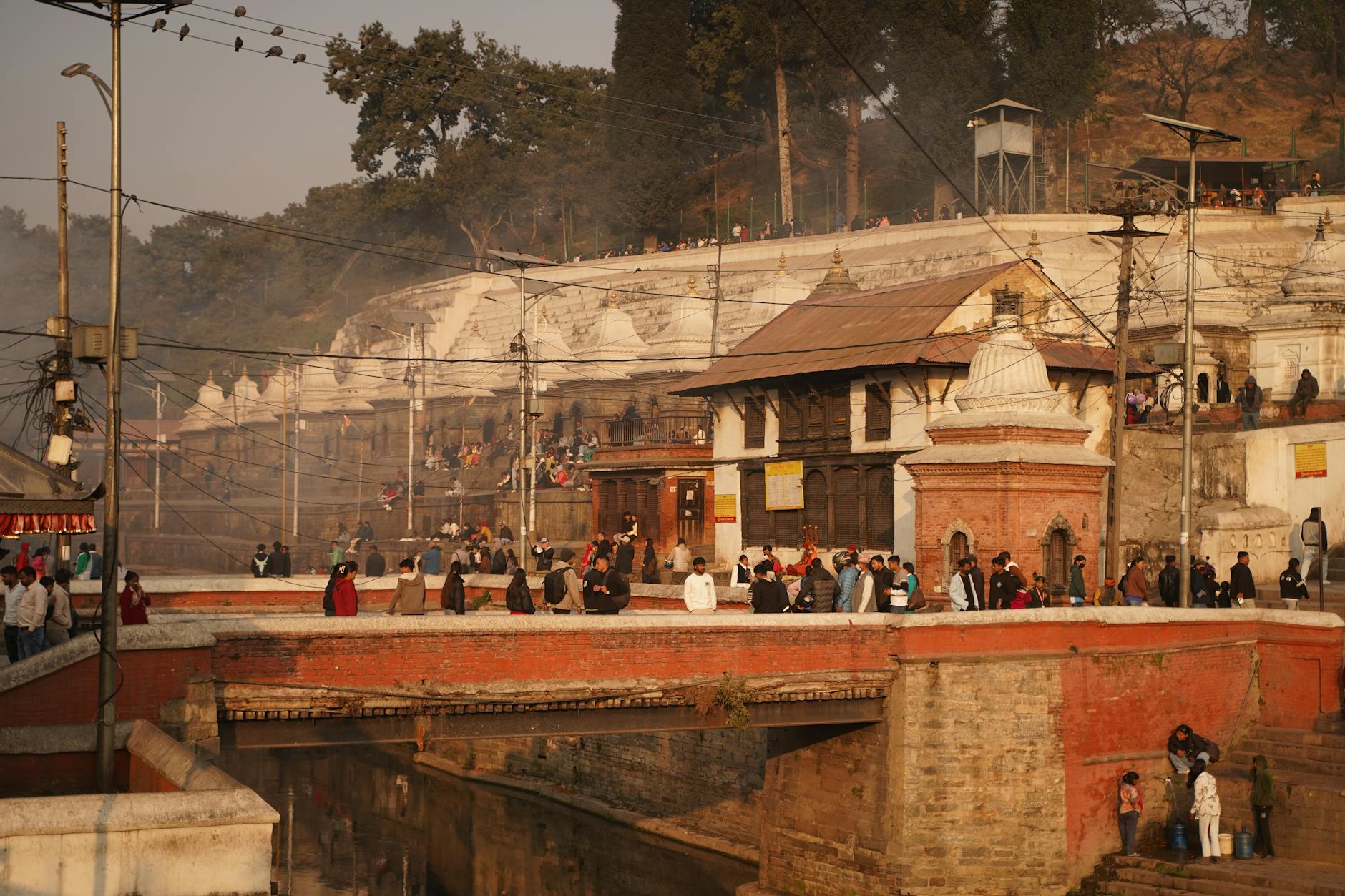
The ghats are not interchangeable. Arya Ghat, the northernmost, is traditionally reserved for royalty and high-caste Hindus, and, in the modern state, for those who have served in senior positions of government or the military. Bhasmeshwar Ghat, downstream, is for common use. The fire on Arya Ghat is the fire that cremated the last king. The fires on Bhasmeshwar Ghat are most of the fires that burn at the site. Each has its own priests, its own protocols, its own fee structure.
The cremation itself takes roughly three to four hours. A heritage writer described the visual: "The body is covered with wet straw from the holy river, producing thick white plumes that curl upward into the night." That is the night cremations. The day cremations produce the same smoke in grey instead of white, which is partly a matter of light, partly a matter of the dryness of the wood, partly a matter of how long the body has been wrapped. The body is washed in the Bagmati. Feet are placed in the river. Fire is lit from the mouth. The order matters.
Pashupatinath's Sadhus Are Not Performing
The sadhus at Pashupatinath are often photographed. Some of them are paid, openly, for the photograph. Some of them are serious ascetics. Some of them are seasonal, arriving for Shivaratri and leaving after. Some of them are neither, which is also a category. What none of them are is decoration.
The practice of abandoning household life, wearing ochre, ash, or nothing at all, travelling between the major Shiva shrines on foot, smoking ganja in small clay chillums, and living on the donations of householders, is a continuous tradition older than the Nepali state. The sadhus who occupy the caves on the hillside above the river have been doing what they do since before the temple was rebuilt in its current form in 1692. A tourist photograph of a sadhu tells you nothing about the man, but it tells you something about the complex: the complex permits him to live there. It has always permitted him to live there. That is the test of a theological centre. Other countries have a heritage economy around holy men. Nepal has actual holy men, inside a functioning temple, funded by alms and by temple endowments that pre-date the modern state. The difference is not merely aesthetic. These men hold institutional standing inside a working religious structure, not a heritage site.
The Rituals That Are Not Cremations
Most visitors never see the rest of what happens. The morning aarti at the Bagmati begins before sunrise, with priests offering flame, water, flowers, and incense to the river. It is modest, quick, and daily. The evening aarti is larger, louder, and draws crowds along the eastern ghats. Neither is cremation. Both are worship.
During Dashain in late September or early October, the site hosts animal sacrifices, mostly goats and chickens, at satellite shrines around the main temple. The practice is contested inside Nepali Hinduism itself. Some priests have stopped. Others have continued. The state has neither banned nor endorsed the practice. What a visitor sees depends on which day they arrive.
During Teej, Hindu women fast for the long life of their husbands, and many of them do it at Pashupatinath. Tens of thousands arrive in red, stand in queues around the main temple, and are fed at community kitchens. The complex becomes a city of women. It is one of the few times the cremation ghats are not the visual centre of the site. These days are as much the temple as any other day. The cremation is famous. The rest is not.
What Non-Hindus Can See
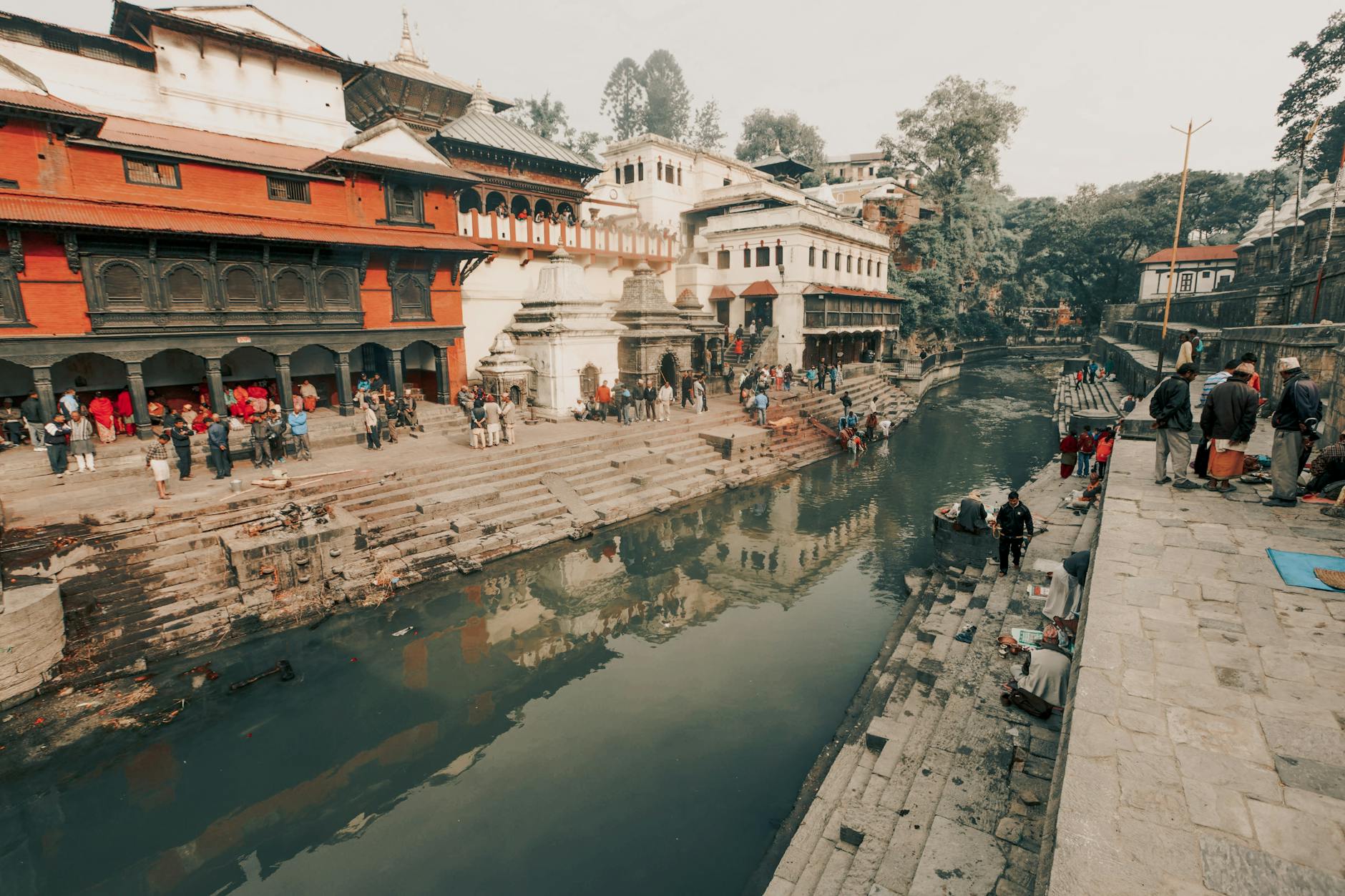
The inner sanctum is closed to non-Hindus. That restriction has been in force since the temple was rebuilt in its current form and is enforced strictly. What non-Hindus can see is most of the complex: the outer courtyards, the ghats, the pilgrim lodges, the Shivalinga garden, the Guhyeshwari temple downstream, the Mrigasthali deer park on the east side, and the view of the main temple from across the river. One South Indian visitor described the architecture this way: "The two-tiered roofs, crafted from intricately carved wood and gilded with copper, were a stark contrast to the towering gopurams and expansive prakarams I was accustomed to." The temple does not look like other Hindu temples. It looks like a Nepali temple: pagoda-tiered, carved hardwood, flared eaves, modest in footprint for the weight of significance it carries. The gilded finial at the top is replaced periodically. The woodwork is restored by carvers who trace their skill to the families who did the original work in the seventeenth century.
Shivaratri: The Night the City Arrives
Once a year, in February or March, Shiva's night arrives. Hundreds of thousands of pilgrims walk to Pashupatinath from all over Nepal and northern India. Many come on foot from Birgunj or from the Terai villages along the highway. Sadhus arrive in much larger numbers than usual and camp in the Mrigasthali park. Fires burn in the open through the night. The smell of ganja is continuous. The queues to the main temple wrap around the complex three times.
It is, on that one night, the largest gathering in Nepal. The state opens extra gates. The police set up perimeters. Food is distributed by dozens of organisations. The city of Kathmandu orients itself toward the river as it has oriented itself on that night for a thousand Shivaratris before this one. Most of the visitors who came for cremations are here too, watching in silence. The spectacle they came to see has been briefly swallowed by the site it is part of.
What Pashupatinath Actually Is
Some things are hard to watch because they do not hide. The cremation is one of them. One observer returned home and later described feeling "distant and irritated that this ash should be the loving person. Because its not." The ritual does not tell you the ash is the person. The ritual tells you the person has been released. Finding that comforting depends on a lot of things that are not the site's to arrange.
Pashupatinath is not a viewpoint. Not for cremations, not for sadhus, not for architecture. It is a working temple where people come to mourn, worship, meditate, sacrifice, beg, and die. Visiting it from a terrace across the river, camera in hand, is one of many ways to spend an afternoon there. It is not the thing. The thing is the river, the sanctum, the fires, the sadhus, the pilgrims, the smoke rising at all hours, and the country that keeps putting itself in relation to all of it, day after day, for as long as anyone can remember.