Nothing Was Impossible: A Tribute to Nims Dai (Nirmal Purja)

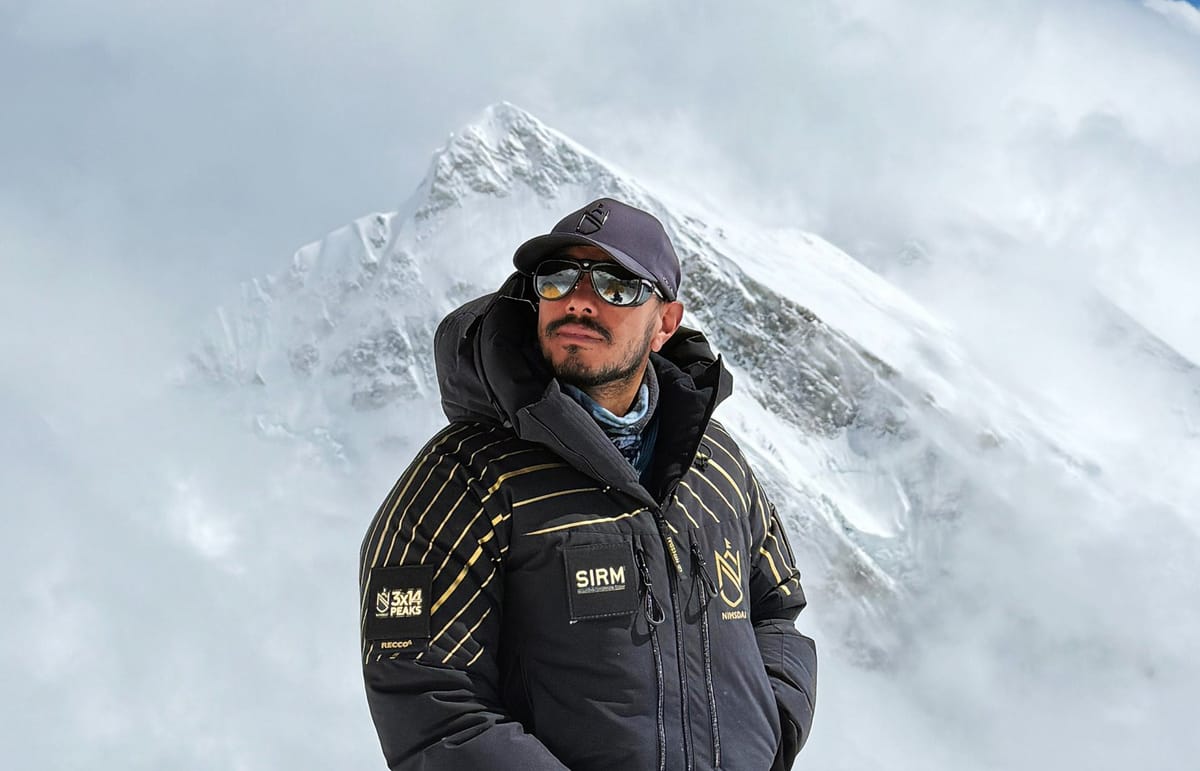
"I have to push my limits to the max. Sitting tight, waiting it out and living in the past, has never been my thing. I want to be at the world's highest point again, knowing it might slip out from underneath me at any moment. Because that is the only way to live."
Nirmal Purja, Beyond Possible
On 16 January 2021, at five in the afternoon, ten Nepali men stood ten metres below the summit of K2.
They had been on the mountain for weeks. The temperature was close to minus fifty. K2 in winter had turned back every expedition that had tried it across more than sixty years of attempts. It was the last unclaimed achievement in high-altitude mountaineering: the only mountain above 8,000 metres that no human being had ever reached in the coldest season.
The ten men stopped.
They found each other's hands. Then, together, walking those last ten metres as a single line, they sang the Nepali national anthem. At 8,611 metres. In winter. Where no one had ever stood in winter before.
One of those ten did it without supplemental oxygen.
His name was Nirmal Purja. Nepal called him Nims Dai, which translates, roughly, as Nims Big Brother. He was forty-two years old, born in a village called Dana in Myagdi District, and he had spent his entire adult life doing things that people with experience told him could not be done.
Dana sits in the Dhaulagiri Zone of western-central Nepal, in highland country where the mountains are not a backdrop but a condition of existence. The village was once a waypoint on the old salt trading route connecting Tibet and Nepal, a place people passed through on the way to somewhere else. Growing up, the mountains were simply there. Closer and larger than most people ever know them.
The Brigade of Gurkhas drew heavily from Magar communities, one of the indigenous hill peoples of Nepal with a generations-long tradition of military service to the British Crown. His father had served. Three older brothers had served before him. Following them was not ambition. It was the available path.
What followed was not the available path.
At eighteen, he joined the Brigade of Gurkhas. SBS selection runs six months, shared with SAS candidates, and begins with a two-week aptitude test: a 600-metre swim, a 20-mile canoe paddle with navigation, a 50-metre underwater breath-hold in full kit. What comes after is harder. The formal specialisation adds submarine insertion, underwater demolition, and a 34-mile canoe navigation challenge in open water. Most candidates do not pass. He passed in 2009, becoming the first Gurkha ever accepted into the unit. He was twenty-four years old.
He specialised in cold-weather warfare. Mountains and Arctic conditions were the professional context, not a hobby.
He deployed operationally for a decade. In one incident, a sniper’s bullet struck the butt of his rifle, close enough to his neck that he described it as a matter of centimetres. He came home.
When he resigned in 2018, he forfeited his military pension. He sold the house. He said: “Elite combat wasn’t enough. I wanted more of a test. Something nobody thought was possible.”
In 2012, he trekked to Everest Base Camp. He was there as a visitor. He was supposed to fly home.
He stayed. He started learning to climb.
In 2019, he needed the money to fund what the mountaineering world had assessed as mathematically impossible: climbing all fourteen of the world's mountains above 8,000 metres in under seven months. The previous record stood at seven years, ten months, and six days, set by South Korean climber Kim Chang-ho.
He called it Project Possible.
He completed it in 189 days. During those same 189 days, he mounted rescue operations on four separate occasions. The first came on April 23, the same day he summited Annapurna. A Malaysian climber, Dr. Wui Kin Chin, had lost contact with his guide near 7,750 metres on the descent. The guide made it down with spinal injuries and frostbitten toes. Chin spent the night alone above 7,500 metres without food, water, or supplemental oxygen.
The next morning, while Chin’s wife in Malaysia was independently chartering a helicopter because the insurance company was delaying authorisation, Nirmal assembled a four-man rescue team. They climbed for five hours in darkness, thirty-six hours after his own summit, and found Chin at 7,500 metres. Three helicopter pickup attempts failed before the evacuation went through. Asked later about the delay, Nirmal was precise: “This is all the insurance company had to do.”
Three weeks on, he rescued two more climbers from 8,400 metres on Kangchenjunga, after summiting it himself. The record, for him, was never only the record. In May 2019, pausing on Everest's summit ridge, he took a photograph of a queue of climbers stretching back through the death zone, waiting their turn on the highest point on earth. The image circulated globally and changed the conversation around commercial high-altitude expeditions. The photograph said something else about its author: even mid-record, at extreme altitude, he was watching the people around him.
He finished Project Possible on 29 October 2019, on the summit of Shishapangma. The Netflix documentary that followed, 14 Peaks: Nothing Is Impossible, brought him to tens of millions of people who had never thought much about the Himalaya. He became, almost reluctantly, a symbol. In the documentary, he said it plainly: "Giving up is not in the blood, sir. It's not in the blood."
He was talking about himself. The phrase went further.
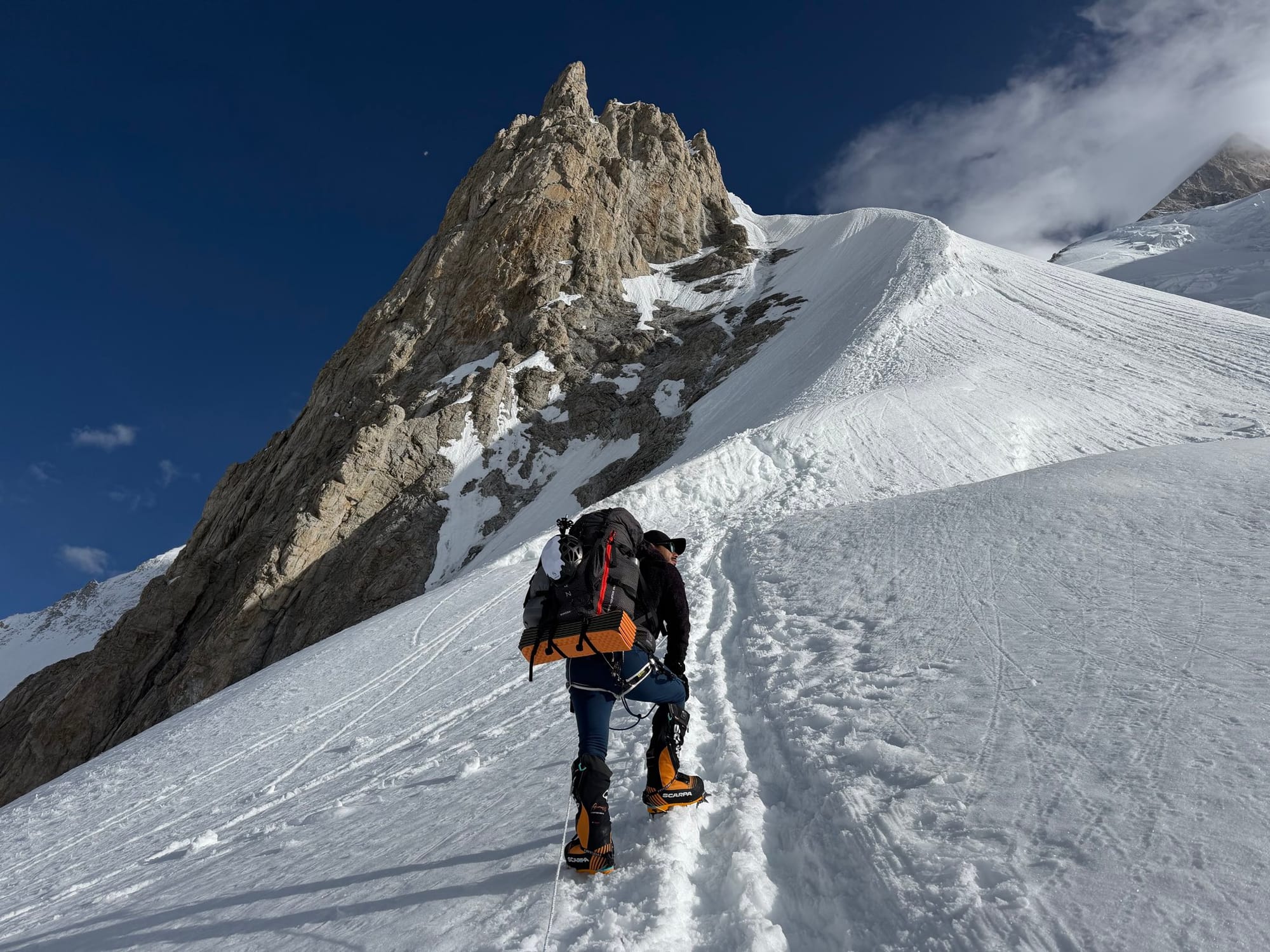
For generations, Nepali climbers had been the indispensable engine behind high-altitude expeditions: fixing ropes, carrying loads, guiding clients through terrain those clients could not have navigated alone. Their skill was rarely the story. Nims Dai changed that. Performance was his argument. He made it impossible to look past the Nepali mountaineer as a figure of athletic ambition in his own right.
Gelje Sherpa, who climbed alongside him, said: "Because of you our nation gained recognition and the world learned who the Sherpas are."
Tul Singh Gurung, president of the Nepal National Mountain Guide Association, said Nims Dai had shown Nepalis that climbing didn't have to be just work. That you could do it for passion and joy.
The way he operated said something about character that the summit count alone could not.
In a culture where Sherpa names routinely disappeared from expedition dispatches, he named his teammates. Every summit post, every interview. When a Sherpa’s contribution was once described without attribution, he said: “He has a name.” The phrase travelled further than he probably intended.
He called his teammates his brothers. They called him brother back. It was the operating principle he had carried for sixteen years in special forces: you do not leave anyone behind. At altitude, where most people are contracting toward survival, he expanded. His own description of what the death zone did to him: “In the death zone, I come alive.”
Prince William, who knew him from the military, said his “humility and selflessness made him truly unique.” Hari Budha Magar, a Gurkha veteran who had summited Everest as a double above-knee amputee, wrote after the accident: “I knew your mission was bigger than you and mountains. That’s what drove you.”
The K2 winter summit was when this came into fullest view. He wrote from the mountain: "Brother to brother, shoulder to shoulder, we walked together to the summit whilst singing the Nepali national anthem. We all stopped around 10m before reaching the summit to huddle and make our final steps together as a team."
Nepal heard him.
On 30 July 2026, at approximately 9:30 in the morning, an avalanche released on Broad Peak's main west-facing gulley, between Camp 2 and Camp 3, at around 6,600 metres. Ten climbers were swept from the mountain.
Nirmal Purja was five days past his forty-third birthday.
He was on Broad Peak as expedition leader, attempting to become the first person in history to summit all fourteen eight-thousanders three times.
Nine people were with him.
Pur Bahadur Gurung, known as Yukta, was thirty-seven years old, a native of Laprak in Gorkha District and an IFMGA-certified guide with Elite Exped. He was the first member of the Gurung community to summit Everest ten times. He had started his climbing career as a porter in 2009. His most recent Everest summit had been on 20 May 2026, ten weeks before Broad Peak. He had said of the mountains: "The moment I head for them, my spirit soars; standing on the summit fills me with pure energy."
Kili Pemba Sherpa, known as Kilu, had been on the mountain with Nims before. He was one of the ten men who stopped ten metres short of the K2 summit in January 2021 and walked up singing. He had been climbing since the age of sixteen, starting as a support worker on the 1996 Manaslu expedition. He had summited Everest fifteen times. He had guided a Chinese climber with both legs amputated above the knee to the Everest summit in 2018. On 3 July 2026, twenty-seven days before Broad Peak, he completed his own full set of all fourteen eight-thousanders. Imagine Nepal, his expedition company, said: "He was humble in every way and never tired of helping climbers when they needed him. He was a foundation of our team."
Nima Sherpa had climbed four eight-thousanders in 2026 alone before Broad Peak. From Chyakse Boda in Sankhuwasabha, raised in a farming family, his colleagues at Elite Exped described him as disciplined and fearless. Nawang Thindu Sherpa was twenty-nine years old. His father and three brothers had all summited peaks above 8,000 metres. He had first reached Everest's summit in 2022 and stood on Makalu earlier in 2026. He was unmarried. Gyalu Sherpa, from Okhaldhunga, had set a Guinness World Record by summiting Kanchenjunga three times in a single season.
Nadhira Al Harthy of Oman had become the first Omani woman to summit Everest in 2019 and had since added K2 and Manaslu. Sohail Sakhi, one of Pakistan's leading guides, was on the mountain with his client Mallory Geis of the United States, who was attempting her first expedition above 8,000 metres. Wang Zhong had come from China.
Five nationalities. One mountain. The mountain did not make distinctions.
His brother Kamal spoke afterward. "I feel as though I have lost my whole world," he said. "My brother was not only my younger brother. He was my heart."
Chhang Dawa Sherpa, director of Seven Summit Treks, said: "An international-standard mountain guide cannot be produced overnight. It takes years of training, repeated expeditions, and practical experience. Losing climbers of this calibre is a devastating blow, not only for Nepal but for the global mountaineering community."
Nirmal Purja leaves behind the Nimsdai Foundation, Elite Exped, and a record that still has not been approached. He leaves behind a Netflix documentary that made people who had never seen a Himalayan ridge believe that limits are, in his own phrase, more flexible than they seem. He leaves behind a generation of Nepali climbers who watched a man from a village on a salt trading route stand on every summit on earth and understood that standing there was theirs to attempt.
He wrote that he wanted to be at the world's highest point again, knowing it might slip out from underneath him at any moment. He said that was the only way to live.
He was right. He just did not get to choose when it ended.
Nirmal "Nims Dai" Purja. 25 July 1983 to 30 July 2026. He was 43.
Rest in peace to all ten climbers lost on Broad Peak, 30 July 2026.