Nepal's Buddhist Monasteries: The Ones That Are Still Actually Monasteries
Most monasteries in Nepal have become heritage sites. A handful are still functioning communities of monks and practitioners. What distinguishes a working monastery and which ones in Nepal still qualify.

Most of Nepal's monasteries now function as heritage sites. The monks who once lived in them have left, or aged out, or been moved to institutions with better resources and more students. What remains is the architecture, the murals, the entry fee. Tengboche has a resident monastic community. So does Kopan, above Kathmandu. Thubten Choling, in Solu Khumbu, still operates as a working institution. These are not the majority. They are the exceptions worth knowing about.
Kopan, Above Kathmandu (Gelug)
Kopan Monastery sits on a hill northeast of Boudhanath, overlooking the city. Over 300 monks live there. The 6 AM schedule is not suspended for visitors: the chanting begins before most guests have woken up, and the sound of an institution operating on its own timetable is the first thing you understand about the place.
Kopan is affiliated with the Foundation for the Preservation of the Mahayana Tradition (FPMT) and runs a monthly meditation course that has been attended by over 300 students per annual cycle since the 1970s. The retreats are residential: meals, accommodation, and a daily schedule built around sitting practice and teaching. Evening silence is enforced after dinner until noon the following day. Some participants wear a yellow ribbon to indicate they are not to be approached. Monks befriend retreat visitors during their stay. The goodbye ceremony is filmed on phones.
This is what a functioning monastery looks like. The monks are studying during the day, not performing. The retreat participants are not observers of monastic life; they are temporarily adjacent to it. Returning to Kathmandu city traffic after a stay at Kopan is described, by more than one visitor, as physically jarring - the monastery's stillness only becomes legible when you re-enter noise.
Tengboche, in the Khumbu (Nyingma)
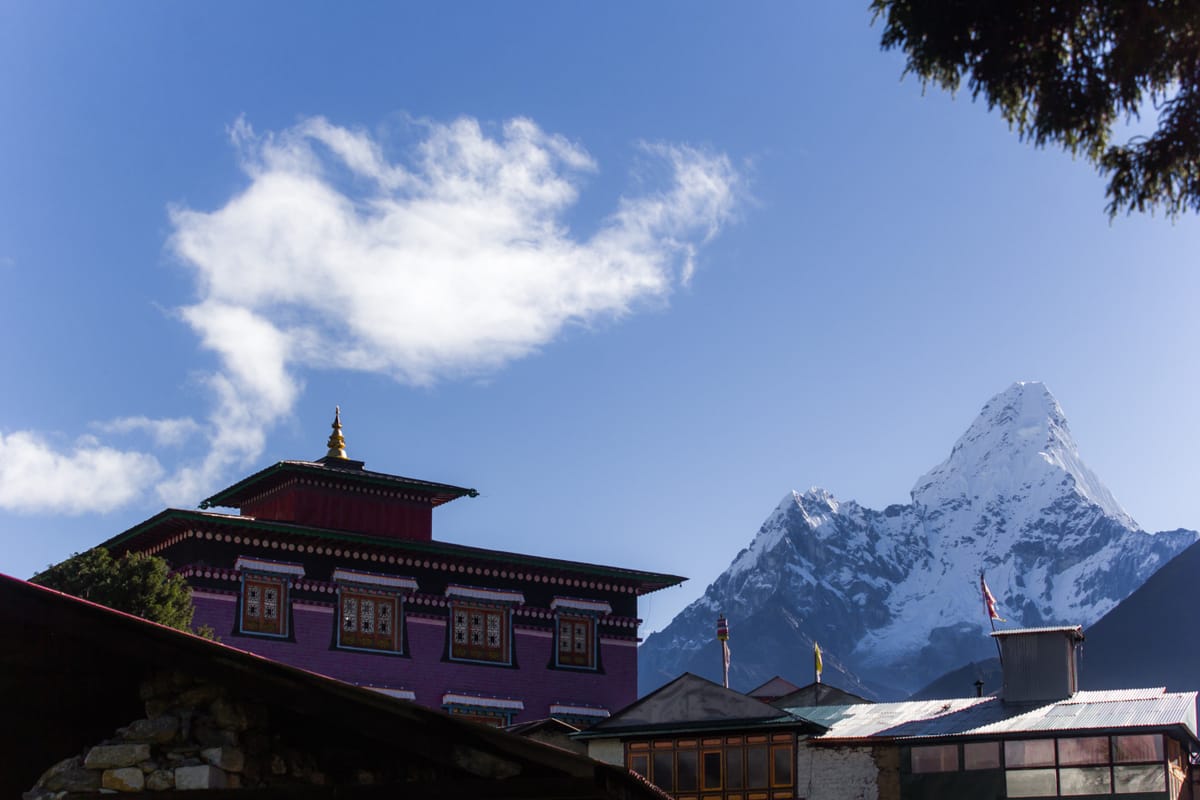
Tengboche Monastery sits at 3,867 metres, above the treeline, with a view of Ama Dablam that photographers attempt from this angle specifically. The monastery is a landmark on the Everest Base Camp route; almost every trekker passes it. Most stop for ten minutes and continue to camp.
The monastery burned to the ground in January 1989 - an electrical fault during a cultural performance. The restoration took four years and was completed in 1993, with funding from Edmund Hillary's Himalayan Trust and international donors. The rebuilt monastery is structurally similar to what was lost, but the murals in the rebuilt assembly hall are new and look it.
Mani Rimdu, held at Tengboche each November on the full moon of the Tibetan lunar month of Kagyur, is a three-day ritual performance depicting the victory of Buddhism over the Bon religion. Monks wear elaborate masks. The third day involves a fire ceremony. The festival runs whether or not trekkers are present, but November falls in the main trekking season and the festival draws visitors specifically.
Thubten Choling, in Solu Khumbu (Nyingma)
Thubten Choling was founded in 1969 by Trulshik Rinpoche, a student of the 14th Dalai Lama, as a refuge for Tibetan monks and nuns who had fled Tibet following 1959. It sits at approximately 3,650 metres in the Solu Khumbu district, below the main Khumbu trekking routes. Most visitors to the Khumbu do not go there.
The community is currently one of the largest active monastic communities in Nepal - several hundred monks, nuns, and laypeople. It is not a heritage site. It is a place where people live and practice, which is a different thing. Access requires a specific intention to visit rather than proximity to a trekking route. It is rarely crowded.
Namo Buddha, East of Kathmandu (Kagyu)
Namo Buddha sits on a hill 38 kilometres southeast of Kathmandu, at 1,750 metres, above the Panauti valley. The monastery is Thrangu Tashi Yangtse, founded in 1978 and affiliated with the Kagyu tradition. The complex includes a monastery, a retreat centre, and accommodation for visitors.
The site is associated with the Jataka story of a prince who encountered a starving tigress and her cubs while walking in the forest. He fed her his own body so she and her cubs would not die. The story is told in Buddhist texts as an account of the Bodhisattva in a previous life. At Namo Buddha, it is treated as history: the hill is where it happened, and the stupa marks where the prince's remains were interred. The tigress story at Namo Buddha is told as history because, here, that is what it is.
The drive from Kathmandu takes about two hours. It is possible to walk the 32-kilometre route from Panauti in a single long day. The monastery guesthouse is simple and requires advance contact. Day visitors arrive in groups on weekends; the hill is quieter during the week.
What Makes a Monastery Still a Monastery
The distinction between a functioning monastery and a heritage site is not architectural. Both have assembly halls. Both have murals. Both may have resident monks. The difference is in the timetable. A functioning monastery has a schedule that does not bend for visitors - chanting at 6 AM, study sessions at specified hours, a kitchen that operates on the community's rhythm rather than the tourist's. A heritage site has visiting hours.
If you want to visit a working monastery and not a museum, arrive early. If you arrive after 10 AM, you have likely missed the morning practice. If there are tour groups, you are in a heritage site regardless of what the sign says. The monks know the difference.
Visitor Etiquette
Remove shoes before entering the assembly hall. Walk clockwise around stupas. Do not photograph monks without asking. Do not enter areas that are closed to visitors - this includes most internal living quarters and some shrines during active ritual. Keep voices low when practice is happening. Dress conservatively: shoulders and knees covered. These are not aesthetic requests. They are the conditions under which a working monastery remains accessible to visitors rather than closed to them.
Frequently Asked Questions
Which Buddhist monasteries in Nepal are still functioning communities?
Kopan Monastery (Kathmandu), Tengboche Monastery (Khumbu), Thubten Choling (Solu Khumbu), and Namo Buddha (Kavrepalanchok) are all active institutions with resident monks or nuns. Kopan runs retreat programmes. Tengboche holds Mani Rimdu in November. Thubten Choling is the largest active community in Nepal.
What is the difference between Nyingma, Gelug, and Kagyu monasteries in Nepal?
These are three of the four main schools of Tibetan Buddhism. Nyingma (Tengboche, Thubten Choling) is the oldest school. Gelug (Kopan) is the school of the Dalai Lama, emphasising monastic discipline and scholastic study. Kagyu (Namo Buddha) emphasises meditation practice and the guru-student lineage. The traditions have different ritual calendars, different emphases in practice, and different lineages of teachers.
Can visitors stay at Buddhist monasteries in Nepal?
Yes, at some. Kopan runs formal month-long meditation retreats with residential accommodation. Namo Buddha has a simple guesthouse. Tengboche has basic trekker accommodation nearby. Contact the monastery directly and well in advance - these are not hotels and availability is not guaranteed.
What is Mani Rimdu and when does it take place?
Mani Rimdu is a three-day Sherpa Buddhist festival held at Tengboche Monastery each November on the full moon of the Tibetan month of Kagyur. Monks perform masked dances depicting the victory of Buddhism over Bon. The third day includes a fire ceremony. It falls within the main trekking season and attracts visitors specifically for the festival.