Kirtipur on a Weekend: Eating Chhoila Where the Valley's History Was Fought
Kirtipur is one of the Kathmandu Valley's most historically significant towns and one of its least visited. What the hilltop settlement offers and why the valley's resistance narrative centres here.

Kirtipur has been called the City of Cut Noses for two and a half centuries. The people of Kirtipur know the name. They do not use it among themselves.
It took Prithvi Narayan Shah three attempts to take this hilltop. The first, in 1757, ended with the death of his commander Kalu Pandey. The second, in 1764, cost his younger brother Sur Pratap Shah his eyes. The third succeeded in 1767, and when it was over, Shah ordered the noses and ears removed from every man in the city who could not play a wind instrument. The rationale was retaliation. The city has carried it since.
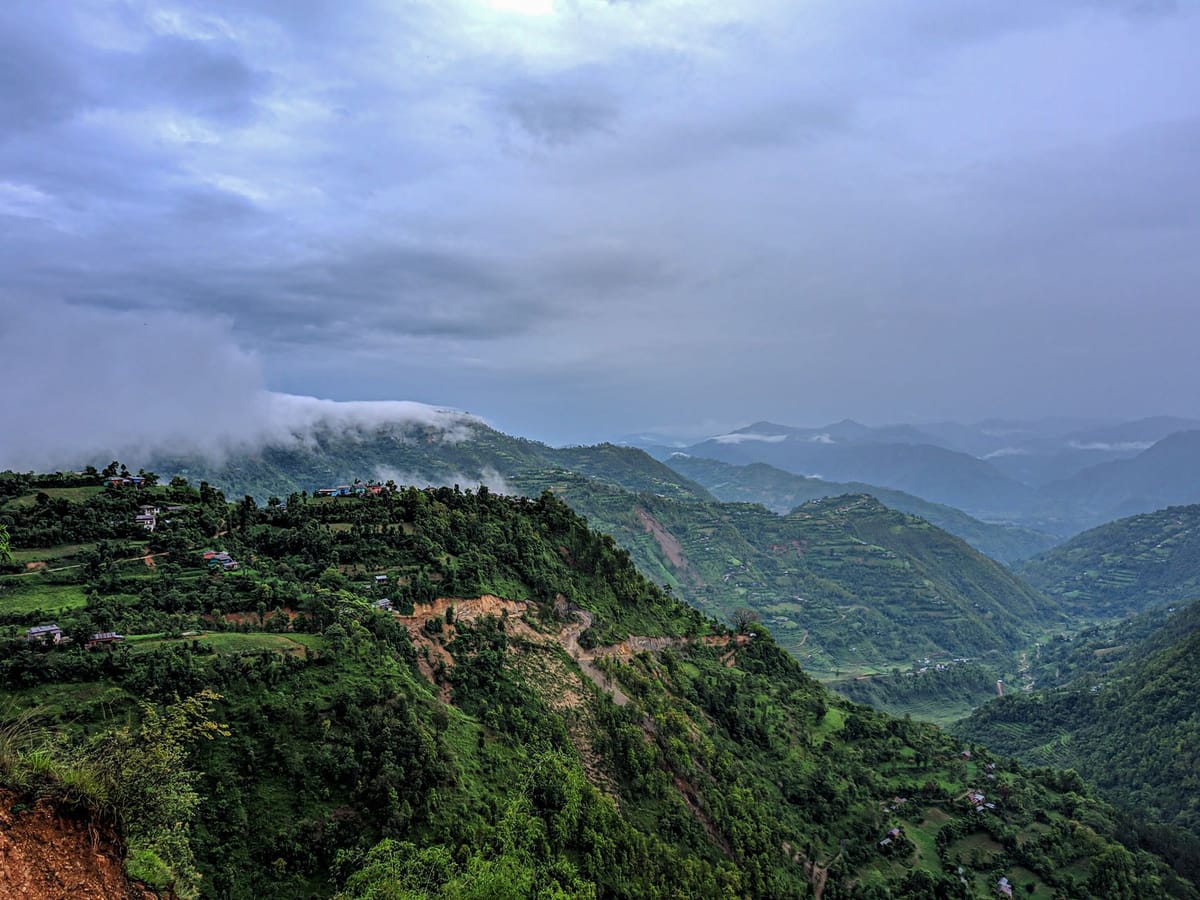
Kirtipur sits seven kilometres southwest of Kathmandu, on a ridge that looks west toward Ganesh Himal on a clear day. The drive is short enough that most visitors do not make it. The narrow lanes of the upper town force you to walk. Old brick architecture crowds in from both sides, temples built at intersections not as monuments but as the corners of a working neighbourhood. Between Chilancho Stupa to the north and Bagh Bhairav at the western end of the ridge, the lanes are narrow enough that two people pass sideways. Households keep gods at their doorposts. The courtyards open onto each other in a spatial logic that does not translate well to a map.
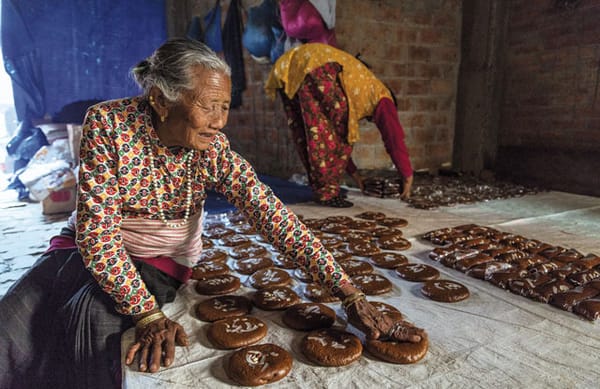
Newa Lahana is a community kitchen run by the housewives of the Newar community in the neighbourhood. It is not a restaurant in the conventional sense. There is no menu handed over. There is no front-of-house management. What arrives is what is being made that day: samay baji, bara, aloo tama, chatamari, and chhoila. The seating is on cushions, low to the ground. The food comes on dried banana leaf plates. Adjustments for tourist spice tolerance are not part of the arrangement.
Samay baji is the full Newari ceremonial plate: beaten rice as the base, chhoila at the centre, surrounded by bara (lentil patties), sadheko aloo (spiced potato), soybeans, and various achars. On the leaf plate, the components are arranged to be eaten together rather than in sequence. The beaten rice cuts through the spiced meat. The bara absorbs the mustard oil. Eating the elements separately is possible. It misses the point.
The chhoila at Newa Lahana is haku chhoila: "black choila" in Newari, named for the char that comes from cooking buffalo over a rice-straw fire. The method chars the outside quickly while the inside stays medium-rare. The meat is then pulled apart and dressed with mustard oil, garlic, ginger, red chilies, turmeric, cumin, and coriander. The result is smoky and aggressively spiced. The spice is not performance. It is the dish. The mustard oil adds a sharpness that cuts through the buffalo fat. The dried chili builds heat rather than peaking. Without chiura alongside it, most visitors find themselves in difficulty.
This is not a restaurant that softens anything. Independent accounts include complaints about hygiene: hair found in the food, waits that extend without explanation during the evening rush, when locals and students from nearby Tribhuvan University fill the space. These are real reports from real visits. They are also reports from a place where the food is prepared daily by home cooks, at a scale that does not permit formal hospitality. What Newa Lahana lacks in consistency it makes up for in accuracy: this is what Newari food has been, made the way it has been made, for a community that is not explaining itself to anyone.
What draws people back, consistently, is the chhoila. Outside the community kitchens of Kirtipur and a few places in old Bhaktapur and Patan, buffalo chhoila made over a rice-straw fire is getting difficult to find. The open flame has been largely replaced by gas. The flavour is different. The char is different. People who have eaten both describe the difference but struggle to name it. Something in the heat, they say. Something in the char.
Newa Lahana sits about two hundred metres from Bagh Bhairav Temple, which opens early and is rarely crowded before nine in the morning. The old city market runs most mornings along the main ridge: vegetables, dried fish, and in winter, dried buffalo hung from the eaves of the older buildings. The Chilancho Stupa is one of the oldest in the valley and receives almost no visitors on a weekday morning. The streets between these places are the point of the visit.
From Kathmandu: take a tempo or local bus from Ratna Park to Kirtipur, then ten minutes on foot up from the bus stop to the old town. Arrive before noon to avoid the lunchtime crowd. Evening visits are for people who do not mind a wait and do not need to see the menu in advance.
Kirtipur is not a place that asks to be noticed. The old lanes run in the same direction they have run for centuries. The food is what it has always been. The name that outsiders gave the city is not the name the city calls itself. The one it chose is harder to translate. It goes something like: the place that held.