George Mallory: The Man Who May Have Summited Everest Before Hillary
George Mallory disappeared on Everest in 1924. His body was found in 1999. Sandy Irvine's remains were found in 2024. Nobody knows if they made it.

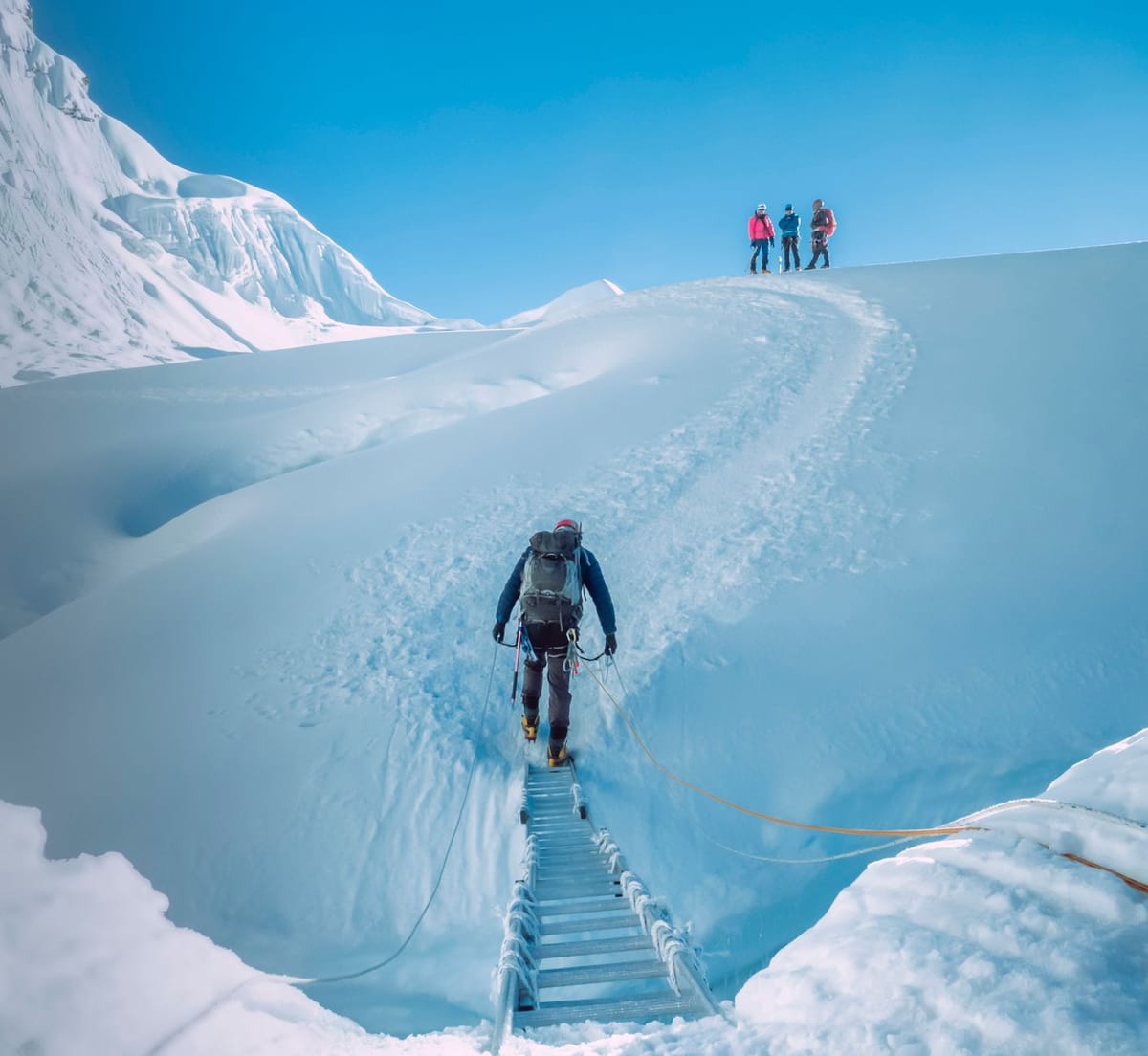
June 8, 1924. Noel Odell is at Camp VI on Everest's northeast ridge when a gap opens in the clouds. He sees two tiny black figures moving along the ridge above him. They are close to the top. The clouds close.
That is the last time anyone saw George Mallory or Sandy Irvine alive.
Neither man was ever found by their team. Mallory's body was discovered seventy-five years later. Irvine's remains were found in October 2024, a hundred years after they disappeared. The camera that would settle the question of whether either of them reached the summit has never been found.
June 8, 1924: The Last Sighting
Noel Odell was a geologist, part of the 1924 British expedition. His account of what he saw through the cloud gap on June 8 is the central piece of evidence in the summit debate, and it is frustratingly imprecise.
He wrote that he saw the two figures at a significant step on the ridge. In later accounts, he identified this as the Second Step, a rock band at approximately 8,610 metres. By his estimate, they were about 800 vertical feet from the summit. If Odell was right, they were making good time.
The clouds closed. He waited. He went higher. He signalled with his sleeping bag. No response came.
The exact position of the two figures, and exactly how far they were from the top when Odell saw them, has been debated by mountaineers and historians for a century. The only certainty: they were moving upward, and then they were gone.
Who George Mallory Was
George Herbert Leigh Mallory was born in 1886 in Cheshire. He was a schoolteacher at Charterhouse before the First World War, a climber in the British tradition of mountaineering as character formation. He was regarded as one of the best rock climbers of his generation by the time the Everest expeditions began.
He was also famously quotable. In 1923, a year before the fatal attempt, a New York Times reporter asked him why he wanted to climb Mount Everest. "Because it is there," Mallory said. He was dead within a year of saying it.
This is the line everyone knows. What is less quoted is the context: the reporter had asked why anyone would attempt such a thing. The answer was not a philosophy. It was a dismissal of the question.
The Three Expeditions
This was not a single attempt. It was Mallory's third time on Everest.
1921: British reconnaissance. The first expedition to survey the mountain's routes. Mallory helped identify the northeast ridge as the viable line of approach. No summit attempt.
1922: The first real summit attempt. It failed. On June 7, 1922, an avalanche killed seven porters. Most of them were Sherpa. They were the first people to die on Everest. Their deaths are recorded in expedition logs and in almost no English-language coverage of Mallory's story. They were not famous men trying to make history. They were working.
Mallory was on that expedition. He was present for those deaths. He came back in 1924 anyway.
1924: The fatal expedition. Mallory and Irvine were given the second summit attempt, after the first team (Norton and Somervell) turned back at 8,573 metres without oxygen. Mallory and Irvine would use supplemental oxygen. They departed from Camp VI on the morning of June 8.
The Body Found
On May 1, 1999, a NOVA-sponsored search team found a body on Everest's north face. They initially believed it was Sandy Irvine. They turned the body over and found clothing tags: G. Mallory.
The body showed an angulated leg fracture, consistent with a fall. There was a rope around his waist, broken. He had been lying face-down with one arm extended, as if trying to arrest a slide. The wounds on his head suggested he had hit rock.
They searched carefully for the Kodak Vest Pocket Camera. Mallory was believed to be carrying it. They did not find it.
The team performed a Church of England committal service at the site and reburied the remains beneath stones. The mountain that killed him became his grave.
October 2024: Sandy Irvine's Remains Found
A hundred years after their disappearance, a National Geographic team led by filmmaker Jimmy Chin found remains on the Central Rongbuk Glacier below Everest's north face.
A leather boot. Inside: a sock embroidered with the letters A.C. Irvine. Andrew Comyn Irvine. Jimmy Chin described finding it.
The location is significant in ways that complicate the camera search. Irvine's remains were found on the glacier below the north face, not on the ridge where researchers had expected them. Bodies that fall from the northeast ridge can travel considerable distances over decades as the glacier moves. If Irvine had the camera when he fell, it may not be where anyone has been looking.
Irvine was 22 years old in 1924. He had been chosen for the summit attempt over more experienced climbers partly because of his skill with the oxygen apparatus. He had redesigned parts of it during the expedition.
The Missing Camera and What It Would Prove
Kodak engineers consulted in 1999 believed that film from that era, properly frozen and never thawed, might still be developable. The temperatures on Everest's north face are cold enough, and consistent enough, that deterioration would have been minimal.
A photograph of the summit from a camera dated to 1924 would be conclusive. Not suggestive. Not a theory. Conclusive.
The camera was not on Mallory's body. It may be with Irvine. It may be somewhere on the glacier below the route, carried down by ice over a century. It may be in a crevasse. It may be buried under metres of snow.
The search continues. It has been continuing for twenty-five years.
Did They Summit?
The case that they did: Odell's sighting placed them at the Second Step at a time consistent with making the summit before darkness if they moved well. Mallory was carrying the photograph of his wife Ruth that he had promised to leave on the summit. It was not found on his body. If it was not on him and was not found elsewhere, one explanation is that he left it where he promised to.
The case against: The Second Step is a near-vertical rock band at 8,610 metres. In 1924, without modern equipment, no jumar, no fixed ropes, crossing it would have taken so long that a return to camp before dark was extremely unlikely. Chinese climbers who first fixed a ladder on the Step in 1975 described it as extremely difficult even with modern equipment. The technical problem is serious.
Odell's sighting is also imprecise. He may have been looking at the First Step, not the Second. If they were at the First Step, they were further from the summit and the timeline does not work.
Edmund Hillary, when asked whether Mallory might have summited, reportedly said it did not matter unless you got back down. It is a climber's answer. It is also correct. A summit without return is not a summit in any operational sense. Hillary and Tenzing Norgay reached the top on May 29, 1953, and came home. That is the record.
What Mallory was cannot be reduced to whether he reached the top. He went back three times. He was there on the day seven porters died. He stood above 8,000 metres at a time when nobody knew what that would do to a body. He kept going.
Frequently Asked Questions
Did George Mallory summit Everest?
It is unknown. The available evidence does not prove he reached the summit. The strongest case for it rests on Noel Odell's sighting on June 8, 1924, and the absence of the photograph Mallory had promised to leave at the top. The strongest case against is that crossing the Second Step without modern equipment likely took too long to allow a return before dark.
What happened to George Mallory?
He disappeared on June 8, 1924. His body was found on May 1, 1999, on Everest's north face by a NOVA-sponsored search team. He showed injuries consistent with a fall, including a rope break and a leg fracture. His remains were reburied on the mountain.
Was Sandy Irvine's body found?
Remains believed to be Sandy Irvine's were found in October 2024 on the Central Rongbuk Glacier by a National Geographic team led by Jimmy Chin. A sock embroidered with his initials A.C. Irvine was found inside a leather boot at the site.
What did George Mallory say about climbing Everest?
In 1923, asked by a New York Times reporter why he wanted to climb Mount Everest, Mallory replied: "Because it is there." He died attempting the summit the following year.