Bisket Jatra: Pulling the Chariot Through Bhaktapur
Bisket Jatra pulls Bhaktapur apart and puts it back together every Nepali New Year. Two chariots, two teams, a tug of war through the old city streets, and one very specific pole.

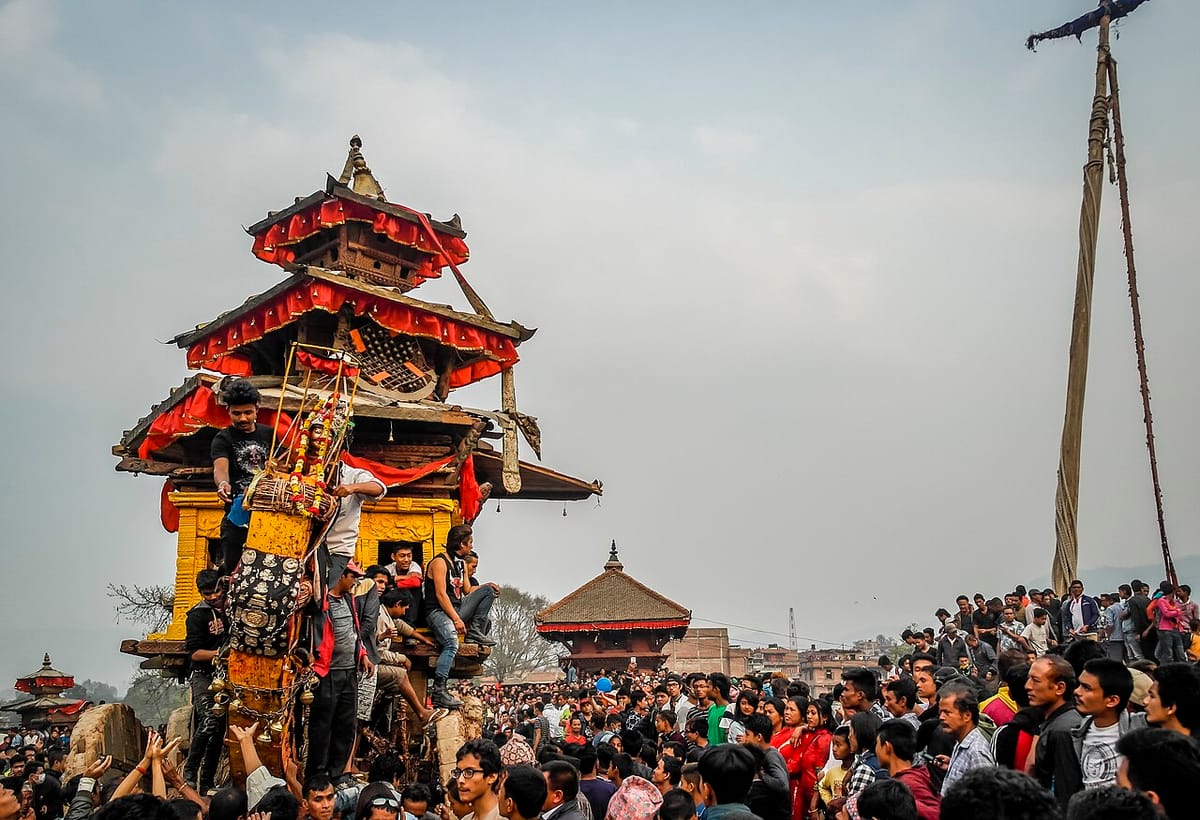
The chariot is built without nails. This is the first thing that changes your understanding of what you are about to watch. The massive wooden structure, rising nine metres from its base platform, is held together by traditional joinery: mortise and tenon, rope lashing, wooden pegs, the accumulated technique of craftsmen who have been making this specific object in this specific city for a very long time. It will be pulled through medieval streets on the first day of the Nepali New Year, and it will do this without modern hardware, because it has always done this without modern hardware.
Bisket Jatra in Bhaktapur is marketed as a New Year festival. This is accurate in the way that describing a river by its colour is accurate: it captures one visible quality and leaves the essential nature out.
What is actually happening
The festival spans eight days. The chariot of Bhairav, the fierce manifestation of Shiva, is the physical centre of the event. A second, smaller chariot carries the goddess Bhadrakali. Both chariots move through the old city during the festival period, and the physical movement of these structures through specific streets in a specific sequence is not ceremonial in the way a modern parade is ceremonial. The routes are ancient. The specific intersections where the chariots pause or turn carry religious weight. The community tug-of-war that pulls the chariot is contested between city sectors whose rivalry goes back centuries.
The wooden yosin pole, which is erected in Khalna Tol and toppled on the last day of the festival, is associated in local mythology with the death of serpent deities and the protection of the community. The raising and falling of this pole, up to 25 metres tall, is the festival's most dramatic moment and one of its most genuinely dangerous ones. The pole falls in an unpredictable direction despite guiding ropes. People have been injured when it falls poorly. The crowd does not thin for this part.
The chariot pull
The actual pulling of the chariot through Bhaktapur's streets is the most accessible part of the festival for someone coming from outside the community. It is also the most honest.
The chariot is heavy. The streets it travels are narrow, crooked, and paved with old brick that offers uneven footing. The teams of young men who pull it use thick ropes that stretch back forty or fifty metres from the structure, and the physical effort required to move the chariot even a few metres at a time is visible in the bodies of the people doing the work. Faces go red. Ropes go taut. The chariot moves in lurches, not smoothly.
Some of the pullers are drunk. This is not incidental. Alcohol has a traditional place in the festival for certain groups, and the consumption is visible in the early afternoon, when the crowd is densest and the temperature is high. A few pulling sequences have broken into shoving matches between sectors. The police presence manages the boundaries of this, mostly.
The atmosphere is not hostile. It is charged. There is a specific kind of crowd energy that forms when thousands of people are physically engaged in something that requires genuine effort and where real stakes are present. The chariot could tip. Someone could be crushed. These possibilities are not decorative: they have occurred historically, and the community's continued practice of the festival in this form is a choice made in full awareness of the physical facts.
Bhaktapur's relationship to its festival
Bhaktapur is the most intact of the three medieval cities of the Kathmandu Valley. The others, Kathmandu and Patan, have expanded and modernised in ways that have fundamentally changed their cores. Bhaktapur's historical centre is denser, more self-contained, and maintains a higher proportion of residents whose families have been in the city for generations.
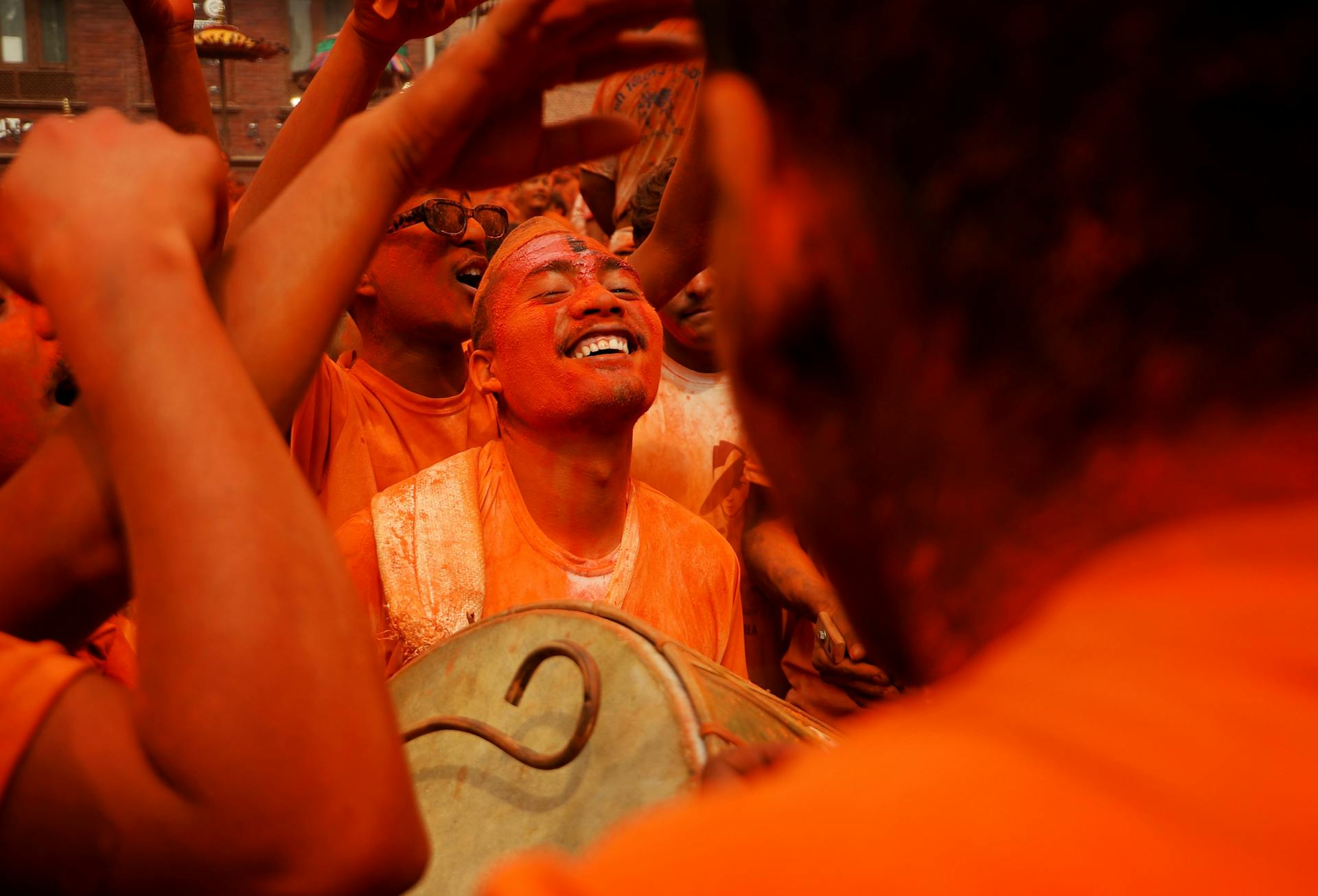
Bisket Jatra is one of several festivals that remain primarily community events rather than tourism events. The ratio of participants to observers is not like Indra Jatra in Kathmandu, where the crowd is majority onlookers. In Bisket Jatra, the people watching are also mostly from Bhaktapur. The festival belongs to the community in a way that is legible if you spend time watching who is doing what.
Foreign visitors are present and visible, and they are generally welcomed without particular ceremony. The festival does not perform itself for an outside audience. It continues in its own logic regardless of who is watching, and that indifference is what makes it worth watching.
Timing and access
The festival follows the Nepali calendar, which means the dates shift each year relative to the Gregorian calendar. It falls in mid-April, typically the first or second week. The first day, when the chariot is pulled through the main streets, is the most concentrated and most physically intense. Arriving before 10am is useful: the pulling begins midmorning and the heat and crowd density increase through the afternoon.
The main chariot pulling happens in the Khalna Tol area, near the central part of the old city. No special permission is required to watch. The streets are narrow enough that staying at the edge of the crowd is advisable if you want to avoid being pressed against walls when the chariot moves toward you, which it will.
The pole ceremony, if you stay through to it, happens at a separate location and is worth finding. The moment of the pole's fall, when it happens, is one of the genuinely unexpected experiences the festival offers: no countdown, no announcement, just movement and then a very large piece of wood in rapid descent.