Indra Jatra: Eight Days That Reorganise Kathmandu
For eight days every September, Indra Jatra restructures Kathmandu. Chariot processions, masked dances, and a living goddess carried through streets that have not changed their route in 900 years.


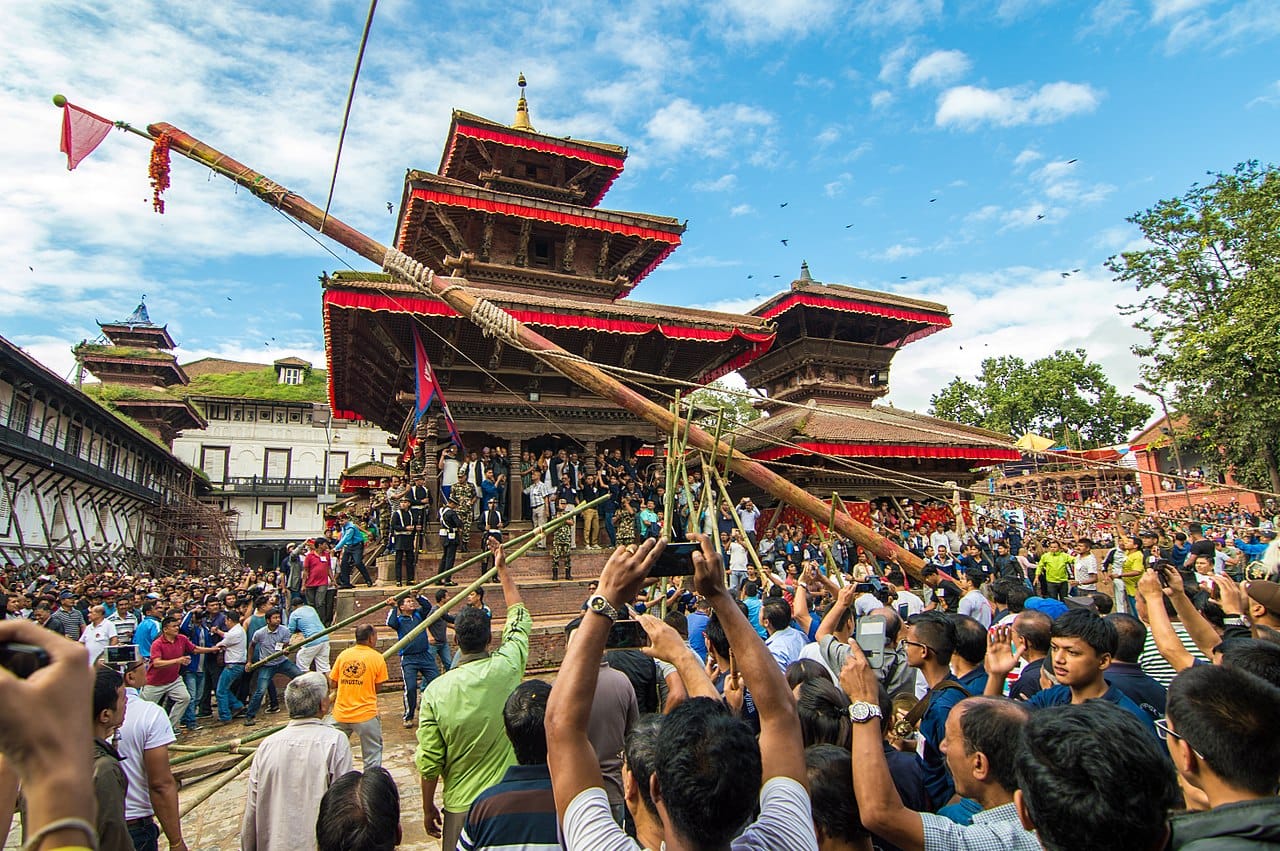
On the first evening of Indra Jatra, before the chariots move, the pole goes up. A pine trunk, sixty feet tall, is raised in Basantapur Square by a crew of men using ropes and collective strength and a technique that has not changed in the centuries since the festival was established. The pole rises slowly and then, at the critical moment, falls into its socket in the square with a sound that carries across the old city. The crowd that has gathered to watch this does not cheer. It breathes out.
Indra Jatra runs for eight days in September, tied to the full moon of the Nepali month Bhadra. It is a Newar festival, organised by and for the Newar community of the old city of Kathmandu, though the city has expanded around it and the crowds who watch the chariot processions now include people from everywhere. The festival's management, its ritual authority, and its deep structure remain with the Newar families and guthi organisations that have held these responsibilities across multiple generations.
What Indra is
Indra, in the Newari cosmological tradition, is not precisely the same deity as the Indra of the Sanskrit texts, though they share origins. The Newari Indra is associated with rain and with the final harvest, and his capture and imprisonment in the valley, and his mother's search for him, and the eventual negotiation that leads to his release, are the narrative spine of the festival. The pole represents Indra's prison. Its raising begins the festival. Its lowering ends it.
The details of this narrative as observed in practice do not always match the version in the textual sources. The festival has been performed continuously for long enough that the practice and the text have developed independently of each other. The live version is the one that matters. It is the one that will continue.
The Kumari
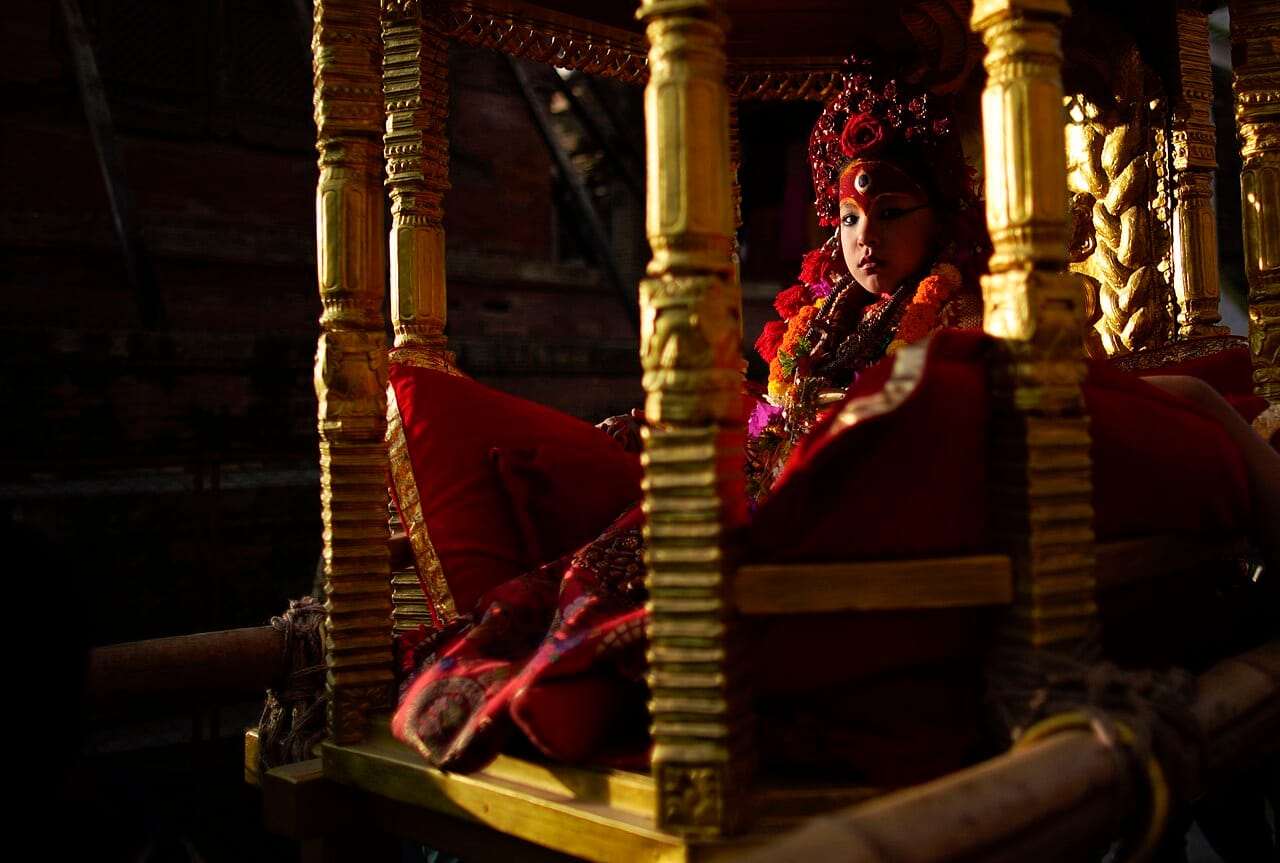
The Kumari of Kathmandu, the living goddess, appears in her chariot on the second day. She is a pre-pubescent girl selected from the Shakya community of Newars through a ritual selection process and installed as the embodiment of the goddess Taleju. During Indra Jatra she is carried through the streets of the old city in a processional chariot with Ganesh and Bhairava chariots flanking hers.
The Kumari's chariot route follows the historic boundaries of the old city. Taleju Marg, Durbar Square, Makhan Tole, the streets that still carry the names and the rough outlines of the medieval city. The people who line the route do not stand in a roped enclosure. They stand where they have always stood, in the doorways and on the steps of the buildings along the route, pressed together in the way that means the city is doing something it considers important.
The Kumari does not speak during the procession. She does not react to the crowds. She holds the stillness of the role. When the festival ends, she will return to the Kumari Ghar in Durbar Square and resume the constrained life of a living goddess until she reaches puberty and is retired.
Pulukisi and the masked dancers
Running through the festival alongside the chariot processions are the masked dancers representing various deities, and the Pulukisi, an elephant costume operated by two men, which moves through the crowds with a comic energy that is deliberately at odds with the ritual gravity of the chariot processions.
The Pulukisi appears as Indra's mount in the festival's mythology and is one of the most immediately legible elements for outsiders because its behaviour is openly playful. It approaches the crowd, it retreats, it charges, it accepts offerings. The crowd responds to it directly in a way that the more formally structured elements of the festival do not invite.
The masked dances of Mahakali and Kumari and the other deities are performed at specific locations in the old city on specific nights. The locations have not changed. The families who perform the dances have held the roles across generations.
How to watch Indra Jatra

The chariot procession moves in the late afternoon and early evening. The route is public. The streets of the old city are narrow and the crowds are dense. There is no good viewing position in the sense of an unobstructed sightline from a comfortable distance. You are in the crowd or you are not watching.
The most direct thing I can say is this: Indra Jatra is not a performance staged for visitors. It is a festival that visitors are permitted to witness. The distinction matters in how you conduct yourself within it. You move with the crowd when the crowd moves. You step back when the chariot needs to pass. You do not put a camera in the face of the Kumari. These are not written rules. They are the behaviour of someone who is a guest in another community's celebration and knows it.
The Close
On the final day, the pole is lowered by the same method that raised it, the ropes and the men and the collective knowledge of how it is done. The festival does not end with a ceremony of conclusion. It ends when the pole is down and the preparations for the following year's festival begin, which happens immediately.
The Newar festivals are not events with a beginning and an end in the way that most outside calendars understand events. They are points in a cycle that has been turning for as long as the city has existed. Indra Jatra will happen next year. The same pole socket will receive the same pole. The same families will hold the same responsibilities. The Kumari will be a different girl.