Bhanubhakta Acharya: The Grass-Cutter Who Made a Poet
A grass-cutter's wish to leave something behind changed Nepali literature forever. The story of Bhanubhakta Acharya, the Aadikavi.

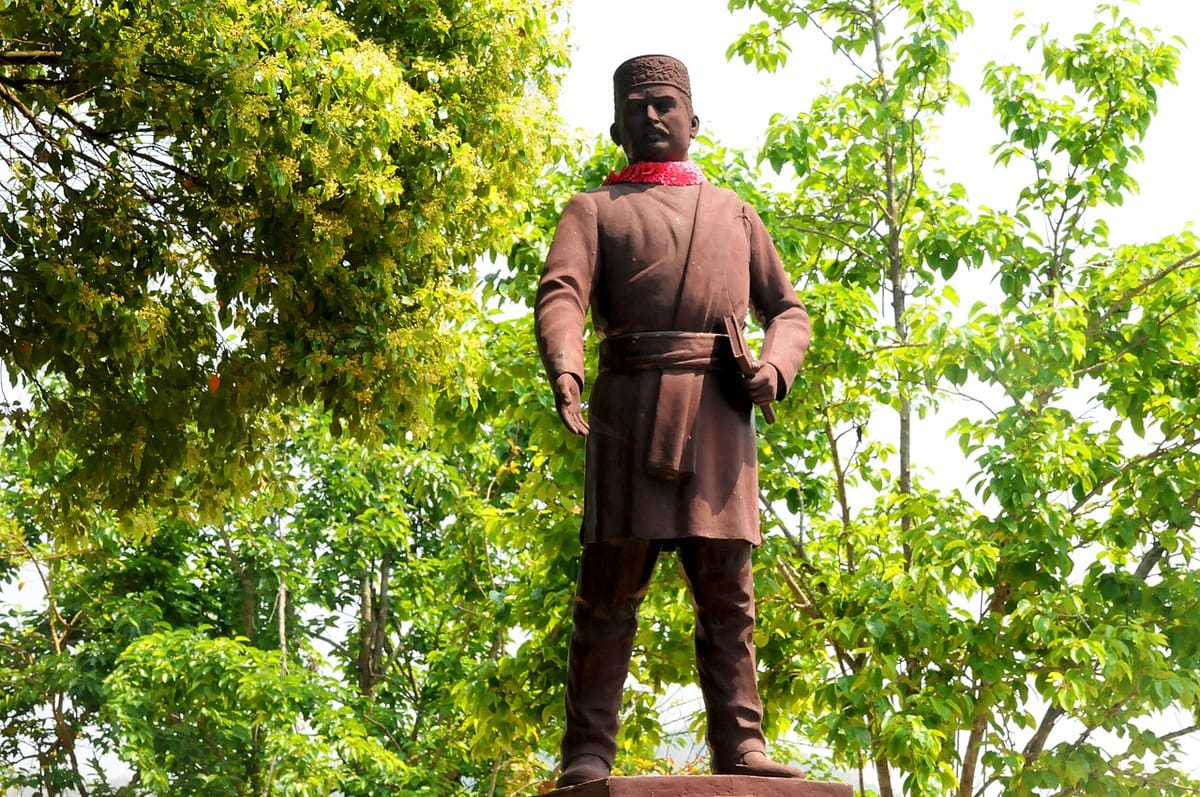
There is a well beside a road in Tanahun that a grass-cutter built so tired travellers could drink. The grass-cutter has been dead for two hundred years. Nobody knows his name.
Bhanubhakta Acharya knew it. He wrote a poem about the man, which is the closest thing to a name that survives. The grass-cutter dug not for payment but to be remembered. He succeeded, in the strange way that anonymous people sometimes do, by handing the work of memory to someone better equipped to carry it.
The man by the road
In the 1850s, Bhanubhakta Acharya was a forty-year-old Brahmin from a comfortable family in Chundi Ramgha, a village in Tanahun District, west of Kathmandu. His father, Dhananjaya Acharya, was a government official. The family had land. They had standing. By any measure available to a Kanyakubja Brahmin household in mid-19th century Nepal, they had everything.
He had not written anything worth keeping.
Then he met the grass-cutter.
The man was poor. Cutting grass in the hills of Tanahun meant long days in the fields for little money, no accumulation, no prestige. Yet here he was beside a road, digging a well for travellers who would never know him. Bhanubhakta asked why. The ghansi said he wanted to leave something behind. He wanted to be remembered after death.
Bhanubhakta went home and began writing.
He wrote a poem called Ghansi about this encounter. But what struck him was not the act of charity. It was the logic. A man with nothing had understood something clearly that a man with everything had been unable to see: that wealth does not outlast a person. Land can be taken. Objects break. Something made, something another person uses and passes on, a well or a poem or a language, persists.
He had been forty years old and entirely comfortable. The grass-cutter had corrected him.
A language without a book
Sanskrit was the prestige language of the subcontinent. In Nepal, Brahmin scholars and the courts of the Rana prime ministers used it for religious texts, for literature, for anything meant to be kept. Nepali was what ordinary people spoke in the hills and valleys. It was the vernacular language of daily life, which is another word for common, which in the literary culture of the time meant unworthy of serious work.
The Ramayana, Valmiki's Sanskrit epic about Ram's exile, Sita's abduction by Ravana, and the war to bring her back, had existed for centuries. Educated Hindus who knew Sanskrit could read it. Ordinary Nepali speakers could not.
Bhanubhakta translated it. Not into a Nepali that approximated Sanskrit's formality. Into the Nepali that people in his village spoke, direct, accessible, capable of holding a great story without deforming it into something unrecognisable.
He also wrote Ram Gita and Bhakta Maala, translated other Sanskrit texts, and continued to write original poetry. But the Ramayana is the work that changed the calculation. A canonical Hindu epic, available in Nepali, was a literary fact with consequences beyond literature. The language he used was sufficient. The people who spoke it deserved the story in the words they used.
Kumarichowk
Bhanubhakta Acharya did not complete the Ramayana in quiet study. He completed it in prison.
The charges related to official accounts. There was a document, a misunderstanding, an accusation of embezzlement that subsequent accounts describe as a clerical error. He was made a scapegoat. The Rana system of the time was not designed to produce precise records about the grievances of poets from hill districts.
He was taken to Kumarichowk jail.
He was forty years old. His son was eight. The bartaman, the thread ceremony that marks a Brahmin boy's passage into religious adulthood, was waiting. It was postponed. He fell ill in the cell. He kept writing.
He finished the Ramayana there. He also wrote a petition poem addressed to the Rana Prime Minister. Formal, structured, detailed in its argument. It described his situation and asked for his freedom in the language that had just proven itself capable of translating an epic.
It worked. He was released. He was also given a bag of money.
A verse bought a man's freedom. This is not a figure of speech.
Aadikavi
Bhanubhakta Acharya died in 1868, at Setighat in Tanahun District, aged fifty-three. He had produced more work than most writers twice his age with twice his comfort. He had been imprisoned and released. He had completed the translation that would define the Nepali literary tradition.
He did not know he would be called Aadikavi.
The title came thirteen years after his death, in 1981 BS, from Motiram Bhatta, who was writing his biography. Aadi means first. Kavi means poet. But Bhatta was not marking chronology. There had been poets who wrote in Nepali before Bhanubhakta. What he was naming was something different: the first person to treat Nepali as a language worthy of serious literary work. The first to write in it as though it deserved a Ramayana.
The title lodged. Other writers came after and built on what he had established. The language he worked in became a literary language because he had worked in it seriously.
In 1955, King Mahendra's government appointed a commission to name Nepal's national heroes, the rashtriya bibhutis. The commission was chaired by the writer Bal Krishna Sama. It produced a list of thirteen names. The others were rulers, warriors, founders. Bhanubhakta Acharya was a poet. He had translated an epic in a jail cell and written a poem about a grass-cutter. He is on the same list as kings.
He had been dead for eighty-seven years.
What Bhanu Jayanti actually is
The 29th day of Ashadh in the Bikram Sambat calendar is his birthday. In the Gregorian calendar it falls on the 13th of July. Each year it is Bhanu Jayanti, and each year the volume of searches for his name in Nepal rises from a baseline of around 4,400 a month to something closer to 18,000.
In Nepali schools, children read his work on this day. His image appears in newspapers. His story is told by teachers who learned it from their teachers, who learned it from theirs.
The same thing happens in Alta, Norway, which is above the Arctic Circle. In Alta, or online from Alta, or wherever Nepali-speaking people have gathered in that latitude, someone recites a poem written in a Tanahun jail cell. One documented Bhanu Jayanti program in Alta drew more than 150 participants via Skype from across Norway. Young people performed and recited from homes across the country.
These are Bhutanese Nepali. They are Lhotshampa, the ethnic Nepali-speaking people of Bhutan. More than 100,000 were expelled from Bhutan in the early 1990s. They lived for years in refugee camps in Jhapa and Morang, in eastern Nepal, before being resettled across eight countries.
The language they speak is Nepali. It connects them across those countries. It is also, in a precise and painful sense, what they were expelled for. The Nepali language was treated by Bhutan's government as evidence of an origin that people were being told to abandon.
In Alta, they recite Bhanubhakta. They are doing what the grass-cutter did: building something with what they have, so they will be remembered.
Frequently asked questions
What does Aadikavi mean? Aadi means first, kavi means poet. The title was given posthumously by biographer Motiram Bhatta in 1981 BS. It does not mean the first person to write verse in Nepali chronologically. It means the first to write in vernacular Nepali with the full seriousness of a literary poet.
Where was Bhanubhakta Acharya born? He was born on 13 July 1814 CE (29 Ashadh 1871 BS) in Chundi Ramgha village, Tanahun District, Nepal.
Why did Bhanubhakta Acharya translate the Ramayana? After meeting a grass-cutter who was building a public well to be remembered after death, he began thinking seriously about what a person could leave behind. Translating the Ramayana into vernacular Nepali was his response: making a great text available to people who could not read Sanskrit.
What happened to Bhanubhakta Acharya in prison? He was imprisoned at Kumarichowk jail on charges related to official accounts. He completed his Ramayana translation during this period and wrote a petition poem to the Rana Prime Minister that secured his release and monetary compensation.
When is Bhanu Jayanti celebrated? Bhanu Jayanti falls on 29 Ashadh BS (generally 13 July CE), Bhanubhakta's birthday. It is observed in Nepal and by Nepali and Gorkha communities worldwide.
The grass-cutter wanted to be remembered. He made a well and handed the task of memory to someone better equipped for it.
Bhanubhakta finished the Ramayana in a jail cell and petitioned his way out with a poem. He died in Tanahun, without a title, not knowing he would be named among thirteen national heroes, not knowing that in the far north of Norway, two hundred years later, young people expelled from their country would recite his work on his birthday to prove their language was still theirs.
The well is probably gone. The poems are not.