Nyatapola Temple: Five Storeys That Have Never Fallen
Nyatapola Temple in Bhaktapur has five storeys and has never fallen - not in 1934, not in 2015. Built in 1702, engineers still study its construction logic.

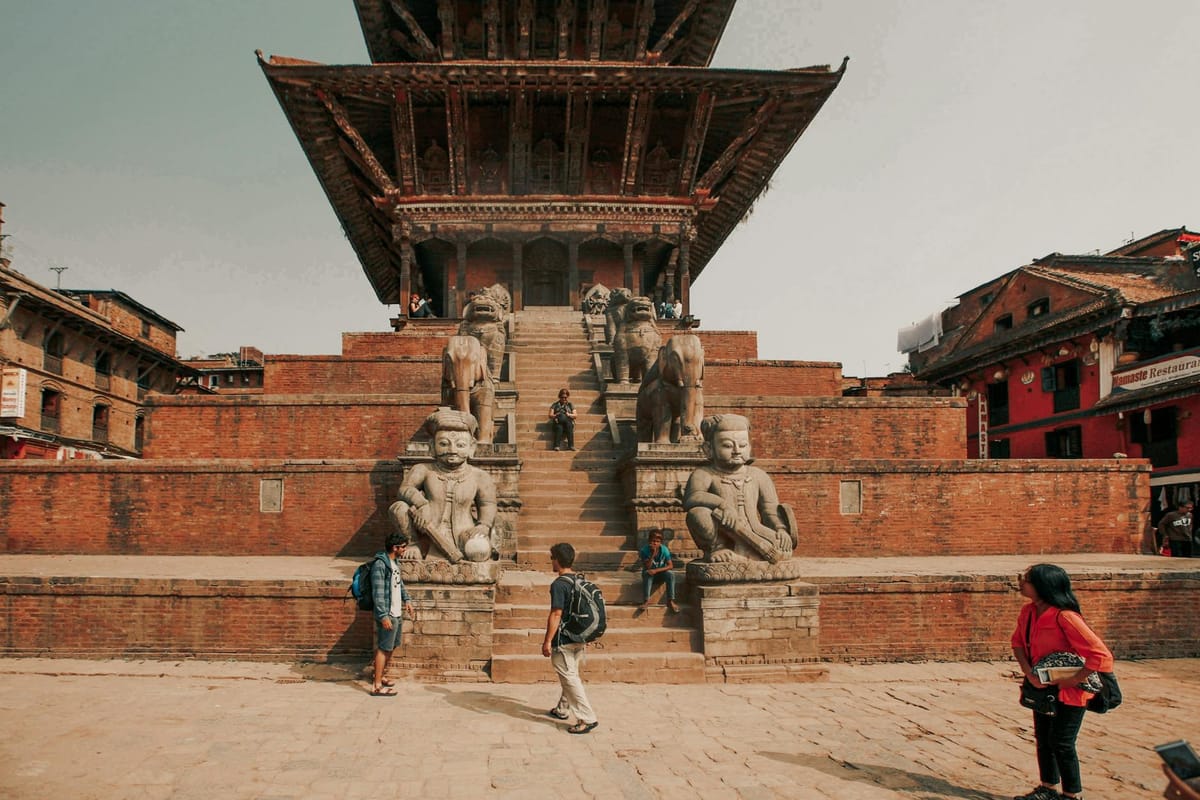
The temple was built in 1702 by King Bhupatindra Malla of Bhaktapur. It has not fallen. This is the fact that the pagoda communicates before anything else: it was built to stand, and it has stood, through the 1934 earthquake that destroyed large parts of Kathmandu and Bhaktapur and Patan, through the 2015 earthquake that did the same to another set of structures, through three centuries of the ordinary events that destroy things over time.
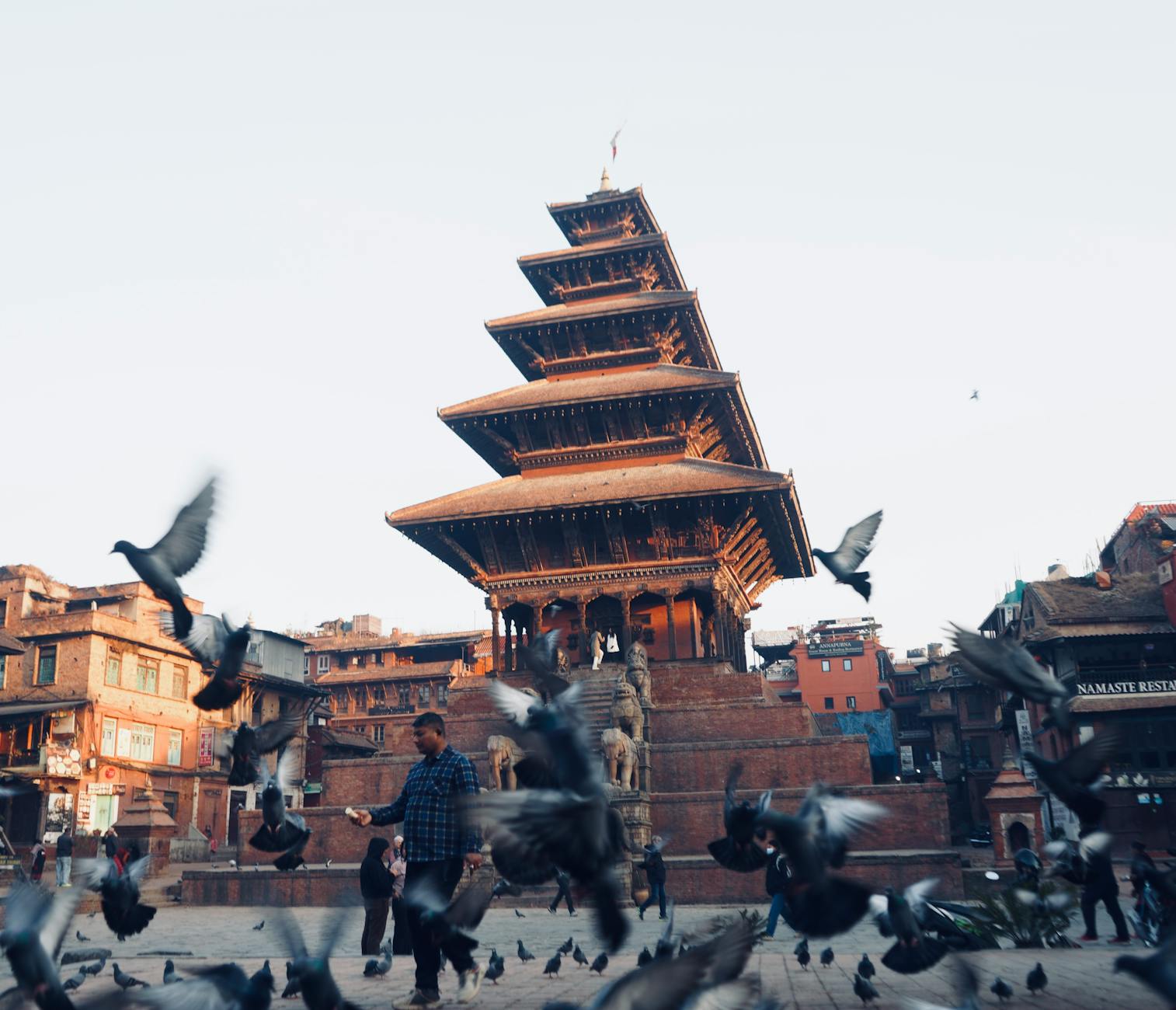
Nyatapola is the tallest temple in Nepal, at approximately thirty metres. It sits in Taumadhi Square in Bhaktapur, which is the square that most people enter first when they come to Bhaktapur's old city. The temple is the visual dominant of the square. Five terraces, each guarded by paired figures that increase in strength by a factor of ten as you climb: first the wrestlers Jaya Malla and Patta Malla, then elephants, then lions, then griffins, then two goddesses at the final terrace. The structural logic of the guardians and the structural logic of the ascending terraces are the same logic. What holds the temple holds is weight distributed correctly across a base designed to receive it.
The architecture of seismic resilience
The pagoda style in Nepal, which developed in the valley over several centuries from a tradition shared with parts of northern India, has certain structural features that explain the survival rate of well-maintained traditional structures in the 2015 earthquake. The heavy timber frame, the flexible joints at the connection points, the mass of the base relative to the height: these are not passive features. They are design responses to a landscape where the ground moves.
The temples that fell in 2015 were, in most cases, temples that had been altered over their history in ways that compromised the original structural system, or temples whose maintenance had been deferred to the point of failure. Nyatapola, which has had continuous and active maintenance since its construction, performed as designed.
The struts that support the extended roof eaves, visible from the outside, are carved. The carvings on many of the struts are explicit, representing sexual union, which in the tantric iconographic tradition that runs beneath Newari Buddhist and Hindu practice is associated with protection: the belief that the goddess of lightning is too modest to strike a surface bearing such images. This is one explanation. Another is that the carvings served as identity markers for the craftspeople who made them. Another is that the iconographic programme of the temple extends from the interior spaces to the exterior surfaces, and the strut carvings are part of that programme. All three explanations are probably partially correct.
The goddess inside
The temple is dedicated to Siddhilakshmi, a tantric form of the goddess who is associated with the powers that the temple's name implies: siddhi means accomplishment or power, and lakshmi is the goddess of abundance. Siddhilakshmi is not visible to most visitors. The inner sanctum is restricted to the priests of the guthi that manages the temple's ritual life, and the deity within has not been publicly documented in detail.
This is not unusual for the major temples of the Kathmandu valley. The visual presence of the temple is for everyone. The ritual interior is for the community that holds it. Nyatapola's exterior is one of the great public architectural achievements of the valley. Its interior is a private matter.
Bhaktapur in context
Nyatapola is the reason most international visitors come to Taumadhi Square, but Taumadhi Square is also the location of the Bhairabnath temple, the Til Mahadev Narayan temple, and the surrounding buildings that form the architectural ensemble of the square. The square functions as a social space as well as a religious one. People sit on its steps. Pigeons occupy its upper terraces. The tea shops that face the square have been serving people watching the temple for several generations.
The entry fee to Bhaktapur's old city for foreign nationals is currently 1,500 rupees, which is among the highest entry fees for any heritage site in Nepal. The fee is managed by the Bhaktapur Municipality and has been used, in part, to fund heritage maintenance including the post-2015 reconstruction of structures in the city. The fee has been controversial, primarily because it applies at the city entrance and does not distinguish between people visiting for a few hours and people staying for several days.
My view is that the maintenance of the Bhaktapur old city at its current standard, which is genuinely higher than the maintenance standard of the equivalent areas in Patan and Kathmandu, justifies the fee. My grandfather worked on temple restoration in Patan, where the funding for that work was always scarce. Bhaktapur chose a different approach. The approach has worked. The temple is still standing.