The Nepal-India Open Border: What It Looks Like at Ground Level
The Nepal-India border is technically invisible. People cross it daily without documents, goods move without declaration, and the towns on either side have more in common with each other than with their respective capitals.

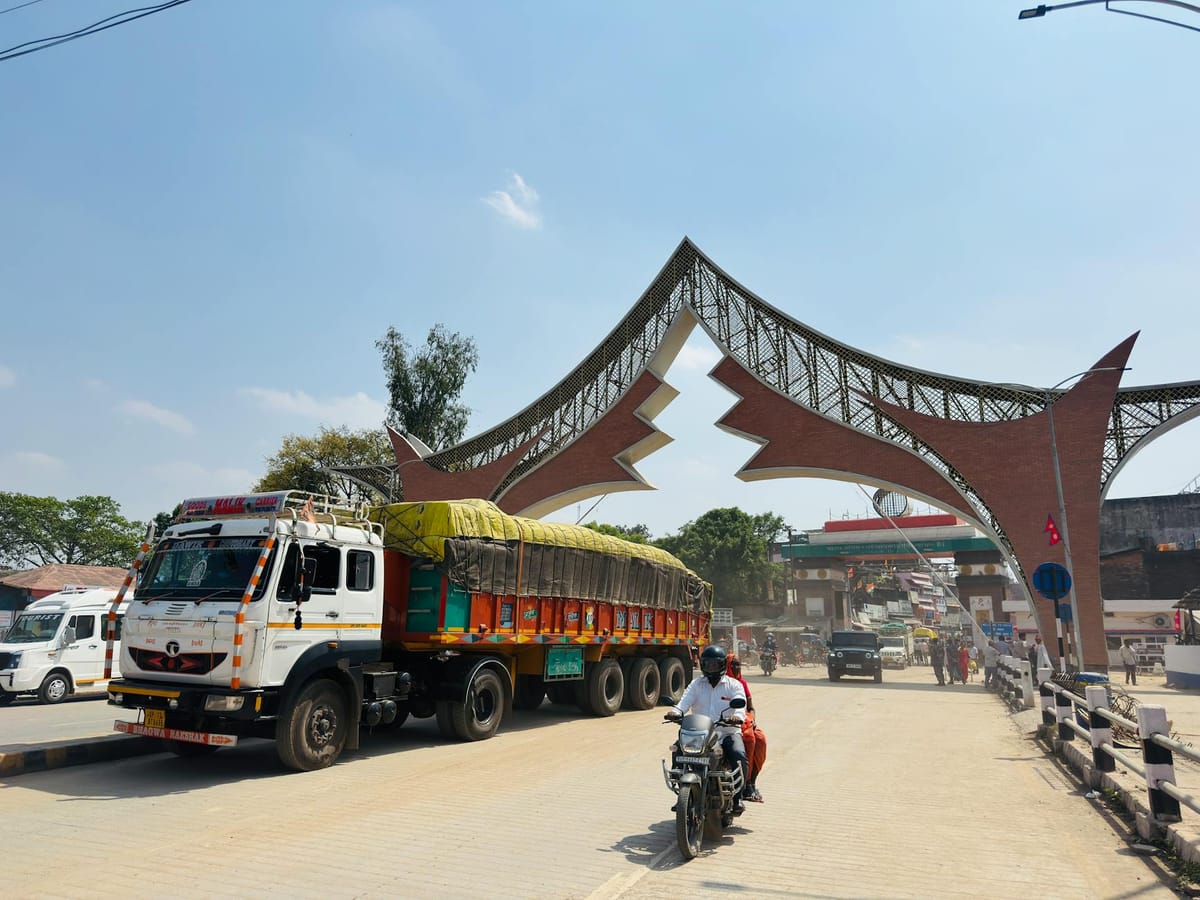
On a Monday morning at Birgunj, the queue for vehicles stretches back into Nepal for four hundred metres. Trucks loaded with Indian textiles, lorries carrying steel rods, three-wheelers piled with plastic goods, motorcycles threading between them, pedestrians walking the shoulder with bundles. The checkpoint opens at six. By seven the queue has already been moving for an hour and the tea stalls along the road have been open since five.
Between India and Nepal, there is no visa. For citizens of either country, no passport is required for crossing by land. The 1950 Treaty of Peace and Friendship established this, and it has held, through border incidents and trade disputes and two earthquakes and one blockade. You present nothing. You walk through.
What that looks like on the ground is different from what it sounds like as a legal fact.
The workers crossing at Birgunj-Raxaul daily are mostly from Madhesh Province. They work in factories in Bihar, in construction, in transport logistics. They cross in the morning and return in the evening or at the end of the week, depending on the job. Their families are in Nepal. Their work is in India. The border is a commute. They do not experience it as an international crossing in any meaningful sense. The currency changes. The road conditions change, sometimes for better and sometimes not. That is the extent of it.
The pilgrims cross in the other direction. Janakpur, in Madhesh Province, is the birthplace of Sita. Indian Hindus from Bihar and Uttar Pradesh come for Vivah Panchami, in December, when the marriage of Rama and Sita is celebrated. They cross at Jayanagar or at Birgunj. They come for Chhath as well, the four-day festival that the Terai and Bihar share completely. Chhath pre-dates the border by centuries and continues to ignore it. The pilgrims carry offerings, not luggage.
What crosses without documentation: rice, lentils, sugar, oil, in both directions, in volumes that do not appear in official trade figures. Small traders have always worked this way at every open border in the world. The goods move by bicycle, by motorcycle, on foot. The customs officials know this. It is a calibrated tolerance.
The 2015 blockade is the event that made this border legible to people who had never thought about it before. After Nepal's new constitution was adopted in September 2015, Madhesi political parties, citing inadequate representation, called an indefinite strike that blocked the crossing at Birgunj. India, whose position on the constitution remained ambiguous, did not intervene. For four and a half months, the crossing was disrupted. Nepal, which imports most of its fuel, cooking gas, and medicine through India, ran short. In Kathmandu, hospitals rationed oxygen. Petrol stations closed for days.
What Nepal ran out of first was cooking gas. Then vehicle fuel. Then, gradually, confidence that the arrangement would hold.
The families who have relatives on both sides of the border, which in the Terai describes most families, did not experience the blockade as a geopolitical event. They experienced it as the interruption of ordinary life. A grandmother could not travel for her granddaughter's wedding. A man could not bring back the medication that was cheaper across the border. The crossing that had always been an irrelevance became a wall.
The blockade ended in early 2016. Constitutional amendments followed, addressing some Madhesi demands and not others. The truck queues resumed. The morning commuters resumed crossing. The Birgunj checkpoint looks as it always has.
But the people who lived through those months have not forgotten what the blockade revealed: that a border this open can close, and when it does, the people who depended on it most are the ones who notice first.