Mardi Himal: The Ridge Where the Clouds Finally Break
Mardi Himal follows a ridge above Pokhara that most trekkers walk straight past on their way to Annapurna Base Camp. Five days, 4,500 metres of high camp, and the point where the clouds finally clear.

Most Himalayan trekking puts the mountains above you. You walk through river valleys, through forest, through the landscape that exists at the base of things, and the peaks are up there somewhere, visible through gaps in the ridgeline, framed by cloud when the weather moves in. The scale is present but you are always below it, looking up.
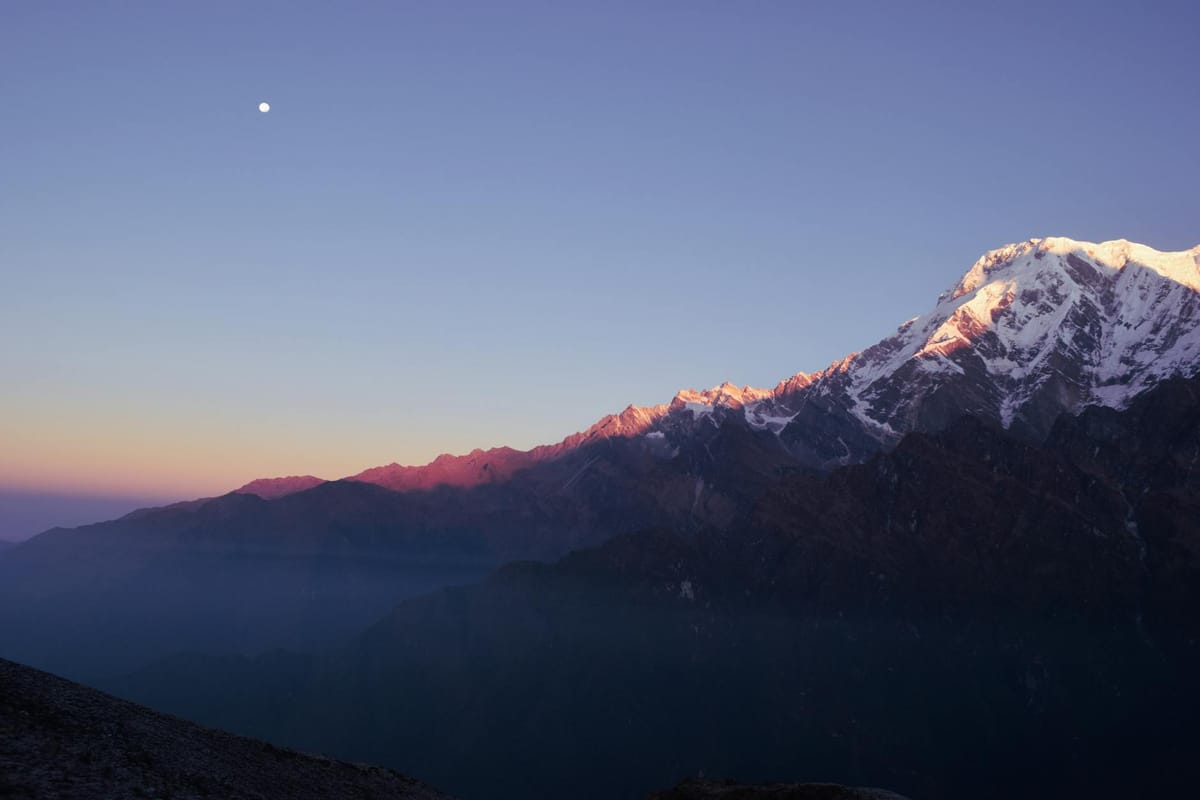
Mardi Himal does something different. From Forest Camp at roughly 2,600 metres, the route leaves the valley floor and gains the ridge. From that point until High Camp at 4,500 metres, you are not below the landscape. You are in it, at eye level with the surrounding terrain, walking a spine of land with the Annapurna massif dominating the western sky at a distance that feels too close for comfort.
Machhapuchhre, the fish-tail peak that defines the Pokhara skyline from the valley, is different from this angle. From Pokhara it is a silhouette. From the Mardi ridge in clear weather, it is dimensional, its two summits distinct, its glaciated faces visible in detail that flattens you.
What the route is
Mardi Himal became a formal trekking route in 2012, following a path that locals had known for much longer. It branches from the Annapurna Sanctuary trail near Kande and takes a separate ridge northeast of the classic routes. The result is a trail that shares a starting point with one of Nepal's busiest treks but diverges quickly into quieter territory.
The standard route to High Camp and back takes four to five days from Pokhara. Acclimatisation is gentler than routes that push rapidly to altitude because the ridge gains height gradually and the sleeping elevations progress sensibly. The path is well-maintained and marked, though the upper sections above High Camp become less defined and require attention in poor visibility.
High Camp sits just below the treeline, in the transitional zone between rhododendron forest and open alpine ground. The tea houses there are basic. The accommodation is mattresses and sleeping bags, shared dorms, food cooked on gas because firewood does not exist at that altitude. The tea is excellent. The view from the dining room window, if you choose the right seat, shows Machhapuchhre filling the entire frame.
November on the ridge
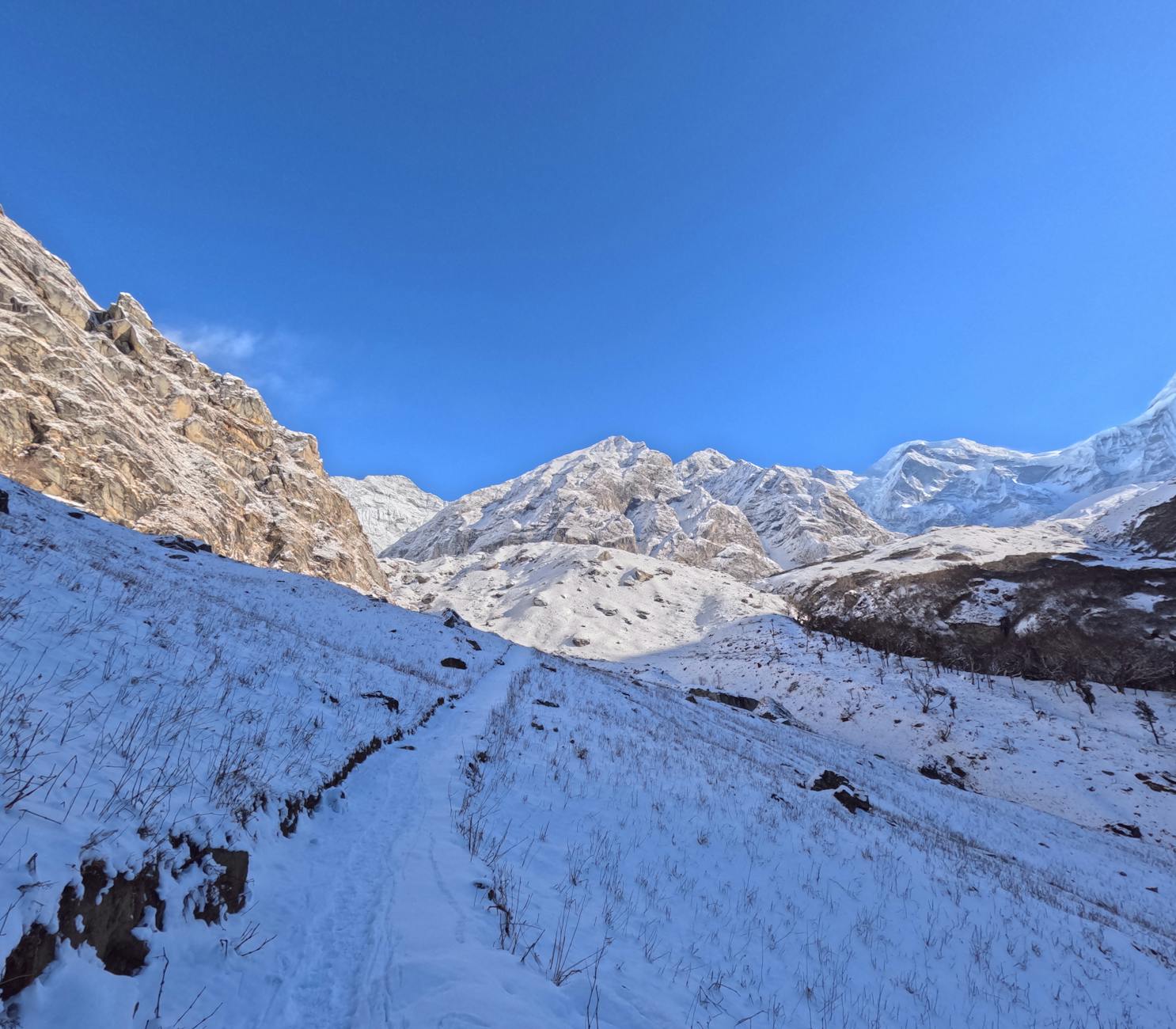
I was there in early November, which is the tail end of the post-monsoon window. The rhododendron forest below Forest Camp was bare of flowers but the light filtered through the branches in a particular way that bare trees permit: flat planes of gold falling across the trail. The mud was dry. The trail was not crowded.
Above Forest Camp, the ridge opens up and the weather becomes the main variable. In November, cloud systems that formed over the Pokhara valley in the afternoon pushed up the southern faces of the hills and arrived at the ridge around 2pm. For an hour or two each afternoon, the visibility dropped to twenty metres and the temperature fell sharply. Then the cloud thinned, the peaks reappeared, and the light in the late afternoon was the colour of copper.
I stayed at Upper Viewpoint Camp one night rather than High Camp, at around 4,200 metres. The trade-off: a slightly less dramatic position but better views in the evening, when the cloud had cleared and the full Annapurna range was visible to the west and Machhapuchhre filled the south.
The two other trekkers at the tea house that night were a father and adult daughter from Bangalore who had been planning the trip for a year. We did not talk much. After dinner we stood outside in the dark and the sky above Machhapuchhre held more stars than the light pollution of any city permits. The father said nothing for a long time, then said it was worth it.
What Mardi Himal is not
It is not a technical climb. The summit of Mardi Himal Peak at 5,587 metres requires mountaineering equipment and permits, and is a different undertaking entirely from the Mardi Himal Trek, which does not reach the peak itself. The confusion between the trek and the peak climb generates misleading information online. The trek ends at High Camp or the viewpoint above it; the summit is for climbers with ice axes and crampons and the necessary experience.
It is not a socialising trek. The trail to Everest Base Camp has a community: dozens of nationalities converging on the same teahouses, the same passes, the same famous campsites. Mardi Himal is quieter. In a week on the ridge I spoke to perhaps thirty other trekkers. The tea houses are small and the evenings are domestic rather than social. If you want to be left alone with the mountains, this is the architecture for it.
The cloud inversion
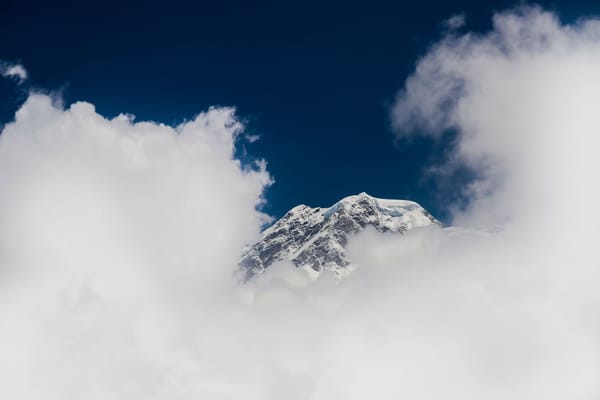
The ridge's particular advantage in November is the cloud inversion. Warm moist air from the south rises and condenses below the ridgeline, filling the valleys with a white floor. From above, you walk along the top of the cloud, with peaks emerging from it, the lower landscape invisible. It is a specific kind of beauty, the kind that depends on particular atmospheric conditions aligning. It does not happen every day. When it does, it is one of the more striking things the Annapurna region offers.
I saw it twice in four days. Both times I stopped and did not move for longer than I can accurately report. The mountains do not require anything of you in those moments except that you stay present, which is its own form of demanding.