Lumbini: What the Pilgrimage Industry Built Around the Buddha's Birthplace
The Maya Devi Temple marks where the Buddha was born. Around it, forty-two monasteries built by nations from Myanmar to Germany. What the pilgrimage economy looks like and what it has built over.


The marker stone at Lumbini Nepal is smaller than you expect. It is not a statue, not a relief, not a throne. It is a worn slab of sandstone about the size of a school desk, placed on a platform inside a glass-walled shrine, and it sits roughly where archaeology says the Buddha was born in the sixth century BCE. Around it the Maya Devi Temple is white and low and quiet. Around the temple is the Sacred Garden. Around the garden is the Monastic Zone, nearly five kilometres long, where forty-two nations have built their own temple for the same man. One traveller wrote that walking through the garden, "you'll immediately sense the gravity of where you are. Prayer flags hang between the trees and pilgrims sit underneath them in silent prayer." That is half the site. The other half is the town outside the fence, which is a different kind of place altogether.
The Marker Stone
What is actually inside the Maya Devi Temple is mostly a question mark around a dot. The dot is the marker stone, a small piece of sandstone whose position archaeologists believe corresponds to the exact spot of the birth. The question marks are the layers underneath it. Excavations conducted between 1994 and 2013 uncovered earlier timber and brick structures, including a sixth-century BCE tree shrine, which is the earliest physical evidence of Buddhist worship anywhere in the world. Above the stone, a fifth-century nativity sculpture shows Queen Maya Devi holding a sal branch, the posture the scripture records.
Entry is barefoot, even on days when the ground outside is forty degrees. "The floor is like lava by midday," one traveller wrote, and that is not metaphor. Visitors who arrive between noon and three often retreat to the grass under the trees within minutes. The temple does not observe the 24/7 opening hours one might expect from a pilgrimage site of this weight. It closes at lunchtime.
The Ashoka Pillar Is the Oldest Inscription in the Country
Twenty-five metres from the temple stands a column of polished sandstone inscribed in Brahmi script. It was erected by the emperor Ashoka in 249 BCE, and the inscription records, in the emperor's own first person, his visit to the place where the Buddha was born. It is the oldest surviving inscription in Nepal. It is also one of the few independent documentary confirmations that the Buddha was a historical person who was born at this specific location. Scholars have spent two centuries arguing over what the text does and does not prove. Pilgrims, mostly, walk past it and touch it for blessing.
Forty-Two Monasteries and Zero Architectural Agreement
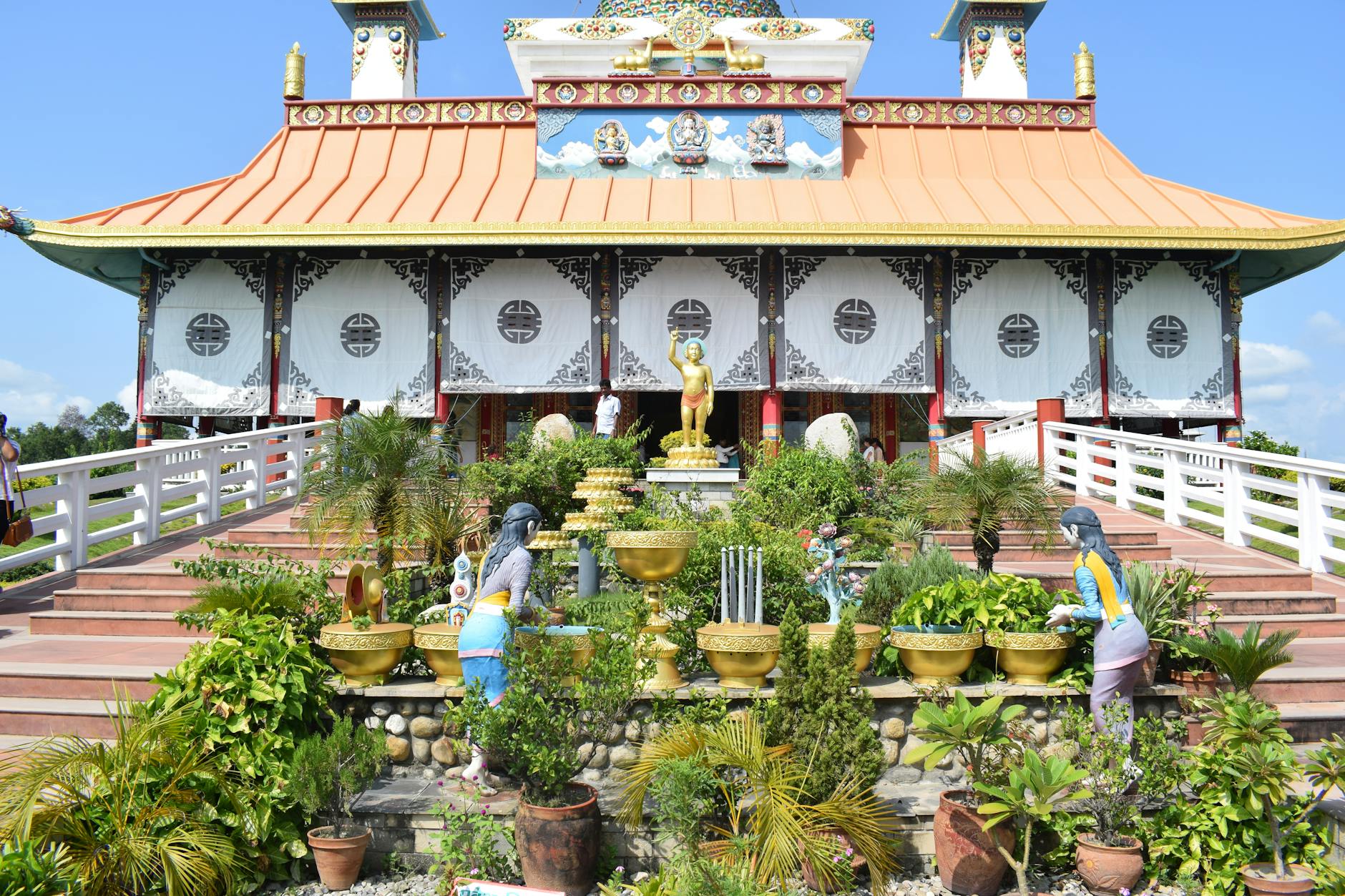
The Monastic Zone was the contribution of Kenzo Tange, the Japanese architect who in 1978 designed the master plan for the site at the request of U Thant and the Nepali government. The plan divides the land east of the Sacred Garden into two rectangular strips, one for Theravada monasteries, one for Mahayana. Each country that wanted to build a temple received a plot. Forty-two have been built so far. The Chinese monastery is a Ming-dynasty compound in red and gold. The Korean monastery is pale stone and steep roofs. The Sri Lankan monastery is white and slender. The Vietnamese monastery looks like a carved lacquer cabinet. The German monastery is concrete.
There is no architectural agreement because there is no theological agreement about what a monastery should look like. That is the argument the site is making, quietly, in built form: Buddhism was one tradition, became many, and the many have returned to the place the one started. "Part of the experience is cycling amongst the nature as you go between the monasteries," one traveller wrote. The cycle path is the best way to see it. Most visitors take half a day and still miss thirty of the forty-two buildings.
Who Comes to Lumbini
Most visitors to Lumbini Nepal are not casual tourists. One writer described them as "true pilgrims, who have come from around the world to visit the birthplace of Buddha," and the description holds. The largest contingent is Indian Buddhist, arriving by bus from Bodh Gaya in Bihar, which is eight hours south-east. The second largest is Sri Lankan, arriving by Kathmandu flight and overland bus. Tibetan monks and nuns are always present in small numbers, usually in the Tibetan and Bhutanese monasteries. Japanese donors fund restoration projects that appear as small bronze plaques near trees. Korean pilgrim groups come in chartered coaches.
The pilgrims sit for hours. That is the distinguishing feature. A Western traveller who came for photographs will leave in three hours. A Japanese pilgrim who came to recite will stay from morning until the gates close. "Being at the birthplace of Lord Buddha, seeing the devotion of the pilgrims around you and feeling the power of this place is an experience not to be missed," one blogger wrote. What the pilgrims are doing is audible from across the lawn.
Bhairahawa, the Airport, and the City That Did Not Arrive

Outside the sacred complex, things change. Lumbini town and the nearby city of Bhairahawa sit in flat Terai farmland seventeen kilometres from the Indian border. Bhairahawa has an international airport, Gautam Buddha International, opened in 2022 after more than a decade of construction and serious cost overruns, built specifically to bring pilgrims directly to the site without routing through Kathmandu. The expectation was that traffic would follow. Mostly it has not. Flights are few. Most passengers still transit through Kathmandu.
One traveller put the contrast plainly: "Great temples on the one side and then a terrible underfunded city on the other." Roads into town have been dug up for years at a time. Another blogger complained of "digging up the sewers... a lot of flies and bad smells." The hotels range from adequate to rough. A third-party visitor reported being "bitten to death throughout the night" by mosquitoes. Food is reliably poor. The same visitor described a hotel meal as "a Thukpa with ants swimming in it."
There is an alternative. The monasteries take in pilgrim lodgers for around five dollars a night, three meals included, plain dormitory rooms, a bell at four in the morning. Most travellers who learn this too late regret the hotel. Those who plan for the monastery do not.
Getting to Lumbini Is Part of It
If you are not flying, you are on the road. The usual land route is from Kathmandu or Pokhara via Narayanghat and Butwal, and the usual time is six to nine hours depending on traffic, weather, and the condition of the strip through the Terai. A traveller who came from Chitwan wrote that "the bus from Chitwan to Lumbini was the worst of our 3 months in Nepal," and the complaint is common. The road improves each year and each monsoon undoes the improvement.
The Indian route is different. Pilgrims from Bodh Gaya come by overnight bus across the open border at Sonauli, then take local transport for the final thirty kilometres. The bus drops them at a dusty stand near the east gate of the complex. They walk the rest.
What the Site Does Not Owe You
Some visitors leave disappointed because they expected Lumbini to look like a theme park of enlightenment and found instead a hot, flat, working sacred site with bad hotels attached. One wrote that they "were glad to leave and head back to comfortable Pokhara." That response is honest. It is also the wrong frame. The site is not in the comfort business. The site is not in any business. It is marking a place where something happened two and a half millennia ago, and it has been overwhelmed for decades by what the world has tried to build around it, and the marker stone remains the same size it has always been.
Arrive with no expectations and no schedule. The garden will give you an afternoon. The cycle path through the monasteries will give you a morning. The Maya Devi Temple will give you ten minutes at a slab of sandstone, after which you will sit outside on the lawn and try to understand why you travelled this far to see something this small. The answer, when it comes, is the same one pilgrims have been carrying from this place since 249 BCE. The place is not the building. The place is the place.