Nepal Currency: What the Rate Is, Where to Change It, What to Avoid

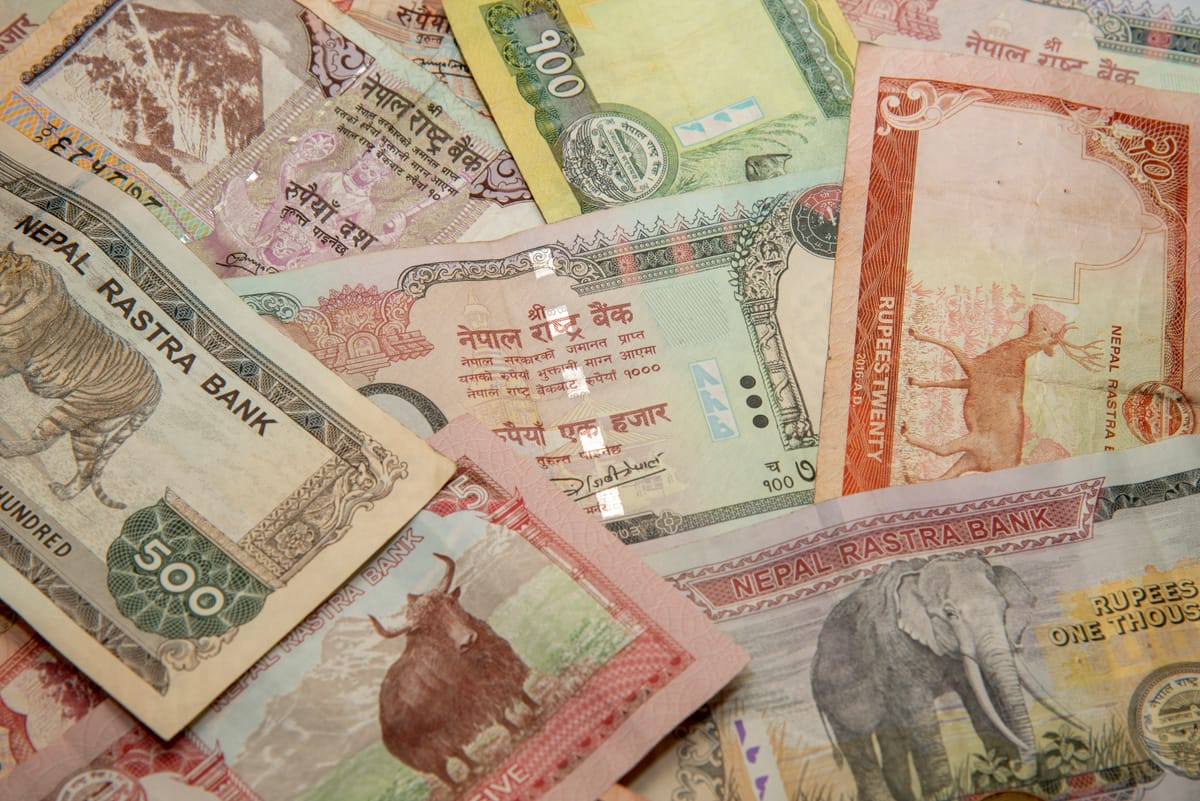
Nepal uses the Nepali Rupee (NPR). As of mid-2025, one US dollar buys around 133-135 NPR. That rate moves daily. Check Nepal Rastra Bank's live rate before you go, and again when you arrive.
Everything else in this guide covers the decisions most travellers get wrong: which bills to bring, where to change money, how to avoid ATM fees, and what happens above Namche Bazaar when the machine is empty.
The basics
The Nepali Rupee is the only legal tender inside Nepal. USD and EUR are widely quoted at hotels and trekking agencies, but all actual payments happen in rupees at whatever the day's rate is. Knowing the current rate is worth five minutes before any negotiation.
A rough shorthand: divide any rupee price by 130 to get the approximate dollar equivalent. At NPR 3,000 for a night in Thamel, that is about USD 23.
Rupees cannot leave Nepal. Airport customs does check. Any NPR left at departure needs to be converted back before you go through. Authorised exchange counters at Tribhuvan International Airport handle this. The rate will not be as good as in the city, but it works. Keep your exchange receipts. Some counters ask for them.
Where to exchange
Three options: the airport on arrival, banks in Kathmandu, or money changers in Thamel.
The airport rate is acceptable. Not the worst place to change a small amount to cover transport and the first night.
Banks offer the official Nepal Rastra Bank rate. The process is slow, requires your passport, and counters close by 5pm.
Thamel's money changers operate under authorised licences. Plenty of travellers told us they used them for every exchange without issue, and the rate is often marginally better than the banks. The ones with shopfronts are fine. Anyone who approaches you on the street with a special rate is not.
The USD condition rule
If you plan to bring USD cash, the bills must be in good condition and dated 2006 or later. A visible fold, a small tear, or a bill printed before 2006 and the counter will turn it away. This is stricter than most countries and it catches people off guard. Check your USD before leaving home. Other major currencies (EUR, GBP, AUD) have looser standards at most counters in Kathmandu.
ATMs
ATMs are the most practical option for most travellers. You draw rupees directly, no queue, no exchange calculation.
Kathmandu and Pokhara have plenty of machines. Himalayan Bank and NIC Asia tend to charge on the lower end: around NPR 500 per withdrawal. Other networks go up to NPR 800. Your home bank adds its own international fee on top.
To reduce costs: withdraw larger amounts less often rather than small amounts every day.
One thing to watch. When the ATM asks whether you want to pay in your home currency, decline. This is called dynamic currency conversion (DCC), and the machine's rate is worse than your bank's. You end up paying a fee twice. Decline DCC every time.
For safety: use ATMs inside bank lobbies. Skimmers have turned up on freestanding machines in Thamel. Cover the keypad when entering your PIN.
Cash for trekking
Above Namche Bazaar, the infrastructure changes. The Everest Base Camp trail has ATMs in Namche, but mid-season they run out of cash or go offline. There is nothing above Namche. Lukla has no ATM at all.
The consistent advice from trekkers: carry enough cash from Kathmandu to cover your entire trek. Meals, lodging, permits, tips, and a 20% buffer. Do not plan to top up in Namche.
Denomination matters above the foothills. A trekker told us they tried to pay with a 1,000 NPR note at a teahouse above Tengboche and the owner had no change. At altitude, teahouses run on small notes. Carry 100s and 500s above Namche. Keep the 1,000s for Kathmandu.
Cards
Credit and debit cards work at most hotels, established restaurants, and gear shops in Kathmandu and Pokhara. Visa and Mastercard have the widest acceptance. American Express works at fewer places.
Outside the cities and above the foothills, assume cash only.
The DCC rule applies at card terminals too. If the machine offers to charge you in your home currency, say no.
Indian rupees

If you are crossing overland from India, note that denominations of INR 100 and below are not accepted in Nepal. INR 50, INR 20, INR 10 notes are useless here. Only INR 200, 500, and 2,000 are exchangeable at Nepal's authorised counters.
Frequently asked questions
What currency does Nepal use?
Nepal uses the Nepali Rupee (NPR). USD and EUR are common reference prices in tourist areas, but all actual payments happen in rupees.
Can I use US dollars in Nepal?
Not directly as payment. You can exchange USD at any authorised money changer or bank. Bills must be in good condition and dated 2006 or later. Older or damaged notes are refused.
Is it better to exchange money before I arrive?
No. Exchange rates in Nepal are better than in most countries abroad. Change a small amount at the airport on arrival, then use ATMs or Thamel money changers for the rest.
Are ATMs available on trekking routes?
Nameche Bazaar has ATMs, but they are unreliable mid-season. Lukla has none. Above Namche there is nothing. Carry all trekking cash from Kathmandu.
Can I use credit cards in Nepal?
In Kathmandu and Pokhara, yes, at hotels, restaurants, and gear shops. Outside those cities and on trekking routes, assume cash only. When a terminal offers to charge you in your home currency, decline.