The Kumari of Nepal: The Living Goddess and the Life She Cannot Own


Nepal's living goddess is not a metaphor. There is a girl in Kathmandu right now who is carried rather than walks, who sits in silence on a throne while a queue of devotees files past her, who receives one hour of tutoring a day and cannot speak to foreigners. She is the Kumari. There have always been girls like her, in that house on Durbar Square, living this particular life.
There is a photograph of Chanira Bajracharya taken in 2007, when she was eight years old. She is in full ceremonial dress: the red robes, the elaborate headdress, the agni chakshu painted on her forehead as a third eye. She is looking directly at the camera with an expression that contains nothing. Not sorrow, not joy. She was the Royal Kumari of Nepal from 2001 to 2006. She did not know how to hold a conversation when she stepped down.
The institution and its origins
The Royal Kumari of Kathmandu is the most visible of approximately twelve living goddesses across the Kathmandu Valley. Patan has its own Kumari, Bhaktapur has one, as do Bungmati and Thimi. Each is maintained by a different Newar community with its own custodians and traditions. The Royal Kumari receives almost all the attention. The others continue with similar rigour and considerably less.

The tradition in its current institutional form dates to the 17th century. The Malla king Jaya Prakash Malla established the Kumari Ghar, the palace on Kathmandu Durbar Square where the goddess still resides, and formalised the selection and custodianship arrangements that remain largely intact today. The king's motive was political as much as religious: a living goddess venerated across Buddhist and Hindu communities unified the Newar people along sectarian lines. This is why a Buddhist girl from the Shakya or Bajracharya goldsmith clan embodies a Hindu goddess. The dual-faith structure was not a compromise. It was engineered.
The goddess Taleju is understood to depart and re-enter human vessels. When the current Kumari reaches puberty and experiences her first menstruation, the goddess is believed to leave. A new vessel is sought. The institution has continued in this form for approximately four hundred years.
How a Kumari is chosen
Eligibility begins with family. The girl must be born into a Shakya or Bajracharya family within the valley. Beyond lineage, she must meet 32 physical attributes called lakshanas, enumerated with the precision that characterises Newar ritual cataloguing: thighs like a deer, chest like a lion, eyelashes like a cow, neck like a conch shell, a voice as clear as a duck. Body inspection is conducted by the committee of five senior Buddhist priests who administer the selection: the Chief Royal Priest, the Priest of Taleju, and the Royal Astrologer among them.
She must have no scars. No teeth missing. No prior bloodshed of any kind.
One selection detail that does not appear in standard accounts: candidates are given specific grains known to produce adverse reactions in some individuals. Girls who react are disqualified. Chanira Bajracharya, who later documented her experience across multiple interviews, advanced because she showed no reaction. The committee read this as confirmation that the goddess Taleju resided within her.
The terrifying dark room with severed buffalo heads, which circulates widely as the fearlessness test used to select a Kumari, is a different ritual entirely. As Rashmila Shakya, another former Royal Kumari, documented in her memoir From Goddess to Mortal, the buffalo head ritual takes place annually after installation, as an ongoing verification of the goddess's fearlessness. It is not part of the selection. The selection itself is quiet and methodical, because by the time a candidate reaches its final stages, almost every other girl has already been ruled out on physical grounds alone.
What she cannot do
Chanira Bajracharya received one hour of tutoring per day during her four years of service. That hour was frequently interrupted for rituals.
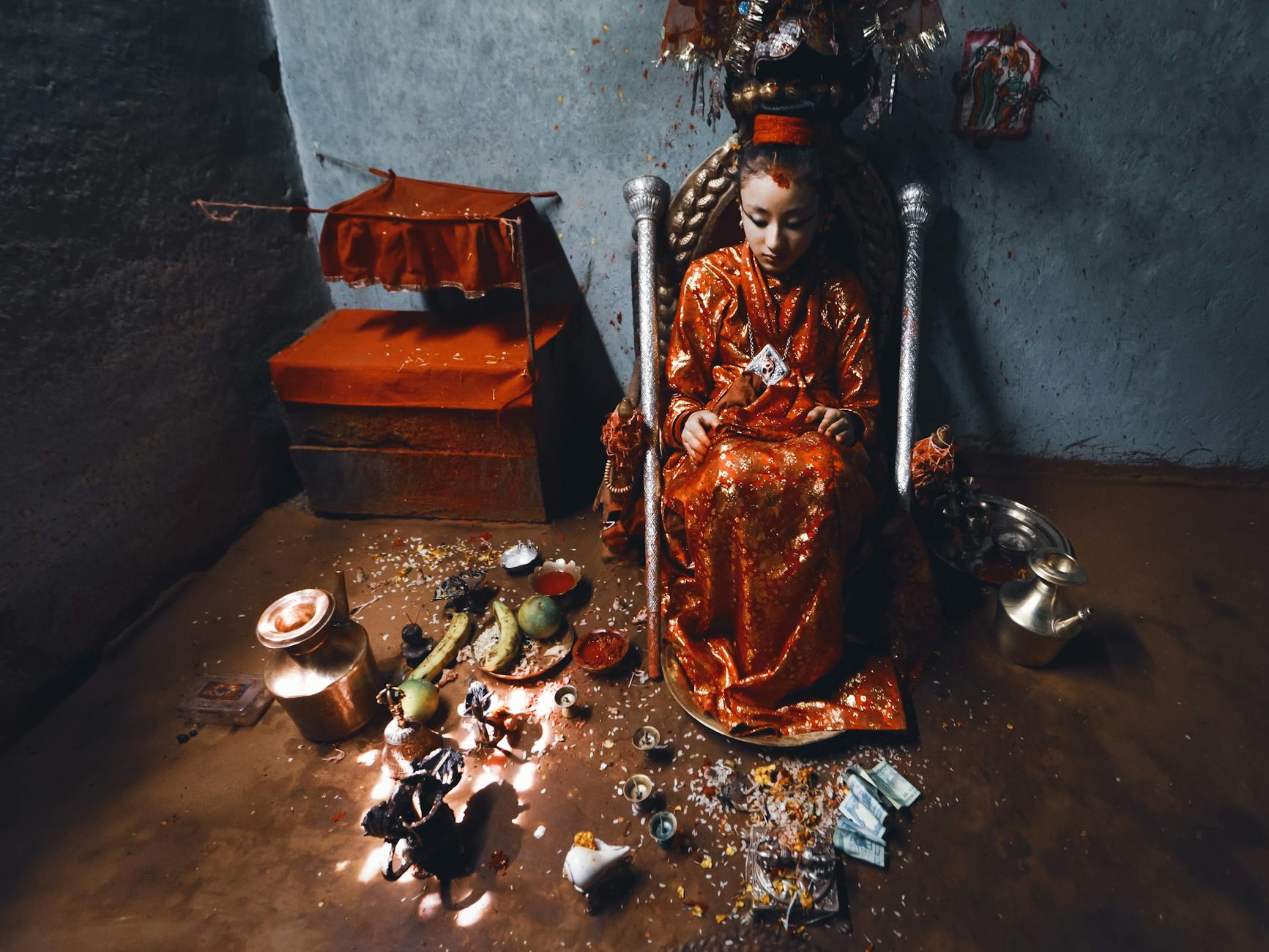
She never wore shoes. The Kumari does not touch the ground outside designated worship sites. The earth is considered profane for a living deity; she is carried on a palanquin, placed on cloth, transported. Rashmila Shakya noted the same: no shoes, no bare feet on bare ground, for the entire duration of her tenure.
She did not speak to outsiders. She did not leave the Kumari Ghar unaccompanied. On busy days when devotees queued for darshan, the brief audience in which the goddess grants or withholds her blessing through a glance, she sat in silence on the throne while the line moved past her. She told the Nepali Times in 2017: "You are not allowed to leave the house alone, you cannot speak to foreigners, it becomes quite stressful once it's all over." On those same busy days, she could rest if needed. Her mother, who lived with her throughout her tenure, learned to apply the ceremonial makeup through practice: the kohl lines extending to the temples, the red pigment, the agni chakshu third eye on her forehead. No formal instruction existed for this.
The mother of a more recent Kumari described watching other children play outside and feeling a mild sadness. She framed it as a trade-off: friends were allowed to visit inside, and any request for toys was fulfilled. The goddess could have visitors. She could rest. She simply could not move through the world in the way children move through the world.
The Indra Jatra procession

Once a year, during the Indra Jatra festival in August or September, the Kumari leaves the palace. She rides in a tall chariot through the lanes of Durbar Square, preceded by the chariots of Ganesh and Bhairab. The chariot is the tallest of the three. Moving it through narrow corners requires, in the account of someone who watched it in 2024, tremendous effort and many hands.
That account describes the transformation of the square over a single afternoon: sparse during daylight, overwhelming by evening, with people pressed against statues, standing in doorways, climbing to windows. When the chariot moved, the crowd went loud. The Kumari sitting in it did not speak a word. She did not emote.
Look at the women lining the route. They are not passive spectators. They are doing the work of recognition: preparing offerings, maintaining household readiness, teaching children what to do with their hands and eyes when the chariot arrives. Their bodies are part of the route's infrastructure. The institution is not only the girl, it is the network that receives her. This is where you can see the Kumari as a living system rather than an exotic child. The city is rehearsing itself.
Before approaching the Kumari Ghar, locals gave a warning to the same observer: if the Kumari smiles at you, it is an omen of misfortune. This inverts how most Western travel writing presents a sighting of the goddess. The unsmiling gaze is not severity. It is the appropriate disposition of a deity attending to something invisible. A smile means she has noticed something wrong.
When she steps down
Chanira Bajracharya stepped down in 2006, at fifteen, when she reached puberty. She described the period following her retirement across interviews spanning nearly a decade, and the account changed as she did.
In 2017, she told the Nepali Times: "I did not know how to join a conversation, could not understand how people behaved, everything was strange." She had never navigated a social group without being at its centre, without everyone deferring to her silence. Her parents taught her physically how to walk confidently in public. Starting college among peers her own age, she could not locate herself among them. "I lost that respect," she said in another interview. "I never imagined that my life would be so changed in such a sudden way."
By 2024, the account had shifted. She told the Kathmandu Post: "It is incorrect to assume that Kumaris are destined to face mental health issues later in life. This is a misconception." By then she had earned a master's degree in business administration and was working as a credit analyst at an Australian mortgage brokerage. She was mentoring young former Kumaris. "We really need education to survive," she said. She plans a peer support network for former living goddesses, focused on education and employment.
The government pension for retired Kumaris is approximately US$110 per month. The same woman. Seventeen years of interviews. A life navigated, in stages.
The curse and what it actually is
The belief that a man who marries a former Kumari will cough blood and die young is a Newar folk belief. It is not religious doctrine. The Guthi, the trust that administers the institution, does not endorse it. No senior priest has formally stated it. It does not appear in any founding document of the tradition.
All documented former Kumaris who chose to marry have married.
The belief functions in the real world regardless. Several former Kumaris have described genuine difficulty finding partners. The folk belief is not religious enforcement, but it is social friction. That distinction matters, because one can be addressed by the institution and one cannot.
What the tradition is doing
The Kumari leaves the palace when she bleeds for the first time. The specific biological event that ends her tenure is menstruation. This is rarely stated directly in coverage of the tradition, though it is always the reason given.
The University of Groningen's Centre for Religion, Conflict and Globalization has argued that this is the reform the tradition most consistently avoids: by structuring the goddess's departure around first menstruation, the institution reinforces the idea that menstrual blood is impure, a belief that operates far beyond the Kumari tradition in Nepali social life. The reform argument is not that the tradition should end. It is that the Kumari's tenure should be decoupled from menarche. The institution could survive that change. The stigma it currently embeds in a child's most significant ritual transition is worth examining on its own terms.
The current Royal Kumari is Aryatara Shakya, enthroned in September 2025 at two years and eight months old. Almost every article about the Kumari still names Trishna Shakya, who served from 2017 to 2025 and stepped down at twelve. What happens to Trishna now is the same question that attaches to every former Kumari, and it is answered differently by everyone who has lived it.
The goddess will find a new vessel. She always has. The girl navigates what comes after.
In Kathmandu, boundaries are not always walls. Sometimes they are rules repeated at a doorway, and honoured by an entire square.