Boudhanath: The Stupa and the Community That Rebuilt It

At 6:32 in the morning, a woman is sweeping. Her broom makes a dry scratching sound against the stone of the outer circuit, and the movement is unhurried. Around her, in one continuous stream, people move clockwise. Some carry malas. Some have their lips moving. A monk in ochre walks at the same measured pace as an elderly woman wrapped in thick wool who is carrying, it seems, the full weight of accumulated ritual.
The Boudhanath Stupa stands at the northeast edge of Kathmandu. This is the stupa, and the life around it begins before sunrise.
What the stupa is, and what it is not
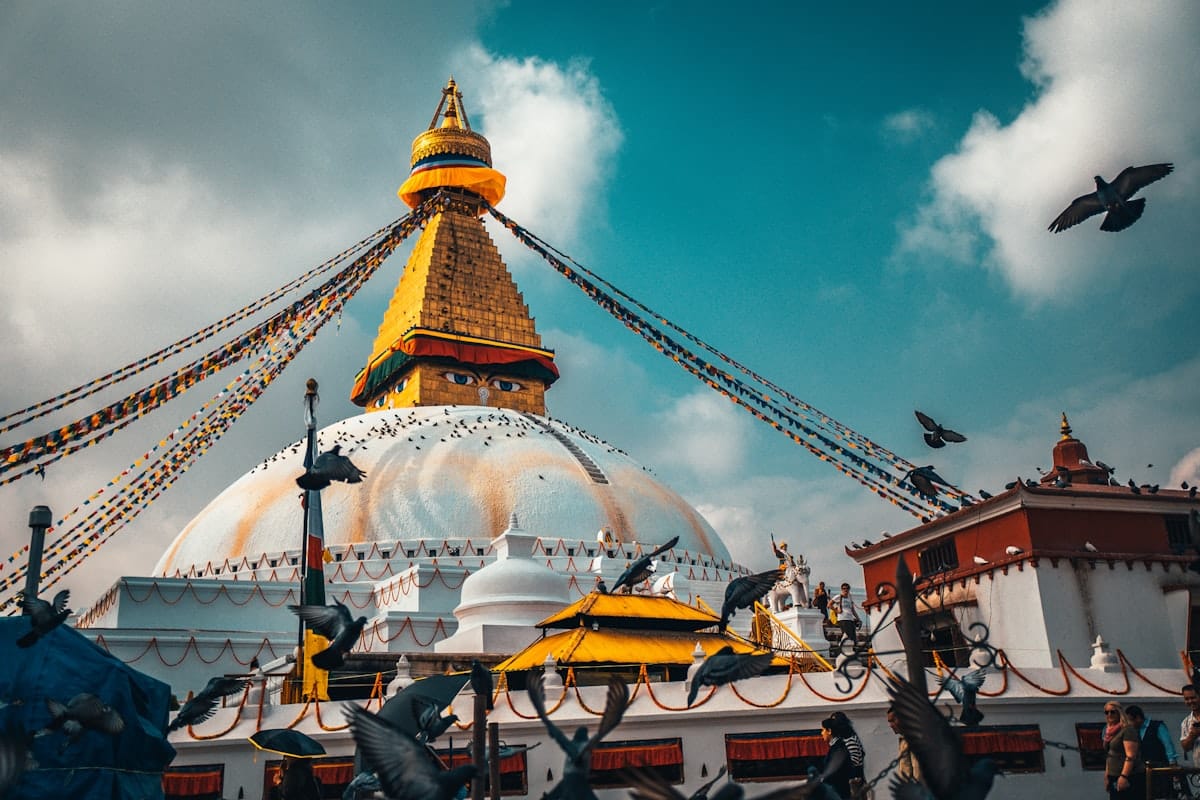
The dome is white. The eyes painted on the tower above it watch in all four cardinal directions: they look. The lotus base. The rising hemisphere. The pinnacle with thirteen rings, each representing a level of the Buddhist path to enlightenment. These are standard elements in Tibetan Buddhist stupa architecture, but at Boudhanath the scale changes the visitor's relationship with the structure. The dome reaches 36 metres. The circumference of the kora circuit takes fifteen minutes at a calm pace.
What the guidebook summary misses is the stupa's function as an engine of daily life. This is not a monument with visiting hours. It opens in the pre-dawn dark and the activity continues until well after nightfall.
The kora: walking the circuit

The people on the morning circuit are not sightseeing. They are engaged in a practice with a specific count. Many carry a mala, a string of 108 beads, and move one bead per recitation of Om Mani Padme Hum: the six-syllable mantra carved into the prayer wheels lining the inner wall. Others no longer need the beads. They have been doing this long enough that the count runs in a different register, the way a craftsperson's hands know their work without conscious supervision.
A monk at the north face performs full prostrations at intervals: he stands, raises both arms above his head, lowers himself completely flat to the stone, and rises again. Woodblock grips protect his palms. He does this repeatedly and does not appear to be performing for anyone, because he is not.
The circuit is not silent, though it is not loud either. Someone is always chanting. The prayer wheels along the inner wall are kept spinning by passing hands, and their collective rotation makes a sound like stones shifting in water. Butter lamp vendors open their stalls just before six. The lamps cost twenty to fifty rupees each, and any person can buy one and light it. No ceremony is required.
At dusk, around five in the afternoon, hundreds of butter lamps are lit at the base of the stupa. The smoke rises with the incense already burning from earlier in the day. Prayer flags strung overhead carry text that altitude and weather have reduced to pattern. People who live near Boudhanath call this the best hour, and they are consistent about it.
One detail visible only from the rooftop cafes ringing the upper storey of the surrounding buildings: during religious observances, saffron water is poured over the dome's surface in a specific pattern, forming lotus petal shapes as it runs down the white plaster. From street level, this is invisible.
The 2015 earthquake and who rebuilt the stupa
In April 2015, the magnitude 7.8 earthquake that killed approximately 9,000 people in Nepal cracked the spire at Boudhanath. Across the Kathmandu Valley, more than 700 heritage structures sustained serious damage.
The Nepali government, managing catastrophe at a national scale, directed its resources elsewhere. The restoration of Boudhanath was funded by the community the stupa has always belonged to: Tibetan Buddhists in Nepal, diaspora organisations around the world, and local families who had built their lives around the structure.
The total cost was 230 million Nepalese rupees, approximately US$2.1 million. Of that amount, US$1.41 million went specifically to gold for the pinnacle and crown. Donors specified where their contributions were directed. Thirty-one kilograms of gold were contributed for the thirteen stepped rings of the spire alone, each ring representing a level of the path to enlightenment. This was not a general charitable donation. It was a community making precise decisions about what it valued.
Ratna Bazra Lama, a businessman in his sixties who had lived inside the Boudhanath complex for decades, watched the damaged spire from his window every day. When the stupa was restored, he described his response plainly: it had been sad to look at. Now he was happy it was fixed.
UNESCO was involved in an advisory capacity. Its representative urged patience: better to do it slowly and do it well than to do it quickly. He also raised technical questions about whether the concrete platform laid during restoration could support the weight of the ancient structure above it. The stupa reopened in November 2016. The ceremony lasted three days. Over 600 monks and nuns participated in the purification prayers before the formal reopening. A helicopter scattered flower petals over the dome. The Prime Minister attended and called the restoration proof that Nepal could rebuild its heritage. Boudhanath became the first of the more than 700 damaged heritage sites to fully recover.
The community that lives here

The neighbourhood around Boudhanath is not a context for the stupa. It is an extension of it.
More than fifty Tibetan Buddhist monasteries have been built in the streets radiating outward from the stupa since 1959. Each represents a different lineage, a different architectural style, a different set of teachings. On mornings when several are conducting prayers simultaneously, the drums and horns from different buildings overlap in the air above the surrounding lanes. The effect is not discordant; each tradition fills its own acoustic space.
In the alleyways leading toward Shechen Monastery, thangka studios occupy single rooms. Painters work in silence. An authentic studio is identifiable by hand-painted rather than printed signage. The work inside ranges from weeks to years depending on the scale and complexity of the composition. Master-painted thangkas sell for thousands of dollars. Studio visits are generally welcome, without appointment.
Across the circuit, butter ghee lamp stalls open at six. Beside them, juniper incense vendors arrange bundles. Corn sellers stand with handfuls for the tourists who want to feed the pigeons. The commercial circuit operates entirely in parallel with the spiritual one, without apparent contradiction. These businesses exist because the practice requires them.
Boudhanath and the Tibetan exile
The year 1959 appears repeatedly in any account of how Boudhanath became what it is today. After the Chinese annexation of Tibet, Tibetan refugees arrived in Nepal in substantial numbers over successive years. Many settled in the Boudha neighbourhood. What has been built around the stupa in the decades since is a functioning Tibetan community: language, food, spiritual infrastructure, and cultural memory intact.
For that community, the stupa carries weight that a purely religious reading does not fully capture. The all-seeing eyes on the tower face in all four cardinal directions. For Tibetans in exile, Boudhanath represents not only a place of practice but a form of home for people who cannot freely reach their actual homeland. Across the diaspora, the stupa is consistently described as the most vital centre for Tibetan Buddhism outside its homeland. People arrive at that phrase independently, which suggests it describes something real.
The political dimension is not spoken about loudly at Boudha. It does not need to be. It is present in the specific way the community maintains the life around the stupa: the monasteries built with exacting care, the festivals held with full ceremony, the thangka tradition sustained in working studios rather than left to archives.
Losar at Boudha: what Tibetan New Year looks like
Losar, Tibetan New Year, falls on a different date each year according to the Tibetan calendar, usually in February. At Boudhanath, the celebrations run for fifteen days.
The first morning begins before sunrise. Families arrive early to walk the kora with an additional intention: the chants are purification prayers for the new year, to cleanse and to ward off the accumulation of the year just ended. The stupa has been decorated with marigold garlands and candles. The traditional greeting exchanged on Losar morning is Tashi Delek, a wish for prosperity and good fortune.
In the monastery courtyards during the festival, Cham dances are performed: elaborate masked performances depicting the encounter between good and evil, accompanied by drums and horns. The audience is primarily community members. Tourists who find their way in tend to stand at the edges and watch.
On the second day, the candles at the stupa base are lit in their hundreds at nightfall. Beautiful and magical. These words are applied loosely to many things. At Boudhanath on the second night of Losar, they are accurate without qualification.
When to visit and what to know
The pre-dawn circuit, from around 5 to 7 in the morning, runs on devotional time. Almost no tourists. The people walking are mainly monks, elderly residents completing multiple circuits, and community members whose days are organised around this practice. Midday is the tourist peak. Dusk is the butter lamp hour.
The kora moves clockwise. This is a convention with the weight of centuries, not a recommendation.
Boudhanath is approximately twenty minutes on foot from Pashupatinath, the Hindu temple complex on the Bagmati River. Most visitors combine both in the same half-day. The stupa also forms a natural starting point for the wider cultural geography of the Kathmandu Valley, whose seven UNESCO heritage zones are connected not just geographically but thematically: the relationship between sacred space, community, and civic memory visible at Boudhanath is present, in different forms, at each of them.
The restoration was completed without government funding, by a community that knew what it was losing and knew who was responsible for restoring it. Thirty-one kilograms of gold went into the spire. Six hundred monks and nuns participated in the purification ceremonies before the doors reopened. The stupa was the first of hundreds of damaged heritage sites in Nepal to fully recover, and it recovered within eighteen months.
Ratna Bazra Lama said he was happy it had been fixed. The sentence is modest for what it describes.
The woman sweeping at 6:32 in the morning finished, set her broom against the inner wall, and rejoined the circumambulation stream. This happened without ceremony. It was simply what came next.